Twice a year, a huge range of bird species travel thousands of miles across the U.S. and Canada. That includes tiny ruby-throated hummingbirds, which fly 500 miles nonstop across the Gulf of Mexico, as well as sandhill cranes which weigh in at seven to 10 pounds and migrate nearly 3,000 miles each year. Here are a few of the North American species that travel the longest distance during migration.
Blackpoll Warbler: 12,000 Miles Roundtrip
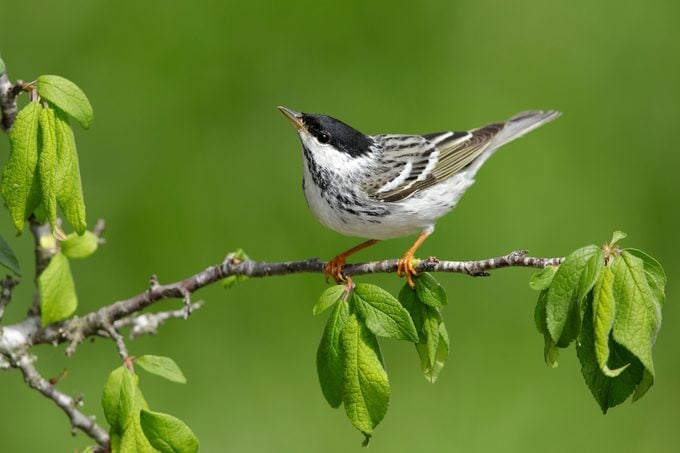 Agami Photo Agency/Shutterstock
Adult male blackpoll warbler during spring migration
Of all the songbirds in North America, half-ounce blackpoll warblers are the true long-distance heavyweights. In fall, they travel down from their breeding grounds in Canada’s boreal forests to winter in the tropical forests of northern South America.
They travel 1,700 miles nonstop across the Atlantic Ocean to get there, a dangerous journey that can take three to four days without rest. Although this path is risky, it’s also the fastest, most direct route to their wintering grounds.
Because blackpoll warblers can’t stop at any point during this leg of the journey, they eat as many insects as possible before the flight to increase their body mass and their chances of survival. On the return route in spring, blackpoll warblers take a different, less dangerous path and stop in the Caribbean Islands before continuing north.
Spring is the easiest time to spot blackpoll warblers migrating through the Midwest and eastern U.S. The male’s black and white plumage is much crisper and blackpoll warblers are actively hunting for insects during the day to add to their energy stores.
Blue-winged Teal: 8,000 to 14,000 Miles Roundtrip
 Courtesy Sundar Cherala
Male blue-winged teal
As cold weather moves in, about 100 million North American ducks move out, migrating to regions where their water habitats don’t freeze. The blue-winged teal racks up some of the highest migration mile counts, with breeding grounds as far north as Alaska and Canada and wintering grounds as far south as Mexico and northern South America, although specific migration distances can differ between birds.
Blue-winged teals tend to migrate earlier compared with other species and are often the first to head south. This is partly because they have a greater distance to travel but also because the bulk of their diet are the insects they catch in shallow wetlands, which freeze earlier than other water sources.
The bonus benefit of an earlier migration schedule in late August and early September is that it makes blue-winged teals a less common target during the regular duck-hunting season, which starts later in the year. Blue-winged teals return to summer breeding grounds later than other species, as well. When other duck species are raising their fledglings, blue-winged teals are just beginning to lay their eggs.
Swainson’s Hawk: 15,000 Miles Roundtrip
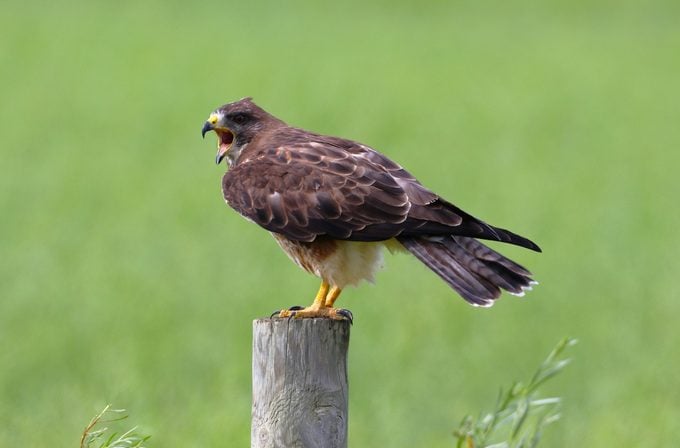 Courtesy Amber Fortowsky
Swainson’s hawk
Although not all raptors migrate, of the North American species that do, the Swainson’s hawk travels the farthest. These birds spend their summers in the grasslands and prairies of the West and Midwest U.S.
Once they’re finished raising their young, Swainson’s hawks will begin to prepare for fall migration by putting on extra weight and forming the flocks they’ll travel with to the plains of the Argentina Pampas. They don’t tend to stop for very long during the journey. Even when they do, they skip their usual diet of hunting for small mammals and catch insects in midflight instead.
Swainson’s hawks rely on thermals and updrafts to glide through the air, so their route south is pretty narrow. There are specific hawk watch stations, like Corpus Christi Hawkwatch, in southern and eastern Texas. Visitors can see Swainson’s hawks and other migrating raptor species fly through in massive groups called kettles.
Red Knot: 18,000 Miles Roundtrip
 jared lloyd/Getty Images
Red Knots during spring migration along the Atlantic Coast
Red knots are shorebirds whose migration is in synch with horseshoe crab populations. Beginning in early February, they leave their primary winter grounds of Tierra del Fuego, an archipelago in South America, and travel up the East Coast, making an important stopover in Delaware Bay, an estuary between New Jersey and Delaware.
Delaware Bay is a pivotal rest stop, because red knots arrive around the same time that horseshoe crabs lay their eggs, an important food source for the red knots and one that keeps them fueled up enough to reach their breeding grounds in the Arctic tundra.
Unfortunately, red knot populations are rapidly declining due to horseshoe crabs being caught in huge numbers by humans. The blue blood of horseshoe crabs is used heavily in biomedical testing.
Arctic Tern: 25,000 Miles Roundtrip
 Attila JANDI/Shutterstock
The longest migration journey is completed by the Arctic tern.
Arctic terns are the undisputed long-distance migration champions. These birds literally migrate from one end of the planet to the other.
In summer, you’ll find them across Alaska as well as other regions near the Arctic, such as Greenland and the Canadian Archipelago. They sometimes breed as far south as New England. Arctic terns chase the sun’s light and warmth, migrating south all the way down to the Antarctic Circle.
Arctic terns live within colonies and the colony migrates together, leaving their summer nests as one. Just before they leave, the noisy colonies will fall mysteriously silent in what’s called a “dread” behavior.
Because these birds are so lightweight, they can ride the winds of ocean flyways rather than having to expend a lot of energy flapping their wings. Their journey takes multiple weeks, but it’s not a straightforward one. Arctic tern colonies will take detours closer to the coast to fuel up, usually where food sources like crustaceans and small fish are plentiful.