
.jpg) 1 hour ago
3
1 hour ago
3
Article content
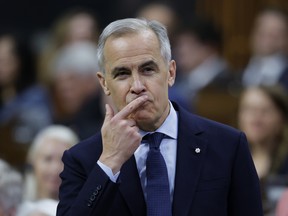
Prime Minister Mark Carney hailed his new $25-billion Canada Strong sovereign wealth fund, the “people’s fund” (which evokes both Karl and Groucho Marx), as a nation-building initiative. In reality, it is a costly boondoggle with problematic funding, objectives and governance that advance more government intrusion in the economy — which is clearly Carney’s favoured solution to every challenge, whether real, imagined or self-inflicted.

THIS CONTENT IS RESERVED FOR SUBSCRIBERS ONLY
Subscribe now to read the latest news in your city and across Canada.
- Exclusive articles from Barbara Shecter, Joe O'Connor, Gabriel Friedman, and others.
- Daily content from Financial Times, the world's leading global business publication.
- Unlimited online access to read articles from Financial Post, National Post and 15 news sites across Canada with one account.
- National Post ePaper, an electronic replica of the print edition to view on any device, share and comment on.
- Daily puzzles, including the New York Times Crossword.
SUBSCRIBE TO UNLOCK MORE ARTICLES
Subscribe now to read the latest news in your city and across Canada.
- Exclusive articles from Barbara Shecter, Joe O'Connor, Gabriel Friedman and others.
- Daily content from Financial Times, the world's leading global business publication.
- Unlimited online access to read articles from Financial Post, National Post and 15 news sites across Canada with one account.
- National Post ePaper, an electronic replica of the print edition to view on any device, share and comment on.
- Daily puzzles, including the New York Times Crossword.
REGISTER / SIGN IN TO UNLOCK MORE ARTICLES
Create an account or sign in to continue with your reading experience.
- Access articles from across Canada with one account.
- Share your thoughts and join the conversation in the comments.
- Enjoy additional articles per month.
- Get email updates from your favourite authors.
THIS ARTICLE IS FREE TO READ REGISTER TO UNLOCK.
Create an account or sign in to continue with your reading experience.
- Access articles from across Canada with one account
- Share your thoughts and join the conversation in the comments
- Enjoy additional articles per month
- Get email updates from your favourite authors
Sign In or Create an Account
or
Article content
Article content
An examination of Norway and Singapore’s sovereign funds is instructive. There are two fundamental differences between their approach and Canada’s.
Article content
Article content
By signing up you consent to receive the above newsletter from Postmedia Network Inc.
Article content
Norway’s US$2.2-trillion Government Pension Fund Global (GPFG) was created to invest oil and gas revenue for future generations and to finance over 20 per cent of the state budget. So as to avoid overheating the domestic economy, all its funds are invested outside Norway. In 2025, GPFG earned about C$348 billion. That’s equivalent to 60 per cent of Ottawa’s total spending last year, which poignantly demonstrates how maximizing oil and gas development can enrich a country that nevertheless positions itself as a leader in climate action. Since embarrassment is entirely absent from the Liberal persona, coping with the cognitive dissonance from such a contradiction would not be a problem.
Article content
Singapore’s two sovereign-fund investors, valued at about US$1 trillion, also invest outside Singapore. The capital came from surpluses and some borrowing, but Singapore’s constitution requires its government to maintain a balanced budget over its term in office.
Article content
Article content
In Canada’s case, the initial $25 billion will all be borrowed, thus adding to $1.34 trillion of federal debt. Carney will classify the spending as a capital investment, however, and put it in a capital budget, rather than the operating budget. That accounting trick will not fool credit rating agencies, institutional investors or economists, while taxpayers will still have to pay interest on the additional indebtedness, wherever it is allocated. If instead the fund borrows directly, that will require a government guarantee, creating a contingent liability on Ottawa’s books. In that event, interest payments would reduce the fund’s profitability. Any profit would result from a hoped-for positive spread between the carrying costs and investment income, much of which would be a long time coming since major projects can take many years to approve and build.
Article content
Article content
The fund’s initial capital could be increased by offering individual Canadians the opportunity to invest, with a backstop if things don’t work out. A guarantee you get your money back is nice; earning a profit is better, although some “patriotic” investors may not mind the dead money. Funding can also come from monetizing federal assets, such as airports, rather than using the proceeds to reduce federal indebtedness. Getting government out of business is desirable, given its inherent incompetence, but then having it re-enter to pick winners and losers does not inspire confidence.
 English (US)