
.jpg) 20 hours ago
5
20 hours ago
5
Article content
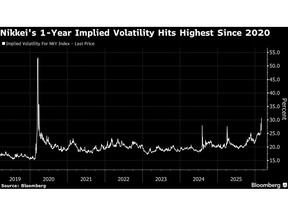
(Bloomberg) — A gauge of fear in Japanese stock markets has surged to the highest level since the Covid crisis in 2020 as a sharp spike in oil prices dampens optimism about the country’s economic outlook and corporate earnings.

THIS CONTENT IS RESERVED FOR SUBSCRIBERS ONLY
Subscribe now to read the latest news in your city and across Canada.
- Exclusive articles from Barbara Shecter, Joe O'Connor, Gabriel Friedman, and others.
- Daily content from Financial Times, the world's leading global business publication.
- Unlimited online access to read articles from Financial Post, National Post and 15 news sites across Canada with one account.
- National Post ePaper, an electronic replica of the print edition to view on any device, share and comment on.
- Daily puzzles, including the New York Times Crossword.
SUBSCRIBE TO UNLOCK MORE ARTICLES
Subscribe now to read the latest news in your city and across Canada.
- Exclusive articles from Barbara Shecter, Joe O'Connor, Gabriel Friedman and others.
- Daily content from Financial Times, the world's leading global business publication.
- Unlimited online access to read articles from Financial Post, National Post and 15 news sites across Canada with one account.
- National Post ePaper, an electronic replica of the print edition to view on any device, share and comment on.
- Daily puzzles, including the New York Times Crossword.
REGISTER / SIGN IN TO UNLOCK MORE ARTICLES
Create an account or sign in to continue with your reading experience.
- Access articles from across Canada with one account.
- Share your thoughts and join the conversation in the comments.
- Enjoy additional articles per month.
- Get email updates from your favourite authors.
THIS ARTICLE IS FREE TO READ REGISTER TO UNLOCK.
Create an account or sign in to continue with your reading experience.
- Access articles from across Canada with one account
- Share your thoughts and join the conversation in the comments
- Enjoy additional articles per month
- Get email updates from your favourite authors
Sign In or Create an Account
or
Article content
The one-year implied volatility of the Nikkei 225 Average shot up to over 30 points on Monday, the highest level since March 2020, when the global financial markets had seized up after the Covid pandemic spread worldwide.
Article content
Article content
Article content
The gauge, which measures the magnitude of price swings investors expect over the next year, has surpassed its recent peaks of around 28 points, reached in April 2025 after the US tariff shock and in September 2024 after the Bank of Japan’s rate hike.
Article content
Article content
Article content
By signing up you consent to receive the above newsletter from Postmedia Network Inc.
Article content
Another widely watched gauge, the Nikkei Volatility Index, which reflects investors expectations for market swings over the coming month, also shot up to 66 points, a level not seen since August 2024.
Article content
The Nikkei also tumbled 7.6% on Monday morning to two-month lows, as the U.S.-Israel war on Iran showed no signs of abating.
Article content
The selloff came as a shock to investors who had been bullish on Japan for a range of reasons — from Japanese Prime Minister Sanae Takaichi’s pro-stimulus policy stance to support from corporate governance reforms.
Article content
“Implied volatilities on far out-of-the-money puts are rising sharply on increased demand for hedging against steep declines in share prices,” said Hiroki Takei, strategist at Resona Holdings.
Article content
Investors are scrambling to buy put options, as their prices gain when the underlying asset prices fall. The surge in one-year volatilities suggests investors are now bracing for a prolonged period of elevated turbulence.
Article content
Article content
Japan’s economy is considered particularly vulnerable to higher oil prices, as the country relies heavily on energy imports, a significant portion of which transits via the Strait of Hormuz.
Article content
Implied volatilities on Japanese stocks have been notably higher since Prime Minister Sanae Takaichi took office in October, as her stance of aggressive fiscal spending have raised worries about the stability of the Japanese bond market.
Article content
Still, many market players are sticking to hopes that the hostilities in the Middle East will end within weeks, allowing the Japanese shares to regain their strength before the war in Iran. Before the war, the Nikkei had gained 16% since the start of year.
Article content
 English (US)