
.jpg) 1 hour ago
3
1 hour ago
3
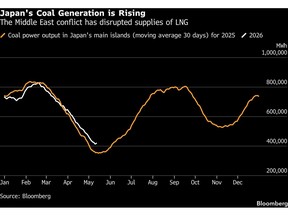
Article content
(Bloomberg) — Japan’s coal-power generation is rising while natural gas-fired output falls, as conflict in the Middle East chokes supplies of the less-polluting fossil fuel and sends prices higher.

THIS CONTENT IS RESERVED FOR SUBSCRIBERS ONLY
Subscribe now to read the latest news in your city and across Canada.
- Exclusive articles from Barbara Shecter, Joe O'Connor, Gabriel Friedman, and others.
- Daily content from Financial Times, the world's leading global business publication.
- Unlimited online access to read articles from Financial Post, National Post and 15 news sites across Canada with one account.
- National Post ePaper, an electronic replica of the print edition to view on any device, share and comment on.
- Daily puzzles, including the New York Times Crossword.
SUBSCRIBE TO UNLOCK MORE ARTICLES
Subscribe now to read the latest news in your city and across Canada.
- Exclusive articles from Barbara Shecter, Joe O'Connor, Gabriel Friedman and others.
- Daily content from Financial Times, the world's leading global business publication.
- Unlimited online access to read articles from Financial Post, National Post and 15 news sites across Canada with one account.
- National Post ePaper, an electronic replica of the print edition to view on any device, share and comment on.
- Daily puzzles, including the New York Times Crossword.
REGISTER / SIGN IN TO UNLOCK MORE ARTICLES
Create an account or sign in to continue with your reading experience.
- Access articles from across Canada with one account.
- Share your thoughts and join the conversation in the comments.
- Enjoy additional articles per month.
- Get email updates from your favourite authors.
THIS ARTICLE IS FREE TO READ REGISTER TO UNLOCK.
Create an account or sign in to continue with your reading experience.
- Access articles from across Canada with one account
- Share your thoughts and join the conversation in the comments
- Enjoy additional articles per month
- Get email updates from your favourite authors
Sign In or Create an Account
or
Article content
The 30-day moving average for coal generation across Japan’s main islands was up 17% on Tuesday compared with the same period last year, and has been consistently higher since late-March, according to utility data compiled by Bloomberg. Natural gas was 10% lower, the figures show.
Article content
Article content
Article content
The crucial Strait of Hormuz has remained effectively closed since the Iran war started in late February, curbing energy shipments from a region that typically accounts for a fifth of global liquefied natural gas supply. An attack early in the conflict on the world’s biggest LNG production plant in Qatar has added to the squeeze and prompted buyers to scramble for alternative supply.
Article content
By signing up you consent to receive the above newsletter from Postmedia Network Inc.
Article content
Japanese utilities have reduced dependence on LNG from the region over the past several years. Supply from Qatar and the United Arab Emirates only made up around 6% of the country’s total in 2025, compared with 25% a year earlier, according to ship-tracking data from analytics firm Kpler.
Article content
Still, that hasn’t spared Japan from the broader impact of rising fuel-import costs. Many power producers secure LNG on long-term contracts linked to oil prices, which have surged since the conflict began. Importers must at times secure spot cargoes, which have also become expensive. That has led to higher spot power prices in the country.
Article content
Total coal-power generation for Japan’s Kansai region — home to many factories and manufacturing bases — was at 56,624 megawatt-hours on Tuesday, the highest level since March 13, according to data on Bloomberg. A recent nuclear power plant outage in the area could also be contributing to the need to ramp up other power-generation sources.
Article content
Advertisement 1
 English (US)