
.jpg) 2 hours ago
3
2 hours ago
3
Article content
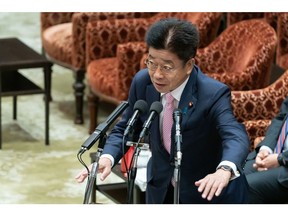
(Bloomberg) — Japan’s finance minister pushed back against a US call to ramp up pressure on President Vladimir Putin to end the war in Ukraine by imposing higher tariffs on China and India for importing Russian oil.

THIS CONTENT IS RESERVED FOR SUBSCRIBERS ONLY
Subscribe now to read the latest news in your city and across Canada.
- Exclusive articles from Barbara Shecter, Joe O'Connor, Gabriel Friedman, and others.
- Daily content from Financial Times, the world's leading global business publication.
- Unlimited online access to read articles from Financial Post, National Post and 15 news sites across Canada with one account.
- National Post ePaper, an electronic replica of the print edition to view on any device, share and comment on.
- Daily puzzles, including the New York Times Crossword.
SUBSCRIBE TO UNLOCK MORE ARTICLES
Subscribe now to read the latest news in your city and across Canada.
- Exclusive articles from Barbara Shecter, Joe O'Connor, Gabriel Friedman and others.
- Daily content from Financial Times, the world's leading global business publication.
- Unlimited online access to read articles from Financial Post, National Post and 15 news sites across Canada with one account.
- National Post ePaper, an electronic replica of the print edition to view on any device, share and comment on.
- Daily puzzles, including the New York Times Crossword.
REGISTER / SIGN IN TO UNLOCK MORE ARTICLES
Create an account or sign in to continue with your reading experience.
- Access articles from across Canada with one account.
- Share your thoughts and join the conversation in the comments.
- Enjoy additional articles per month.
- Get email updates from your favourite authors.
THIS ARTICLE IS FREE TO READ REGISTER TO UNLOCK.
Create an account or sign in to continue with your reading experience.
- Access articles from across Canada with one account
- Share your thoughts and join the conversation in the comments
- Enjoy additional articles per month
- Get email updates from your favourite authors
Sign In or Create an Account
or
Article content
“Japan has made a commitment within the framework of the World Trade Organization not to apply tariffs beyond its stipulated limits and to treat all member countries fairly, as long as others uphold their obligations under WTO agreements,” Finance Minister Katsunobu Kato told reporters Tuesday.
Article content
Article content
Article content
“It would be difficult for us to raise tariffs to, say 50%, solely on the basis that a particular country is importing oil from Russia,” he added.
Article content
By signing up you consent to receive the above newsletter from Postmedia Network Inc.
Article content
Kato’s comments came after the Group of Seven nations discussed sanctions on Russia in an online meeting Friday. During the session, the US urged its G-7 allies to consider tariffs as high as 100% on China and India due to their continued purchases of Russian oil.
Article content
The finance minister’s remark show Tokyo remains cautious about joining efforts to raise tariffs on countries trading with Russia, especially since Japan itself has continued importing oil and liquefied natural gas from its neighbor.
Article content
Tokyo sees Russia’s Sakhalin-2 export project — just north of Japan — as a key source of the nation’s LNG supply, and the production and import of its oil is required for stable operations. Those shipments aren’t subject to western restrictions. LNG from the plant also isn’t sanctioned.
Article content
About 1% of Japan’s oil imports in June came from Russia, according to the trade ministry.
Article content
“We are reviewing what type of pressure might be most effective and coordinating closely with our G-7 partners,” Kato said, referring to possible measures to help halt Russia’s aggression against Ukraine.
Article content
Article content
G-7 officials are currently working on a new sanctions package and are aiming to finalize a text in the next two weeks, according to a person familiar with the matter.
Article content
The US proposal is the latest example of how Donald Trump’s administration is increasingly using tariffs as a tool to achieve political goals and encouraging its trading partners to follow its lead.
Article content
The plan calls for 50% to 100% secondary tariffs on China and India as well as restrictive trade measures on both imports and exports to curb the flow of Russian energy and to prevent the transfer of dual-use technologies into Russia, according to the proposal.
Article content
Separately, Trump said he is ready to implement “major” sanctions on Russian energy exports if NATO countries follow suit. While many European nations have reduced or halted imports of Russian oil, some NATO members, including Hungary, have opposed stricter EU proposals targeting Russia’s energy sector.
Article content
—With assistance from Stephen Stapczynski.
Article content
 English (US)