
.jpg) 1 hour ago
2
1 hour ago
2
Article content
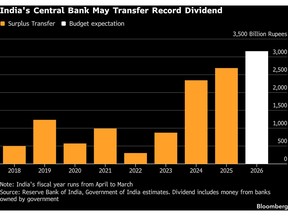
(Bloomberg) — India’s central bank may transfer a record surplus of nearly 3 trillion rupees ($31.2 billion) this week to the government, economists estimated, providing Asia’s third-largest economy a vital buffer as the Iran war escalates energy prices.

THIS CONTENT IS RESERVED FOR SUBSCRIBERS ONLY
Subscribe now to read the latest news in your city and across Canada.
- Exclusive articles from Barbara Shecter, Joe O'Connor, Gabriel Friedman, and others.
- Daily content from Financial Times, the world's leading global business publication.
- Unlimited online access to read articles from Financial Post, National Post and 15 news sites across Canada with one account.
- National Post ePaper, an electronic replica of the print edition to view on any device, share and comment on.
- Daily puzzles, including the New York Times Crossword.
SUBSCRIBE TO UNLOCK MORE ARTICLES
Subscribe now to read the latest news in your city and across Canada.
- Exclusive articles from Barbara Shecter, Joe O'Connor, Gabriel Friedman and others.
- Daily content from Financial Times, the world's leading global business publication.
- Unlimited online access to read articles from Financial Post, National Post and 15 news sites across Canada with one account.
- National Post ePaper, an electronic replica of the print edition to view on any device, share and comment on.
- Daily puzzles, including the New York Times Crossword.
REGISTER / SIGN IN TO UNLOCK MORE ARTICLES
Create an account or sign in to continue with your reading experience.
- Access articles from across Canada with one account.
- Share your thoughts and join the conversation in the comments.
- Enjoy additional articles per month.
- Get email updates from your favourite authors.
THIS ARTICLE IS FREE TO READ REGISTER TO UNLOCK.
Create an account or sign in to continue with your reading experience.
- Access articles from across Canada with one account
- Share your thoughts and join the conversation in the comments
- Enjoy additional articles per month
- Get email updates from your favourite authors
Sign In or Create an Account
or
Article content
The Reserve Bank of India’s board will meet Friday to approve the dividend, according to people familiar with the matter who asked not to be identified as the information is not public. The central bank didn’t immediately respond to an email seeking comment.
Article content
Article content
Article content
The payout is expected to surpass last fiscal’s 2.7 trillion rupees, according to a majority of the 12 economists surveyed by Bloomberg News. Some estimates run as high as 3.4 trillion rupees.
Article content
By signing up you consent to receive the above newsletter from Postmedia Network Inc.
Article content
The surplus, generated through RBI’s activities in the year ended March, will shore up the government’s finances in the ongoing fiscal 2026-27 as the crude price rise inflates India’s import bill, widens the current account deficit and exacerbates the foreign fund sell off. The benchmark 10-year yield has climbed about 50 basis points so far this year to 7.10% on Tuesday, while the rupee has weakened nearly 7%. The currency slide has prompted a raft of austerity measures to narrow the external deficit.
Article content
The bond market is already pricing in close to 3 trillion rupees from the RBI, according to Puneet Pal, head of fixed income at PGIM India Asset Management Pvt. Ltd. “The higher dividend can help in fiscal management, but it won’t really have an impact unless it’s substantially higher.”
Article content
India has budgeted 3.2 trillion rupees in payouts from the RBI, state-run lenders and other financial institutions for the current fiscal year. The central bank typically accounts for the bulk of this transfer and it will help finances but the deficit numbers could still be under pressure due to rising oil and fertilizer prices.
Article content
Article content
Article content
The RBI pays the dividend from income earned on its investments, foreign-exchange holdings and fees from printing currency notes. Last year, it decided to maintain a contingency buffer at 7.5% of its total assets, the ceiling in a band of 4.5%-7.5%.
Article content
Economists expect the buffer to be retained at the higher end, given the ongoing uncertainty. But it will still provide room to transfer a bigger surplus than the previous fiscal, they said.
Article content
The dividend could be as high as 3.2 trillion rupees for the year, said Rajeev Sharan, head of research at Brickwork Ratings. “This estimate reflects sizable gains from foreign-exchange trading and higher interest income on the RBI’s large foreign assets, supplemented by steady domestic income from government securities and liquidity operations.”
Article content
Economists estimate that the RBI’s balance sheet expanded nearly 20% in 2025-26 after the central bank bought about 9 trillion rupees of bonds to inject liquidity into the banking system. At the end of 2024-25, RBI had a balance sheet of 76.25 trillion rupees.
Article content
“In the past few years, there has been a clear upshift in the RBI’s ability to generate higher returns on assets,” said Gaurav Kapur, economist at IndusInd Bank Ltd. Elevated global interest rates have boosted earnings, and rising gold prices bumped up revaluation gains, boosting the capital, he said. The central bank has been one of the world’s largest buyers of the precious metal in recent years.
Article content
Gains on the sale of dollars to support the rupee could also bolster the surplus payout.
Article content
The historical acquisition cost of the dollar reserves in fiscal 2025-26 was about 84 rupees, according to IDFC First Bank Ltd. economist Gaura Sengupta. The RBI’s intervention in the currency market intensified after the Iran war and the rupee ended the previous fiscal at 94.83 to a dollar, while the average exchange rate has been 88.33 to a dollar in the ongoing fiscal.
Article content
 English (US)