
.jpg) 1 hour ago
3
1 hour ago
3
Article content
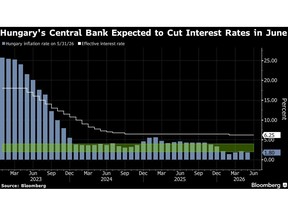
(Bloomberg) — Hungary’s central bank is likely to lower borrowing costs for the first time in months as slowing inflation and a stronger currency give policymakers room to diverge from global peers starting monetary tightening.

THIS CONTENT IS RESERVED FOR SUBSCRIBERS ONLY
Subscribe now to read the latest news in your city and across Canada.
- Exclusive articles from Barbara Shecter, Joe O'Connor, Gabriel Friedman, and others.
- Daily content from Financial Times, the world's leading global business publication.
- Unlimited online access to read articles from Financial Post, National Post and 15 news sites across Canada with one account.
- National Post ePaper, an electronic replica of the print edition to view on any device, share and comment on.
- Daily puzzles, including the New York Times Crossword.
SUBSCRIBE TO UNLOCK MORE ARTICLES
Subscribe now to read the latest news in your city and across Canada.
- Exclusive articles from Barbara Shecter, Joe O'Connor, Gabriel Friedman and others.
- Daily content from Financial Times, the world's leading global business publication.
- Unlimited online access to read articles from Financial Post, National Post and 15 news sites across Canada with one account.
- National Post ePaper, an electronic replica of the print edition to view on any device, share and comment on.
- Daily puzzles, including the New York Times Crossword.
REGISTER / SIGN IN TO UNLOCK MORE ARTICLES
Create an account or sign in to continue with your reading experience.
- Access articles from across Canada with one account.
- Share your thoughts and join the conversation in the comments.
- Enjoy additional articles per month.
- Get email updates from your favourite authors.
THIS ARTICLE IS FREE TO READ REGISTER TO UNLOCK.
Create an account or sign in to continue with your reading experience.
- Access articles from across Canada with one account
- Share your thoughts and join the conversation in the comments
- Enjoy additional articles per month
- Get email updates from your favourite authors
Sign In or Create an Account
or
Article content
The National Bank of Hungary will cut its benchmark interest rate by a quarter point to 6% on Tuesday, according to 20 out of 21 economists surveyed by Bloomberg. One analyst expects a half-point reduction. The decision is scheduled for 2 p.m. in Budapest, followed by a briefing, fresh inflation projections and statement an hour later.
Article content
Article content
Article content
The case for easing one of the European Union’s highest rates has strengthened significantly since the last meeting, when only a single member of the Monetary Council supported a cut. While Governor Mihaly Varga has stuck to a cautious tone citing global uncertainties, he has signaled that there may be more room for maneuver after the publication of the inflation projections due today.
Article content
By signing up you consent to receive the above newsletter from Postmedia Network Inc.
Article content
The potential cut in Hungary contrasts with the European Central Bank and peers like the Czech Republic, which raised interest rates for the first time in four years last week. Hungary’s last move was a cut in February, before the spike in energy costs from the Iran war boosted price risks.
Article content
Hungary’s expected rate reduction “will be the key event this week in the region,” analysts at Erste Group Bank AG wrote in a note. “Low inflation, a strong forint and prospects for a resolution of the Middle East conflict, reducing the risks of inflationary pressure in the future, support such a move.”
Article content
Hungary’s inflation has already surprised on the downside with consumer-price growth slowing to 1.8% in May, below the central bank’s 2%-4% tolerance band. While temporary government measures continue to suppress some prices, economists increasingly expect inflation to remain contained even after those measures are phased out.
Article content
The forint has strengthened sharply since Prime Minister Peter Magyar’s election victory in April, with Hungarian government bond yields falling on his plans to adopt the euro.
Article content
The strength of the Hungarian currency — up 9% against the euro this year — is helping to limit imported inflation and provides policymakers with greater confidence to begin the lowering of borrowing costs. Money market traders are pricing in more rate cuts for the rest of the year, based on forward rate agreements.
Article content
 English (US)