
.jpg) 2 hours ago
2
2 hours ago
2
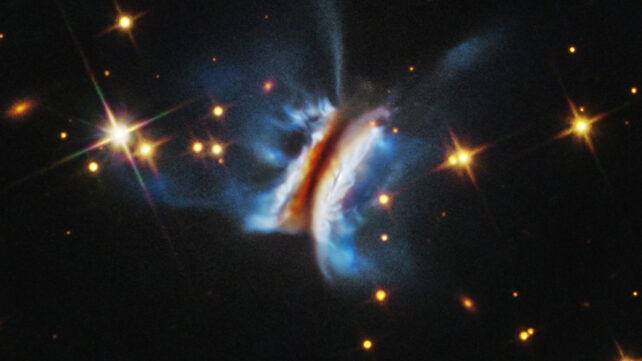 New imagery of the IRAS 23077+6707 system. (NASA/ESA/STScI/Kristina Monsch/CfA)
As a young star develops, so too does a protoplanetary disk of dust and gas around it, ready to birth new planets. Scientists have just discovered more about IRAS 23077+6707, the largest protoplanetary disk ever observed by a telescope.
First spotted last year, the system is about 1,000 light-years from Earth and has a diameter of nearly 644 billion kilometers (400 billion miles), more than 100 times the distance between the Sun and Pluto.
IRAS 23077+6707 is also known as Dracula's Chivito – named after the Transylvanian vampire and the meat-laden sandwich that is Uruguay's national dish.
Now, NASA researchers from the US and UK have new visible-light imagery from the Hubble telescope that reveals how chaotic and turbulent this enormous disk is, and some of the elements that may be driving its gigantic size.
Related: A Super-Tiny Star Gave Birth to a Giant Planet And We Don't Know How
"Both Hubble and NASA's James Webb Space Telescope have glimpsed similar structures in other disks, but IRAS 23077+6707 provides us with an exceptional perspective – allowing us to trace its substructures in visible light at an unprecedented level of detail," says astrophysicist Kristina Monsch, from the Center for Astrophysics (CfA) in the US.
"This makes the system a unique, new laboratory for studying planet formation and the environments where it happens."

IRAS 23077+6707 is significantly different from what would be expected of regular, textbook protoplanetary disks. The wisps of material expanding from the system stretch much further out than the norm, for example.
It's also notably lop-sided. Extended filaments of gas are falling into the disk from vast distances, but only on one side. The opposite side has a much sharper boundary, with far less planet-forming material surrounding the central star.
There's still work to do to figure out what all this means, but the researchers suggest interactions with gas, stellar winds, or the movement of the system itself could be responsible for these dramatic observations.
"The level of detail we're seeing is rare in protoplanetary disk imaging, and these new Hubble images show that planet nurseries can be much more active and chaotic than we expected," says Monsch.
"We're seeing this disk nearly edge-on and its wispy upper layers and asymmetric features are especially striking."

The system has been given the nickname of Dracula's Chivito in honor of two of the astrophysicists who discovered it – one from Transylvania and one from Uruguay.
Related: Strange Object Described as Dracula's Sandwich Could Represent a New Kind of Baby Star
While these findings still need to be properly interpreted, the NASA team is relishing the chance to study the dynamics of such a complex and out-of-the-ordinary system in detail. Further light readings, and a longer-term analysis of the system, should reveal more as this protoplanetary disk settles down.
There appears to be enough material here to make 10-30 Jupiters, making it an intriguing environment for studying how planets might start forming in such strange and violent conditions. While planet formation takes millions of years, astronomers will be able to see snapshots of the process from IRAS 23077+6707 over much shorter timescales.
"Hubble has given us a front row seat to the chaotic processes that are shaping disks as they build new planets – processes that we don't yet fully understand but can now study in a whole new way," says astrophysicist Joshua Bennett Lovell, from the CfA.
The research has been published in The Astrophysical Journal.
 English (US)