
.jpg) 2 hours ago
2
2 hours ago
2

Article content
In the late 1980s, Denmark’s pioneering wind power sector celebrated a potential new customer. Engineers at Bonus Energy completed an order for 13 turbines from a company in China’s Xinjiang region, which were delivered on the Trans-Siberian railway.

THIS CONTENT IS RESERVED FOR SUBSCRIBERS ONLY
Subscribe now to read the latest news in your city and across Canada.
- Exclusive articles from Barbara Shecter, Joe O'Connor, Gabriel Friedman, and others.
- Daily content from Financial Times, the world's leading global business publication.
- Unlimited online access to read articles from Financial Post, National Post and 15 news sites across Canada with one account.
- National Post ePaper, an electronic replica of the print edition to view on any device, share and comment on.
- Daily puzzles, including the New York Times Crossword.
SUBSCRIBE TO UNLOCK MORE ARTICLES
Subscribe now to read the latest news in your city and across Canada.
- Exclusive articles from Barbara Shecter, Joe O'Connor, Gabriel Friedman and others.
- Daily content from Financial Times, the world's leading global business publication.
- Unlimited online access to read articles from Financial Post, National Post and 15 news sites across Canada with one account.
- National Post ePaper, an electronic replica of the print edition to view on any device, share and comment on.
- Daily puzzles, including the New York Times Crossword.
REGISTER / SIGN IN TO UNLOCK MORE ARTICLES
Create an account or sign in to continue with your reading experience.
- Access articles from across Canada with one account.
- Share your thoughts and join the conversation in the comments.
- Enjoy additional articles per month.
- Get email updates from your favourite authors.
THIS ARTICLE IS FREE TO READ REGISTER TO UNLOCK.
Create an account or sign in to continue with your reading experience.
- Access articles from across Canada with one account
- Share your thoughts and join the conversation in the comments
- Enjoy additional articles per month
- Get email updates from your favourite authors
Sign In or Create an Account
or
Article content
The turbines were a proof of concept to help show Chinese officials that it was “doable, and if you got the technology right, it was reliable”, recalls Henrik Stiesdal, sometimes known as the “godfather” of the wind industry for his influential turbine inventions and who at the time was working for Bonus.
Article content
Article content
Article content
Denmark even threw in some financial incentives: China’s Xinjiang Wind Energy Corporation received funding from Danida, the country’s development aid agency, for the turbines.
Article content
By signing up you consent to receive the above newsletter from Postmedia Network Inc.
Article content
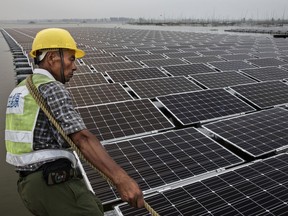
Nearly four decades later, the tables have completely turned. China has become the global powerhouse in renewable energy technologies, supplying more than 90 per cent of the world’s solar panels and dominating battery supply chains, as well as the processing of rare earth materials that are critical to the industry.
Article content
China’s enormous manufacturing capacity has lowered costs of solar power beyond the most ambitious projections of industry executives, triggering a rush to adopt it around the world. But competition from China has also helped tip swaths of United States and European industry into bankruptcy.
Article content
“We created the market [for solar] and made it interesting for investors,” says Eicke Weber, a solar industry veteran and former co-chairman of the European Solar Manufacturing Council. “But we forgot to make industrial policies.”
Article content
At a time when Europe and the U.S. are both scrambling to find ways to respond to China’s industrial competitiveness, the experience of how the green tech industry lost its early lead has become a central lesson.
Article content
Article content
Among western governments and officials, there are three key questions. How was it that so many of the key technologies for the emerging industry were initially developed in the west but have been commercialized in China? How was China able to scale its industry at a time when the west was betting on open markets and globalization? Has the tilt towards industrial policy over the past five years helped recover any of the lost ground?
Article content
Article content
“We all were asleep at the switch as the Chinese government decided to prioritize these clean energy technologies as a matter of national industrial strategy,” says Geoffrey Pyatt, a former U.S. assistant secretary of energy and diplomat now at the advisory firm McLarty Associates.
Article content
Having lost out to China in solar, European officials fear their companies might not be able to hang on in other renewable technologies. Although Europe’s wind turbine manufacturers still lead outside China, competition from China-based companies such as Goldwind, Xinjiang Wind’s successor, is becoming ever more intense.
Article content
“In both wind and even the auto sector, Europe still has an industry that it could protect,” says Michal Meidan at the Oxford Institute for Energy Studies. “In solar, that’s gone.”
Advertisement 1
Advertisement 2
Article content
In an effort to regain the initiative, Brussels has stepped up its use of trade probes and tariffs to slow the flow of subsidized Chinese goods into the bloc and is pushing more robust efforts to diversify supply chains away from China.
Article content
It is also working on plans to introduce “Made in Europe” targets, akin to the “Made in China 2025” plan Beijing first launched in 2015 to boost domestic content of key goods and innovation.
Article content
In the U.S., the Biden administration embraced more vigorous industrial policy on cleantech while Donald Trump is putting significant focus on developing alternative sources of rare earths.
Article content
But some believe such measures may be too little too late. The collapse of Swedish battery champion Northvolt at the end of 2024 and the insolvency of several subsidiaries of Swiss solar-panel maker Meyer Burger in 2025 suggests that Europe will need to do more to support its homegrown companies if it is to compete with China.
Article content
Gunter Erfurt, chief executive of Meyer Burger until September 2024, says overcapacity in China is still undercutting European companies. “Europe is now even more trapped [by China] than ever before,” he says.
Article content
Article content
Fatih Birol, executive director of the International Energy Agency, says that “developing technology is like running a marathon”. He adds: “Europe finished the first 10 kilometres ahead of everybody. But China finished the marathon. China gets the gold medal.”
Article content
Article content
As it stands today, China now controls more than 80 per cent of production for each key stage of solar panel manufacturing, from polysilicon ingots to wafers, cells and modules. To achieve such dominance, it initially leaned on outside help.
Article content
One of the early links was Martin Green, a professor at the University of New South Wales in Australia, who invented the PERC technology that would go on to be used in about 90 per cent of solar panels. This helped him attract students from around the world to his courses.
Article content
Among those students was Shi Zhenrong, the adopted son of a poor Chinese family, who had been sent abroad to study by China’s Shanghai Institute and completed his PhD with Green in 1992. Shi returned to China in 2001 to set up a solar panel company, helped by financial support from the city of Wuxi, eastern China.
Article content
Article content
Suntech Power would become the world’s largest solar-panel maker and, in 2005, the first privately owned Chinese company to list on the New York Stock Exchange.
Article content
It kicked off a wave of IPOs among China’s growing solar panel industry, which raised billions of dollars and saw several of Green’s team hired as chief technology officers in order to meet U.S. due diligence rules, Green recalls.
Article content
“There’s a strong Australian connection,” says Green, noting that Shi was not the only one of his students who went back to China to set up solar-panel makers. “We have played a big part in the technical development of the industry.”
Article content
Green’s experience is just one example of how research, technical knowhow and equipment spread from the west to China during the 1980s to 2000s. During this period U.S. and European companies regularly sold production lines or other equipment to China and licensed or shared their technology in exchange for access to the Chinese market.
Article content
“There were different technology transfer channels and mechanisms, but the common thread was the learning-centred approach by the Chinese government and companies,” says Rasmus Lema, an expert on the spread of green technology at the University of Johannesburg in South Africa. “From the beginning, they had a strategic vision of becoming leaders in these technologies.”
Article content
For years, Germany was a prolific exporter of solar production equipment to China. So much so that Michael Carr, executive director of the U.S. Solar Energy Manufacturers for America Coalition, a trade group, recalls being told during a tour of leading manufacturers in China in 2008 that the production lines were all German. “But we’ve improved them by 20 per cent,” Carr says he was told.
Article content
Similarly Poly Engineering, an Italian maker of polysilicon — the key ingredient in solar panels — transferred key production knowhow to China’s Daqo New Energy in 2008, helping China break the grip on polysilicon supply held by the U.S., Europe and Japan.
Article content
That same year, Goldwind, now the world’s largest turbine manufacturer, bought a 70 per cent stake in Vensys, a German pioneer of gearless wind turbines. Goldwind had licensed Vensys’s technology for manufacture in China five years earlier. “Vensys had a smart nacelle design [the brain of the turbine] and that became the basis of the early Goldwind machines,” recalls Stiesdal, the Danish inventor.
Article content
In the early days of the solar industry in the 1980s, there was “very little caution… No one had the fantasy to believe China would compete on an equal footing in 15 years’ time,” says Lema.
Article content
Article content
But as China’s solar sector became more competitive, companies became more wary about selling their kit. “Meyer Burger supplied equipment but got increasingly nervous about how quickly the Chinese were able to copy it,” says Weber, the solar veteran who was also on the board of Meyer Burger between 2007 and 2010.
Article content
A turning point came towards the end of the 2000s, as China’s rapid development of factories, encouraged by the crucial development of its own polysilicon industry, helped push the industry into overcapacity.
Article content
Solar-panel makers in Germany battled with falling prices, difficulty accessing financing and Chinese competitors who were undercutting aggressively on price but were also offering payment terms of more than 100 days. “Europeans really could not compete,” says Anton Milner, co-founder of Q-Cells, a leading solar-panel maker.
Article content
The industry lobbied the EU to intervene, arguing Chinese companies were getting unfair subsidies.
Article content
But anti-dumping tariffs the EU imposed on China in 2013 were “too little too late”, argues Michael Schmela, executive adviser at Solar Power Europe.
Article content
Article content
Milner’s company Q-Cells filed for bankruptcy in 2012 and was taken over by South Korea’s Hanwha. It was one of several companies succumbing to a brutal wave of consolidation which also rebounded on China’s solar sector, which was struggling with heavy debts.
Article content
Shi’s Suntech went bankrupt in 2013. But China, which had made significant advances in automation, efficiency and scale, emerged stronger. By 2018, about 60 per cent of the world’s solar panels were made in China. “It was a rollercoaster ride,” adds Milner.
Article content
Article content
Western governments were slow to realize the implications of China’s renewables boom.
Article content
Jos Delbeke, the EU’s most senior climate official between 2010 and 2018, recalls how the EU initially enjoyed the cost reductions from Chinese technology, and did not see growing trade with it as a threat. “We did not sufficiently realize that China may have been taking over,” he says.
Article content
Pyatt, at McLarty Associates, says supply chains were taken for granted. “And China offered such a compelling cost structure — [albeit] with a lot of shadow costs, including often atrocious labour and environmental standards,” he added. Human rights groups accuse China of using forced labour in polysilicon production, particularly in Xinjiang.
Article content
Isabel Hilton, founder of China Dialogue, a non-profit, says that western companies were hampered by a relative lack of support from their governments.
Article content
“There was an ideological commitment to globalization which was deeply embedded across the western business ecosystem, and an ideological hostility to industrial policy,” she says. “And once China was in the World Trade Organization [from 2001], you had an absolutely straightforward clash of systems and, frankly, China won.”
Article content
Kai Wu, a Goldwind vice-president, says that when China entered the sector, it was able to utilize newer technologies. The country’s rapid expansion in infrastructure and a surge in engineering graduates made renewables projects cheaper and faster to build than those in many western countries.
Article content
It has also benefited from a boom in entrepreneurialism. “Every Chinese New Year, there’s a massive number of employees who don’t return to their jobs but go and form their own start-up,” says Charlie Gay, a solar industry veteran who set up a major R&D centre for his former employer, U.S. company Applied Materials, in China.
Article content
Article content
The first Obama administration recognized the importance of clean energy industries, putting in place legislation with measures to boost clean energy production and jobs in the installation sector as well some manufacturing tax credits.
Article content
But even there, “most of the trade policy was really incentivizing overseas production of solar [ie equipment],” says Kate Gordon, chief executive of non-profit California Forward and a former US government energy adviser. “It was just part of a normal, neoliberal approach to trade at the time.”
Article content
Vince Cable, the United Kingdom’s business secretary between 2010 and 2015, remembers how the Green Investment Bank he set up to boost the development of green energy in Britain was reined in by limited funding, before being sold to Australian bank Macquarie in 2017.
Article content
“What we’d hoped to do originally was to create a sort of KfW [Germany’s state-owned development bank] type of institution with very substantial borrowing powers as well as equity to operate on a big scale,” he recalls. “In the event, I had to accept that the Treasury was never going to agree to that . . . by 2016 they wanted their money back.”
Article content
Article content
Belated attempts to use protectionism to support renewables sometimes backfired. After the U.S. imposed tariffs on Chinese solar imports in 2012, China responded with higher tariffs on polysilicon in 2014, heaping pressure on U.S. companies. When SunEdison in the U.S. filed for bankruptcy in 2016, its patents were sold to China’s GLC-Poly Energy Holdings. Tariffs have also been hard to enforce, as China rerouted supply chains.
Article content
“We’ve had to play whack-a-mole for the better part of 15 years,” recalls Timothy Brightbill, a U.S. trade lawyer.
Article content
Article content
As they try to protect what’s left, U.S. and European governments have steadily been taking a much more muscular approach to supporting green industries.
Article content
Under the current European Commission president Ursula von der Leyen, the bloc has introduced measures such as quicker access to EU funds, simpler regulation and reducing energy costs.
Article content
Officials say some results have been encouraging. Chinese wind turbine makers have not made significant inroads into Europe, as feared. Denmark’s Vestas remains the largest wind turbine maker outside China.
Article content
“The EU’s decisive actions seem to have been effective in strengthening the use of turbines ‘Made in Europe’,” says Christoph Zipf, spokesman for the WindEurope trade group.
Article content
Yet even after the collapse of Northvolt, efforts to introduce Made in Europe rules setting targets for homegrown content have now had to be delayed due to opposition among EU members such as the Czech Republic, highlighting the difficulties of getting political consensus in such a diverse, democratic system.
Article content
In Washington, the Trump administration is rolling back many of the measures in predecessor Joe Biden’s flagship Inflation Reduction Act, leading to concerns it is further eroding the U.S.’s position as China exports more clean technology around the world. “The world is moving towards a decarbonized economy,” says Andrew Light, who worked in both the Obama and Biden administrations.
Article content
Trump has also suspended new leases for offshore wind projects and blocked several projects, threatening an industry where the U.S. could in theory develop an edge, says Gordon at California Forward. “Offshore wind has extremely large component parts and needs to be built and maintained near where it’s installed. So there is an inherent advantage to opt for wind being manufactured locally. We are of course now abandoning it.”
Article content
Article content
However Ernest Moniz, former U.S. energy secretary, says Trump’s decision to take stakes in rare earth companies Vulcan Elements and ReElement Technologies is a step that has had “way too little attention” and does add up to the steady progress of industrial policy.
Article content
Light says the U.S. could still lead the way in areas such as advanced nuclear technologies and geothermal energy, which shares techniques with oil fracking and thus has attracted attention from oil companies.
Article content
Birol at the IEA says Europe should now focus on areas where it can gain an edge rather than those commoditised by China, including electricity grid equipment such as electrical transformers and transmission equipment. “Europe has to pick its battles,” he says.
Article content
Erfurt at Meyer Burger argues that Europe could still have an opportunity in next-generation solar perovskite technology. However, even there, Europe’s champions are under pressure. Chris Case, chief scientist at perovskite specialist Oxford Photovoltaics, which is headquartered in Britain and manufactures in Berlin, says he is vastly outgunned by R&D spending from competitors in China such as Longi.
Article content
Article content
Moreover, given the difficulties of accessing the Chinese market, Oxford Photovoltaics, which was spun out of the University of Oxford, felt its best route was to license its technology, for sales only in China, to TrinaSolar, one of China’s largest solar-panel makers.
Article content
“How easy would it be for our company to build a factory in China?” says Case. “The answer is, not so easy. To me, the simplest way was to license the technology to China.”
Article content
Delbeke, the former EU climate official, suggests that the EU should direct some of its defence spending towards renewables, given the dual civilian-military uses of technology such as solar panels that are used on military satellites.
Article content
The recognition of China’s increasing dominance, he adds, has been a “bitter awakening”.
Article content
Additional reporting by Martha Muir in New York and Edward White in Shanghai
Article content
© 2026 The Financial Times Ltd
Article content
 English (US)