
.jpg) 1 hour ago
3
1 hour ago
3
Article content
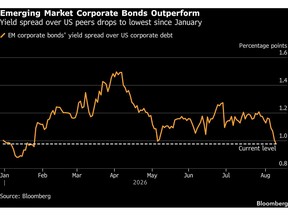
(Bloomberg) — The average borrowing cost of emerging-market companies has fallen to the lowest level since January relative to US corporates as global bond investors’ diversification into higher-yielding assets drives an outperformance.

THIS CONTENT IS RESERVED FOR SUBSCRIBERS ONLY
Subscribe now to read the latest news in your city and across Canada.
- Exclusive articles from Barbara Shecter, Joe O'Connor, Gabriel Friedman, and others.
- Daily content from Financial Times, the world's leading global business publication.
- Unlimited online access to read articles from Financial Post, National Post and 15 news sites across Canada with one account.
- National Post ePaper, an electronic replica of the print edition to view on any device, share and comment on.
- Daily puzzles, including the New York Times Crossword.
SUBSCRIBE TO UNLOCK MORE ARTICLES
Subscribe now to read the latest news in your city and across Canada.
- Exclusive articles from Barbara Shecter, Joe O'Connor, Gabriel Friedman and others.
- Daily content from Financial Times, the world's leading global business publication.
- Unlimited online access to read articles from Financial Post, National Post and 15 news sites across Canada with one account.
- National Post ePaper, an electronic replica of the print edition to view on any device, share and comment on.
- Daily puzzles, including the New York Times Crossword.
REGISTER / SIGN IN TO UNLOCK MORE ARTICLES
Create an account or sign in to continue with your reading experience.
- Access articles from across Canada with one account.
- Share your thoughts and join the conversation in the comments.
- Enjoy additional articles per month.
- Get email updates from your favourite authors.
THIS ARTICLE IS FREE TO READ REGISTER TO UNLOCK.
Create an account or sign in to continue with your reading experience.
- Access articles from across Canada with one account
- Share your thoughts and join the conversation in the comments
- Enjoy additional articles per month
- Get email updates from your favourite authors
Sign In or Create an Account
or
Article content
The yield on the Bloomberg EM USD Aggregate Corporate Index has fallen 19 basis points this month thanks to bond gains in energy companies benefiting from the closure of the Strait of Hormuz and distressed borrowers eyeing restructuring progress. Meanwhile, US securities have seen a yield compression of only 2 basis points as higher Treasury yields and increasing new issuance limit gains.
Article content
Article content
Article content
The divergent performances have pushed the yield premium for emerging-market company debt over US counterparts to the smallest since Jan. 26, data compiled by Bloomberg shows. The outperformance is driven by oil companies that are helping to bridge a supply gap arising from the Mideast conflict, duration-related technical factors and diversification into high-yield names, said Ninety One’s Alan Siow.
Article content
By signing up you consent to receive the above newsletter from Postmedia Network Inc.
Article content
“The asset class remains underinvested,” said Siow, co-head of EM corporate debt at Ninety One. “The outperformance year-to-date and attractive relative risk-adjusted returns frame an interesting opportunity for allocators at the moment.”
Article content
The EM corporate-bond index trades near a record high as a hunt for yield puts the gauge on course for a fourth successive year of gains. This quarter, the rally leaders are typically oil companies or distressed borrowers.
Article content
China Vanke, which received a credit upgrade from Fitch Ratings after completing a debt restructuring, has delivered investors a 30% total return in its 2027 bond since the end of June. Gran Tierra Energy’s 2031 note has given 18% gains, while other top performers include bonds of Tullow Oil, Kosmos Energy, Braskem, Aegea, SierraCol and Total Play Telecomunicaciones.
Article content
“EM offers resilience against DM counterparts in the face of the global energy shock emanating from the closure of the strait,” Siow said in reference to energy companies. “Higher prices have led to stronger cash flows and improved refinancing prospects, which for the moment are an idiosyncratic rather than generic EM risk-on theme.”
Article content
Advertisement 1
 English (US)