
.jpg) 2 hours ago
7
2 hours ago
7
SpaceX isn't a launch company anymore.
SpaceX is famous for launching, and landing, its Falcon 9 and Falcon Heavy rockets and sending astronauts to space aboard its Dragon crew capsule. Recently, however, the company has been transitioning into an artificial intelligence (AI) outfit — and that journey is now mostly complete.
"Our AI revenue will exceed all other SpaceX revenue probably in September — like, next month — and will significantly exceed all other SpaceX revenue in in the fourth quarter," company founder and CEO Elon Musk said during an address to employees that the company posted on X today (Aug. 11). "So, AI has become an extremely important part of SpaceX's future."
Earlier this year, SpaceX bought xAI, a startup that Musk founded in 2023. xAI created the chatbot Grok and also operates a powerful supercomputer cluster in Tennessee called Colossus.
But that was just the beginning. Musk laid out just how deeply SpaceX is diving into AI during his 29-minute talk, which came a week after SpaceX's first-ever quarterly earnings call as a public company.
"Probably in four or five years, AI will be 99% of the value of SpaceX; I'd say five years for sure," Musk said. "And the value of SpaceX will be some astronomical number."
Astronomical is right. According to Musk, the company aims to get 10 gigawatts of AI compute up and running by the end of next year. That's a big jump from its current 1.4 GW, which SpaceX sells to tech companies and AI labs.
"The value per watt is probably going to be 30 to $50, which means if we bring 10 gigawatts of AI online by the end of next year, it will be 300 to $500 billion a year in revenue," he said. "Big numbers."
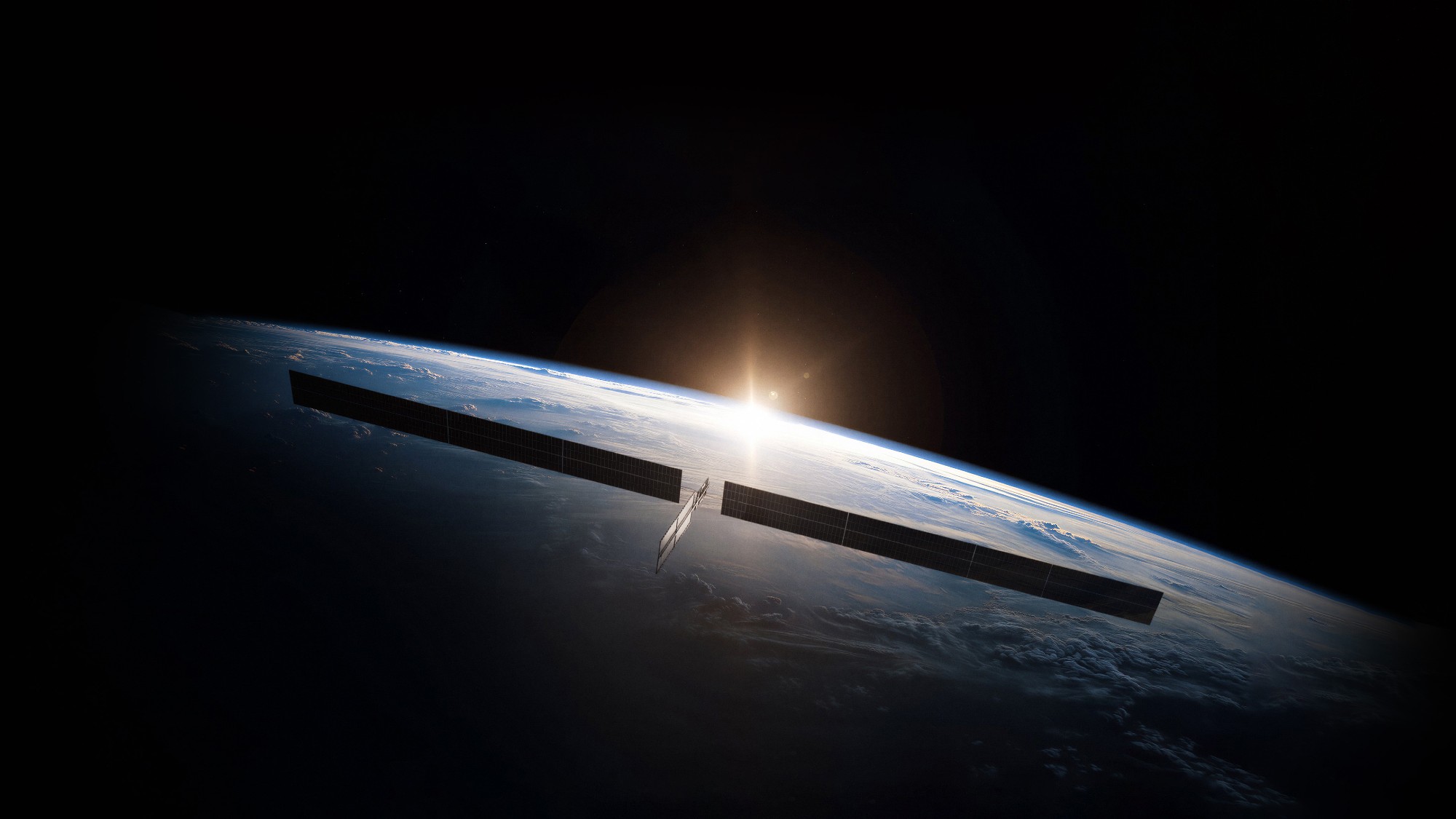
And those numbers will get even bigger over time, if all goes according to plan. SpaceX just announced plans to build a gigantic complex in Texas called Terafab, a joint operation with Tesla that will manufacture advanced semiconductor chips for a wide range of applications. And the company aims to launch a million of its "Starmind" AI satellites to low Earth orbit in the coming years using its fully reusable Starship megarocket, which is still in development.
Over the longer haul, the company plans to establish factories on the moon that will build these off-Earth data centers. The satellites will be launched into space from the lunar surface via electromagnetic mass drivers — basically, high-powered rail guns.
SpaceX envisions Starmind and its other AI efforts as returning almost unimaginable profits down the road. For example, in paperwork the company filed just before its record-breaking IPO, SpaceX identified an eventual "total addressable market" of $28.5 trillion, nearly $23 trillion of it in the AI field.
For some perspective: The gross domestic product of the entire United States last year was about $30.8 trillion.
"The future is fundamentally AI and robots," Musk said during his address to employees. "Assuming civilization continues to progress, I think that AI will probably — the amount of digital intelligence will probably be more than a trillion times the amount of biological intelligence."
He also said he's not just in this for the money.
"It's important that we have an AI that cares about humanity, that fosters humanity and helps take us to other planets and other star systems," Musk said.
"This is why I think it's essential that SpaceX succeed not just with AI hardware but also with AI software," he added. "I think an AI that is sort of SpaceX's baby will be a very good AI. I think SpaceX is a collection of some of the very best humans on Earth, both in capability and morality and goodness."
He urged SpaceX employees to aid the company's AI efforts in any way that they can, stressing that success could lead to some amazing vacations.
"One of the nice benefits of this also is that anyone at SpaceX who wants to go to the moon or Mars will be able to go in the future," he said. "You have my word."
 English (US)