
.jpg) 1 hour ago
3
1 hour ago
3
Article content
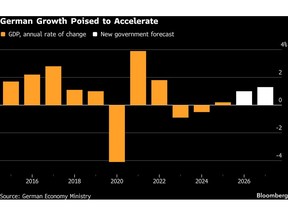
(Bloomberg) — The German government expects Europe’s biggest economy to emerge from three years of stagnation in 2026, but a heavy reliance on state spending shows fostering a broader-based recovery remains a work in progress.

THIS CONTENT IS RESERVED FOR SUBSCRIBERS ONLY
Subscribe now to read the latest news in your city and across Canada.
- Exclusive articles from Barbara Shecter, Joe O'Connor, Gabriel Friedman, and others.
- Daily content from Financial Times, the world's leading global business publication.
- Unlimited online access to read articles from Financial Post, National Post and 15 news sites across Canada with one account.
- National Post ePaper, an electronic replica of the print edition to view on any device, share and comment on.
- Daily puzzles, including the New York Times Crossword.
SUBSCRIBE TO UNLOCK MORE ARTICLES
Subscribe now to read the latest news in your city and across Canada.
- Exclusive articles from Barbara Shecter, Joe O'Connor, Gabriel Friedman and others.
- Daily content from Financial Times, the world's leading global business publication.
- Unlimited online access to read articles from Financial Post, National Post and 15 news sites across Canada with one account.
- National Post ePaper, an electronic replica of the print edition to view on any device, share and comment on.
- Daily puzzles, including the New York Times Crossword.
REGISTER / SIGN IN TO UNLOCK MORE ARTICLES
Create an account or sign in to continue with your reading experience.
- Access articles from across Canada with one account.
- Share your thoughts and join the conversation in the comments.
- Enjoy additional articles per month.
- Get email updates from your favourite authors.
THIS ARTICLE IS FREE TO READ REGISTER TO UNLOCK.
Create an account or sign in to continue with your reading experience.
- Access articles from across Canada with one account
- Share your thoughts and join the conversation in the comments
- Enjoy additional articles per month
- Get email updates from your favourite authors
Sign In or Create an Account
or
Article content
Gross domestic product is seen expanding by 1% this year and by 1.3% in 2027, according to an updated outlook published Wednesday by the economy ministry in Berlin. The predictions are broadly in line with other institutions like the International Monetary Fund, while marking a slight downgrade from October forecasts of 1.3% and 1.4% respectively.
Article content
Article content
Article content
In a press release, the ministry said the expected upswing will be underpinned by the government’s splurge of hundreds of billions of euros on infrastructure and an overhaul of the armed forces.
Article content
By signing up you consent to receive the above newsletter from Postmedia Network Inc.
Article content
Together with tax incentives for investment and other reforms enacted by Chancellor Friedrich Merz’s ruling coalition, public-sector spending will account for about two thirds of expansion this year, the ministry said.
Article content
“The background to the somewhat more careful assessment is that the boost from the government’s economic and fiscal policy measures hasn’t materialized as quickly and to the extent that we expected,” Economy Minister Katherina Reiche said at a news conference.
Article content
Further details from Wednesday’s government report:
Article content
- The outlook remains challenging, and last year’s US tariff increases continue to weigh on the global economy
- Germany is expected to lose further global market share, despite robust export performance within the EU
- The contribution of foreign trade to growth is likely to be negative again this year, although less pronounced than in 2025
- Geopolitical uncertainties, trade fragmentation and increased protectionism hampered Germany’s export-oriented manufacturers last year
- That exacerbated existing structural challenges like declining international competitiveness, high regulatory density and bureaucratic costs, a backlog of investment in infrastructure and digitalization, expensive energy and high taxes on corporate profits
- The anticipated economic recovery, driven primarily by fiscal stimulus, should not obscure the fact that structural growth prospects remain significantly weakened
Article content
Article content
Reviving growth is key for Merz’s conservatives and Klingbeil’s Social Democrats to lure back voters who have switched allegiance to the far-right Alternative for Germany, or AfD, since last February’s national election.
Article content
The anti-immigrant party’s support base is significantly stronger in the former communist east, and it’s on course to win two regional ballots there in September, potentially giving it a chance to lead a state government for the first time since it was founded in 2013.
Article content
Merz has vowed never to cooperate with the AfD in any form and pledged to halve its support, in part by pushing through tougher immigration and asylum rules.
Article content
However, it has climbed to first place in some polls to as high as 27%, with backing for the chancellor’s CDU/CSU bloc dipping to as low as 24%.
Article content
Helena Melnikov, managing director of the DIHK industry lobby, welcomed Germany’s return to expansion but complained it’s still growing “far too slowly.”
Article content
“This is also shockingly clear in international comparison,” Melnikov said by email, noting that since 2019 the global economy had grown by 19%, the US by 15%, and Italy by 6%, while Germany had recorded “practically no growth at all” during that period.
Article content
“We are feeling the effects domestically with the exodus of businesses and job losses,” she added. “And we are consequently experiencing a decline in our global economic standing.”
Article content
(Updates with economy minister comment in fifth paragraph.)
Article content
 English (US)