
.jpg) 3 hours ago
6
3 hours ago
6
Article content
Recommendations help organizations safeguard sensitive data while maintaining effective security operations

THIS CONTENT IS RESERVED FOR SUBSCRIBERS ONLY
Subscribe now to read the latest news in your city and across Canada.
- Exclusive articles from Barbara Shecter, Joe O'Connor, Gabriel Friedman, and others.
- Daily content from Financial Times, the world's leading global business publication.
- Unlimited online access to read articles from Financial Post, National Post and 15 news sites across Canada with one account.
- National Post ePaper, an electronic replica of the print edition to view on any device, share and comment on.
- Daily puzzles, including the New York Times Crossword.
SUBSCRIBE TO UNLOCK MORE ARTICLES
Subscribe now to read the latest news in your city and across Canada.
- Exclusive articles from Barbara Shecter, Joe O'Connor, Gabriel Friedman and others.
- Daily content from Financial Times, the world's leading global business publication.
- Unlimited online access to read articles from Financial Post, National Post and 15 news sites across Canada with one account.
- National Post ePaper, an electronic replica of the print edition to view on any device, share and comment on.
- Daily puzzles, including the New York Times Crossword.
REGISTER / SIGN IN TO UNLOCK MORE ARTICLES
Create an account or sign in to continue with your reading experience.
- Access articles from across Canada with one account.
- Share your thoughts and join the conversation in the comments.
- Enjoy additional articles per month.
- Get email updates from your favourite authors.
THIS ARTICLE IS FREE TO READ REGISTER TO UNLOCK.
Create an account or sign in to continue with your reading experience.
- Access articles from across Canada with one account
- Share your thoughts and join the conversation in the comments
- Enjoy additional articles per month
- Get email updates from your favourite authors
Sign In or Create an Account
or
Article content
MONTRÉAL, Jan. 26, 2026 (GLOBE NEWSWIRE) — To support Data Protection Day, Genetec Inc. (“Genetec”), the global leader in enterprise physical security software, is sharing best practices to help organizations protect sensitive physical security data while maintaining effective security operations.
Article content
Article content
Article content
Physical security systems generate large volumes of information from video footage, access control records, and license plate information. As this data plays a growing role in daily operations and investigations, organizations are under increasing pressure to manage it responsibly amid evolving privacy regulations, rising cyber threats, and heightened expectations around transparency.
Article content
By signing up you consent to receive the above newsletter from Postmedia Network Inc.
Article content
“Physical security data can be highly sensitive, and protecting it requires more than basic safeguards or vague assurances,” said Mathieu Chevalier, Principal Security Architect at Genetec Inc. “Some approaches in the market treat data as an asset to be exploited or shared beyond its original purpose. That creates real privacy risks. Organizations should expect clear limits on how their data is used, strong controls throughout its lifecycle, and technology that is designed to respect privacy by default, not as an afterthought.”
Article content
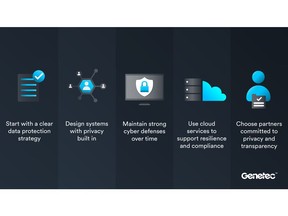
Observed annually on January 28, International Data Protection Day serves as a reminder that protecting personal data is a shared and ongoing responsibility. For physical security teams, adopting clear strategies, resilient technologies, and trusted partnerships can help ensure privacy and security objectives remain aligned as risks and regulations continue to change. Genetec recommends the following best practices to help organizations strengthen data protection across physical security systems:
Article content
Article content
Start with a clear data protection strategy
Organizations should regularly assess what data they collect, for which purpose they collect it, where it is stored, how long it is retained, and who has access to it. Documenting these practices helps reduce unnecessary data exposure, identify policy gaps, and support ongoing compliance as regulations continue to evolve. Transparency around data handling practices also plays an important role in building trust with employees, customers, and the public.
Article content
Design systems with privacy built in
Privacy-by-design means limiting privacy risk not only through security controls, but also through how personal data is collected, used, and governed. Organizations should apply purpose limitation and data minimization principles to ensure only the data required for defined security objectives is collected and retained. Strong security measures, including encrypting data in transit and at rest, enforcing strong authentication, and applying granular access controls, help reduce the risk of unauthorized access. Privacy-enhancing technologies, such as automated anonymization and masking, further support transparency and help protect individuals’ identities while preserving the operational value of security data.
 English (US)