
.jpg) 2 hours ago
3
2 hours ago
3
Synopsis
Religion is playing a role in the US conflict with Iran. President Donald Trump has met with Christian pastors who offered blessings. Some officials view the conflict as a divine mission. This echoes historical religious wars. Iran's government is also religiously rooted. The US is invoking religious themes in its foreign policy.
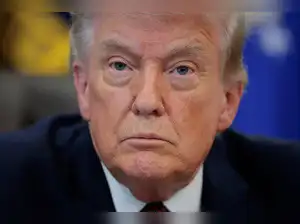 ReutersU.S. President Donald Trump
As he wages war on Iran, President Donald Trump was joined in the Oval Office by Christian pastors. Solemnly, some placed their hands on his shoulder or forearm. They offered their blessings.
In a war against a country led by Shia Muslim clerics, the US-which has a constitutional separation between church and state-is also invoking religion, with some Trump officials casting it as almost a divine mission.
At the event for Holy Week, when Christians mark the last days of Jesus Christ before the resurrection on Easter, the Reverend Franklin Graham told Trump of the Bible's Book of Esther in which he said "the Iranians"-a Persian king of contested historical accuracy-ordered the killing of all Jews.
"Today the Iranians, the wicked regime of this government, wants to kill every Jew and destroy them with an atomic fire. But you have raised up President Trump. You've raised him up for such a time as this. And Father, we pray that you'll give him victory," said Graham, son of famed late evangelist Billy Graham.
Unmentioned, the Persian emperor Cyrus the Great, still revered by Iranians, was the first world leader to grant freedom to the Jews, liberating them from captivity in Babylon.
The story of the Book of Esther has also been repeatedly cited by Israeli Prime Minister Benjamin Netanyahu, who used the occasion of Passover to compare his war alongside Trump to the emancipation of the Jews from Egyptian captivity.
Iran's government since 1979 has been explicitly rooted in religion, with a top Shia cleric serving as supreme leader.
Iran's military has drawn parallels between their defenses and the Battle of Karbala, the 680 CE battle in which the Prophet Mohammed's grandson Hussein was killed, an event commemorated by Shia as an act of martyrdom and self-sacrifice in the face of tyranny.
Crusades are back
When George W Bush went to war against Afghanistan's Taliban after the September 11, 2001 attacks, he called his campaign a "crusade" but quickly backtracked, aware of the historical baggage in the Islamic world of a term often used loosely as a metaphor in the West.
Trump's defence secretary, Pete Hegseth, has shown no such compunctions. In a 2020 book, he called "American Crusade" in which he called for a "holy war" to rid America of the left.
Among his tattoos are a Jerusalem Cross, a Crusader-era emblem embraced by the far-right, along with the Latin inscription "Deus Vult," or "God wills it," a motto for the Crusaders.
If there was any doubt on his views on Muslims, he also has a tattoo that reads "kafir," or "infidel," in Arabic. AFP
 English (US)