
.jpg) 2 hours ago
3
2 hours ago
3
Article content
(Bloomberg) — European gas and power markets, once a niche corner of global energy trading, are in for a major change next week: Hours will more than double to 21 from 10, ending the narrow daytime window that has been the norm for years.

THIS CONTENT IS RESERVED FOR SUBSCRIBERS ONLY
Subscribe now to read the latest news in your city and across Canada.
- Exclusive articles from Barbara Shecter, Joe O'Connor, Gabriel Friedman, and others.
- Daily content from Financial Times, the world's leading global business publication.
- Unlimited online access to read articles from Financial Post, National Post and 15 news sites across Canada with one account.
- National Post ePaper, an electronic replica of the print edition to view on any device, share and comment on.
- Daily puzzles, including the New York Times Crossword.
SUBSCRIBE TO UNLOCK MORE ARTICLES
Subscribe now to read the latest news in your city and across Canada.
- Exclusive articles from Barbara Shecter, Joe O'Connor, Gabriel Friedman and others.
- Daily content from Financial Times, the world's leading global business publication.
- Unlimited online access to read articles from Financial Post, National Post and 15 news sites across Canada with one account.
- National Post ePaper, an electronic replica of the print edition to view on any device, share and comment on.
- Daily puzzles, including the New York Times Crossword.
REGISTER / SIGN IN TO UNLOCK MORE ARTICLES
Create an account or sign in to continue with your reading experience.
- Access articles from across Canada with one account.
- Share your thoughts and join the conversation in the comments.
- Enjoy additional articles per month.
- Get email updates from your favourite authors.
THIS ARTICLE IS FREE TO READ REGISTER TO UNLOCK.
Create an account or sign in to continue with your reading experience.
- Access articles from across Canada with one account
- Share your thoughts and join the conversation in the comments
- Enjoy additional articles per month
- Get email updates from your favourite authors
Sign In or Create an Account
or
Article content
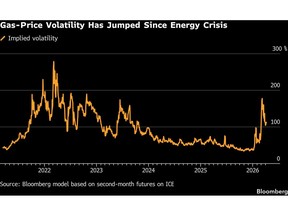
The permanent expansion, announced several months ago, comes at a particularly volatile time as war in the Middle East drives sharp price swings. Even after the recent ceasefire announcement, contracts for European gas remain almost 40% above pre-conflict levels. With traders glued to their screens, preparations for the new 21-hour trading day have lagged. Some firms are taking a wait-and-see approach on whether to hire more staff or reorganize their desks.
Article content
Article content
Article content
Yet despite the turbulence, many energy traders say the change is a logical next step for a market transformed by Russia’s invasion of Ukraine. Europe’s break from a single dominant energy supplier pushed it into the global liquefied national gas market, exposing prices to disruptions far beyond the region. At the same time, the growth of renewables has added further swings in power generation, feeding through to gas demand.
Article content
By signing up you consent to receive the above newsletter from Postmedia Network Inc.
Article content
These developments have made European gas and power more attractive to global traders. What was once a fundamentals-driven market, focused on weather, storage and pipeline flows, now features more complex strategies, including cross-market hedging between Europe’s gas benchmark and US Henry Hub. Options activity has picked up from near non-existent levels, while spread trading has grown amid persistent supply risks and hedge funds have driven volumes higher.
Article content
To many, aligning trading hours with US and Asian benchmarks widens investor access and better reflects a market with expanding reach and relevance. The market will open at 5:50 a.m. Singapore time on Monday, making it the first major energy contract to begin the trading week.
Article content
Article content
The new 21-hour day is “an advantage for global players,” said Marco Saalfrank, head of continental Europe merchant trading at Swiss-based Axpo Holding AG. “If something happens in the market that affects prices, they can react immediately.”
Article content
For traders on the ground in Europe, the longer window is set to reshape how they work and live.
Article content
Until now, the routine has been relatively structured: Traders log on before markets open at 8 a.m. in Amsterdam, assess fundamentals such as flows and storage, scan weather and geopolitical developments, and take positions at roughly the same time. When the hours expand, that rhythm will fragment across time zones, with participants dipping in and out of the market much like they do in oil.
Article content
Whether that’s a net positive depends on whom you ask. In interviews with European traders, the mood was mixed, with concerns that a 21-hour market could erode a work-life balance already rare in the industry.
Article content
A Swiss trading desk head said he worries about missing his children’s bedtime as market-moving headlines from US President Donald Trump on Iran often land after 6 p.m. in Europe. A London-based trader said unreliable train Wi-Fi could make the evening commute more stressful, while a utility trader joked he would expect a pay rise if longer hours become the norm. Some plan to set alarms overnight to monitor markets.
 English (US)