
.jpg) 21 hours ago
3
21 hours ago
3
Article content
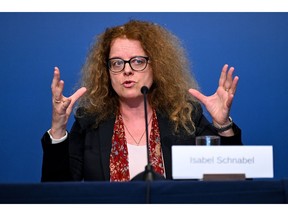
(Bloomberg) — European Central Bank Executive Board member Isabel Schnabel warned that price pressures could turn out stronger than anticipated even as a US-Iran peace deal reopens the Strait of Hormuz.

THIS CONTENT IS RESERVED FOR SUBSCRIBERS ONLY
Subscribe now to read the latest news in your city and across Canada.
- Exclusive articles from Barbara Shecter, Joe O'Connor, Gabriel Friedman, and others.
- Daily content from Financial Times, the world's leading global business publication.
- Unlimited online access to read articles from Financial Post, National Post and 15 news sites across Canada with one account.
- National Post ePaper, an electronic replica of the print edition to view on any device, share and comment on.
- Daily puzzles, including the New York Times Crossword.
SUBSCRIBE TO UNLOCK MORE ARTICLES
Subscribe now to read the latest news in your city and across Canada.
- Exclusive articles from Barbara Shecter, Joe O'Connor, Gabriel Friedman and others.
- Daily content from Financial Times, the world's leading global business publication.
- Unlimited online access to read articles from Financial Post, National Post and 15 news sites across Canada with one account.
- National Post ePaper, an electronic replica of the print edition to view on any device, share and comment on.
- Daily puzzles, including the New York Times Crossword.
REGISTER / SIGN IN TO UNLOCK MORE ARTICLES
Create an account or sign in to continue with your reading experience.
- Access articles from across Canada with one account.
- Share your thoughts and join the conversation in the comments.
- Enjoy additional articles per month.
- Get email updates from your favourite authors.
THIS ARTICLE IS FREE TO READ REGISTER TO UNLOCK.
Create an account or sign in to continue with your reading experience.
- Access articles from across Canada with one account
- Share your thoughts and join the conversation in the comments
- Enjoy additional articles per month
- Get email updates from your favourite authors
Sign In or Create an Account
or
Article content
In a presentation for the Petersberger summer dialogue 2026 in Koenigswinter, Germany, Schnabel said Saturday that “food, goods and services inflation are facing upside risks,” adding that the “energy price shock can feed into broader inflationary dynamics.”
Article content
Article content
Article content
The slides back Schnabel’s comments in a recent interview that from today’s perspective more rate hikes are needed to bring inflation back to 2%. While she welcomed the recent drop in energy prices due to the prospect of an US-Iran peace deal, she cautioned that the ceasefire is no reason to let the guard down.
Article content
By signing up you consent to receive the above newsletter from Postmedia Network Inc.
Article content
“Uncertainty remains high, but announced peace deal makes negative scenarios less likely,” she said. Still, oil prices are “expected to stay persistently higher as Strait of Hormuz opens only gradually.”
Article content
Schnabel, who’s seen as the most hawkish Governing Council member, reiterated that the “ECB is expected to raise rates further to bring inflation back to 2% over medium term.”
Article content
“Consumer inflation expectations have increased,” the German official said. Still, there’s “no sign of wage pressures yet.”
Article content
Euro-area inflation likely slowed in June to 3% from 3.2%, according to a Bloomberg survey, with data due next week. Analysts expect core price growth, excluding energy and food, to stay at 2.6%, significantly above the ECB’s target. Earlier this month, officials concluded that they can no longer look through the shock and raised rates.
Article content
Article content
Schnabel’s presentation also said:
Article content
- “Energy shock hit euro area particularly hard but less than in previous oil price shocks.”
- “Staff projections see lower euro area growth and higher inflation due to Iran war.”
- “Higher energy costs are weighing on confidence and private consumption.”
- “Higher energy prices have knock-on effects, reinforced by supply chain pressures.”
- “Producers pass through part of higher input prices, especially in manufacturing.”
- “Growth is supported by government investment and global AI boom.”
- “Labour market remains resilient with cooling labour demand but tight supply.”
- “Rising financial stability risks due to stretched risk asset valuations and higher leverage.”
Article content
 English (US)