
.jpg) 1 hour ago
3
1 hour ago
3
There's new evidence to add to the ever-growing pile that suggests you don't need to feel guilty about your daily coffee. A large, long-term study has found that moderate caffeine intake is linked to reduced risk of dementia and slower cognitive decline.
The study analyzed data on nearly 132,000 participants, who were followed for up to 43 years. Those who reported the highest caffeine intake were found to have an 18 percent lower risk of developing dementia, compared to those who said they drank little or no caffeine.
Among a subset of participants, those who drank caffeinated coffee or tea also had slightly better scores on cognitive tests than those who drank less. Intriguingly, no association was found for decaf drinkers, suggesting caffeine itself is the protective component.
Of course, this doesn't mean you can just guzzle coffee by the gallon every day and stay sharp forever. As with everything, moderation is important – the study found the most pronounced cognitive benefits among people who drank two to three cups of coffee or one to two cups of tea per day.
But even moderate caffeine consumption is no silver bullet.
"While our results are encouraging, it's important to remember that the effect size is small and there are lots of important ways to protect cognitive function as we age," says Daniel Wang, a nutritionist at Mass General Brigham in Boston.
"Our study suggests that caffeinated coffee or tea consumption can be one piece of that puzzle."
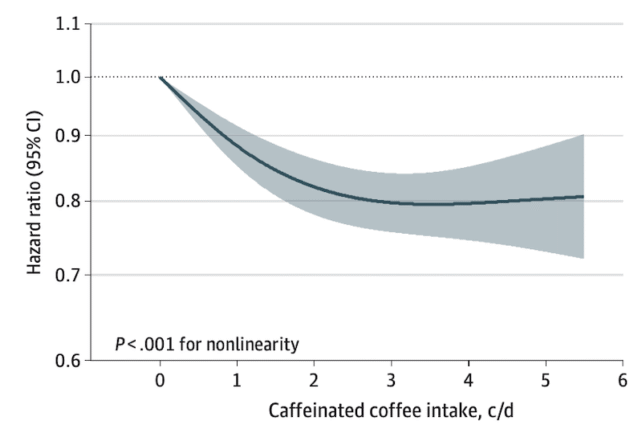 A chart illustrating the hazard ratio for dementia with caffeinated coffee intake, in cups per day (c/d) (Zhang et al., JAMA, 2026)
The report echoes the findings of several recent studies. An analysis of over 200,000 people in the UK Biobank found that coffee drinkers were 34 percent less likely to develop Alzheimer's, and 37 percent less likely to develop Parkinson's, than non-coffee drinkers – as long as it was caffeinated and unsweetened.
Another linked three cups of coffee per day with an average increase of almost two years of life. Yet another found that among people with high blood pressure, those who drank four to five cups of tea per day had the lowest risk of developing dementia.
The new study involved an analysis of health data from 86,606 women in the Nurses' Health Study and 45,215 men in the Health Professionals Follow-up Study, both of which began collecting data in the 1980s.
Their caffeine intake was calculated using food frequency questionnaires conducted every two to four years. Participants were also asked about changes they had noticed in their memory, attention, and other cognitive skills. Some 17,000 people completed telephone tests of cognitive function, conducted several times during the study period.

Of the 131,821 total participants, 11,033 developed dementia during the study. This translated to an 18 percent lower risk of dementia for those in the highest tier of caffeine intake, compared to the lowest.
Those who drank caffeinated coffee were also found to have a slightly lower prevalence of self-reported cognitive decline – 7.8 percent compared to 9.5 percent of non-coffee drinkers.
However, among patients who completed cognitive tests, there was no significant difference in their composite scores of brain function.
Interestingly, the study found that higher caffeine intake wasn't linked to negative effects. Instead, the benefits just leveled off, so that higher intake had about the same benefits as a moderate intake.
That's in contrast to other studies, which have found that drinking more than six cups a day is linked to a higher risk of dementia.
Related: Here Are All The Reasons Why You Should Enjoy Your Cup of Coffee
As always, observational studies like this one can point to associations, but can't conclusively say that drinking coffee reduces your risk of dementia.
In their analysis, the researchers accounted for other lifestyle factors, such as diet, medical and family history, but more work is needed to investigate potential links between caffeine and dementia, and the possible mechanisms.
"We also compared people with different genetic predispositions to developing dementia and saw the same results – meaning coffee or caffeine is likely equally beneficial for people with high and low genetic risk of developing dementia," adds Yu Zhang, lead author of the study.
The research was published in JAMA.
 English (US)