
.jpg) 1 hour ago
4
1 hour ago
4
Article content
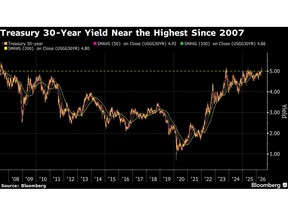
(Bloomberg) — Bond traders are zeroing in on 5.5% as the new “round number” for 30-year US Treasury yields as inflation concerns ripple across markets, according to Citigroup Inc.

THIS CONTENT IS RESERVED FOR SUBSCRIBERS ONLY
Subscribe now to read the latest news in your city and across Canada.
- Exclusive articles from Barbara Shecter, Joe O'Connor, Gabriel Friedman, and others.
- Daily content from Financial Times, the world's leading global business publication.
- Unlimited online access to read articles from Financial Post, National Post and 15 news sites across Canada with one account.
- National Post ePaper, an electronic replica of the print edition to view on any device, share and comment on.
- Daily puzzles, including the New York Times Crossword.
SUBSCRIBE TO UNLOCK MORE ARTICLES
Subscribe now to read the latest news in your city and across Canada.
- Exclusive articles from Barbara Shecter, Joe O'Connor, Gabriel Friedman and others.
- Daily content from Financial Times, the world's leading global business publication.
- Unlimited online access to read articles from Financial Post, National Post and 15 news sites across Canada with one account.
- National Post ePaper, an electronic replica of the print edition to view on any device, share and comment on.
- Daily puzzles, including the New York Times Crossword.
REGISTER / SIGN IN TO UNLOCK MORE ARTICLES
Create an account or sign in to continue with your reading experience.
- Access articles from across Canada with one account.
- Share your thoughts and join the conversation in the comments.
- Enjoy additional articles per month.
- Get email updates from your favourite authors.
THIS ARTICLE IS FREE TO READ REGISTER TO UNLOCK.
Create an account or sign in to continue with your reading experience.
- Access articles from across Canada with one account
- Share your thoughts and join the conversation in the comments
- Enjoy additional articles per month
- Get email updates from your favourite authors
Sign In or Create an Account
or
Article content
Jim McCormick, Citi’s London-based macro rates strategist, said the focus is likely to shift to this level after long-end yields climbed to 5.16% this week to approach the highest since 2007.
Article content
Article content
Article content
“Investors’ calculus in terms of buying the dip on Treasuries has changed,” McCormick said in an interview in Singapore. Core inflation shows no signs of slowing, while US growth should outperform developed-market peers as the world’s largest economy is expected to weather the energy crisis better, he added.
Article content
By signing up you consent to receive the above newsletter from Postmedia Network Inc.
Article content
The recent upward march in 30-year yields has upended the traditional notion that the 5% mark is the threshold which will attract dip buyers. Barclays Plc and BNP Paribas SA have cautioned the selloff may not be over, as elevated energy prices continue to boost inflation expectations.
Article content
All this has led investors to recalibrate their expectations for the monetary policy outlook. Swap markets show that traders are pricing in a 25-basis point rate hike from the Federal Reserve by March 2027 to damp price pressures, compared with bets for rate cuts before the Iran war broke out in late February.
Article content
“I see markets underpricing the risk of a Fed rate hike starting this year,” said McCormick.
Article content
The repricing in inflation expectations has been felt across the globe. Germany’s 30-year yield rose to a 15-year high this week, while the yield on similar-dated Japanese notes advanced to the highest level since the maturity was first sold in 1999. In the UK, worries about the fiscal implications of a leadership challenge to Prime Minister Keir Starmer remain top of investors’ minds.
Article content
And while risk assets have rebounded despite the ongoing Iran war, with a MSCI gauge of developed-market equities having climbed over 10% from a low reached in March, there are growing worries that elevated risk-free rates could upend the rally at some point.
Article content
“The biggest risk to the global economy is the size of the shock to global bond yields,” McCormick said. “If long-dated US yields continue to march higher, it creates a pretty unstable equilibrium for riskier assets such as equities and credit.”
Article content
 English (US)