
.jpg) 1 hour ago
3
1 hour ago
3

Article content
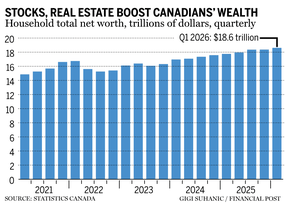
Canadian households continued to get wealthier overall in the first quarter of 2026 reaching just over $18.6 trillion in the tenth consecutive quarterly increase.

THIS CONTENT IS RESERVED FOR SUBSCRIBERS ONLY
Subscribe now to read the latest news in your city and across Canada.
- Exclusive articles from Barbara Shecter, Joe O'Connor, Gabriel Friedman, and others.
- Daily content from Financial Times, the world's leading global business publication.
- Unlimited online access to read articles from Financial Post, National Post and 15 news sites across Canada with one account.
- National Post ePaper, an electronic replica of the print edition to view on any device, share and comment on.
- Daily puzzles, including the New York Times Crossword.
SUBSCRIBE TO UNLOCK MORE ARTICLES
Subscribe now to read the latest news in your city and across Canada.
- Exclusive articles from Barbara Shecter, Joe O'Connor, Gabriel Friedman and others.
- Daily content from Financial Times, the world's leading global business publication.
- Unlimited online access to read articles from Financial Post, National Post and 15 news sites across Canada with one account.
- National Post ePaper, an electronic replica of the print edition to view on any device, share and comment on.
- Daily puzzles, including the New York Times Crossword.
REGISTER / SIGN IN TO UNLOCK MORE ARTICLES
Create an account or sign in to continue with your reading experience.
- Access articles from across Canada with one account.
- Share your thoughts and join the conversation in the comments.
- Enjoy additional articles per month.
- Get email updates from your favourite authors.
THIS ARTICLE IS FREE TO READ REGISTER TO UNLOCK.
Create an account or sign in to continue with your reading experience.
- Access articles from across Canada with one account
- Share your thoughts and join the conversation in the comments
- Enjoy additional articles per month
- Get email updates from your favourite authors
Sign In or Create an Account
or
Article content
Households added $243 billion to their collective wealth, a 1.3 per cent increase from the fourth quarter of 2025, according to Statistics Canada’s latest national balance sheet, released Friday. Compared with last quarter, however, net worth gains were boosted by increases in both financial and non-financial assets.
Article content
Article content
Article content
Non-financial assets (which include residential real estate) were up 1.1 per cent overall in the first quarter of 2026 after two consecutive quarters of declines, while financial assets (such as stocks) grew 1.3 per cent.
Article content
By signing up you consent to receive the above newsletter from Postmedia Network Inc.
Article content
Toronto-Dominion (TD) Bank economist Maria Solovieva said declining home prices over previous quarters may have enticed those sitting on the sidelines to enter the market, driving residential real estate values higher.
Article content
The national average sale price was up 2.2 per cent on a year-over-year basis in April, according to the latest data from the Canadian Real Estate Association (CREA).
Article content
“This (upcoming) quarter, we’re expecting some strength in home prices,” Solovieva said. “It’s a reflection, mostly, of some recovery in the housing market after a fairly low slump.”
Article content
However, Kari Norman, senior economist at Desjardins Group, said there is a “bifurcation” between higher-cost metros such as Toronto and Vancouver where home prices have been falling since 2022 but may have hit their bottom, compared with the rest of the country which has seen price increases over the past three years.
Article content
Article content
Article content
Article content
Meanwhile, financial assets grew at their lowest quarterly pace since a year ago, likely influenced by the downswing in markets in March, Solovieva said. “The conflict in the Middle East … was the biggest factor in the first quarter.”
Article content
Article content
Weakness in U.S. equities was offset by the S&P/TSX Composite index gaining 3.3 per cent during the first quarter. The resource-heavy TSX benefited from growth in the energy sector amid the spike in oil prices due to the conflict in Iran, said Norman.
Article content
“We are continuing to expect strong gains in stock markets for both the Canadian market and south of the border, and that is likely to continue to support household net worth,” she said, adding that growth in artificial intelligence has been bolstering the U.S. stock market.
Article content
Energy cost pressures may have also weighed on the household savings rate, which dropped to 3.5 per cent — the lowest savings rate since the first quarter of 2024 — as household spending outpaced disposable income, Solovieva said.
Article content
However, the savings rate is still “relatively healthy” especially in comparison with the quarters of negative savings seen before the COVID-19 pandemic, Solovieva said.
 English (US)