
.jpg) 1 hour ago
4
1 hour ago
4
Article content
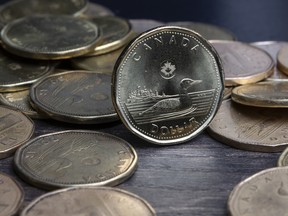
The Canadian dollar on Monday slumped to a new closing low for 2026 of 71.67 cents U.S., with economists at National Bank of Canada singling out gold as “a key factor” behind the loonie’s weakness.

THIS CONTENT IS RESERVED FOR SUBSCRIBERS ONLY
Subscribe now to read the latest news in your city and across Canada.
- Exclusive articles from Barbara Shecter, Joe O'Connor, Gabriel Friedman, and others.
- Daily content from Financial Times, the world's leading global business publication.
- Unlimited online access to read articles from Financial Post, National Post and 15 news sites across Canada with one account.
- National Post ePaper, an electronic replica of the print edition to view on any device, share and comment on.
- Daily puzzles, including the New York Times Crossword.
SUBSCRIBE TO UNLOCK MORE ARTICLES
Subscribe now to read the latest news in your city and across Canada.
- Exclusive articles from Barbara Shecter, Joe O'Connor, Gabriel Friedman and others.
- Daily content from Financial Times, the world's leading global business publication.
- Unlimited online access to read articles from Financial Post, National Post and 15 news sites across Canada with one account.
- National Post ePaper, an electronic replica of the print edition to view on any device, share and comment on.
- Daily puzzles, including the New York Times Crossword.
REGISTER / SIGN IN TO UNLOCK MORE ARTICLES
Create an account or sign in to continue with your reading experience.
- Access articles from across Canada with one account.
- Share your thoughts and join the conversation in the comments.
- Enjoy additional articles per month.
- Get email updates from your favourite authors.
THIS ARTICLE IS FREE TO READ REGISTER TO UNLOCK.
Create an account or sign in to continue with your reading experience.
- Access articles from across Canada with one account
- Share your thoughts and join the conversation in the comments
- Enjoy additional articles per month
- Get email updates from your favourite authors
Sign In or Create an Account
or
Article content
“The loonie has been the weakest reserve currency in recent weeks,” chief economist Stefane Marion and senior economist Kyle Dahms said in a report, referring to a group of currencies that include the United States dollar, euro and Japanese yen, among others.
Article content
Article content
Article content
They said one reason behind the Canadian dollar’s poor showing is that it now has a stronger relationship with the price of gold than the price of oil, which is a change from when the loonie and oil moved more in tandem during the previous oil shock of 2022 after Russia attacked Ukraine.
Article content
By signing up you consent to receive the above newsletter from Postmedia Network Inc.
Article content
Gold is down 20 per cent from its all-time high of about US$5,400 an ounce.
Article content
“The rolling correlation between daily moves in the loonie and (West Texas Intermediate) has turned negative in recent months, a clear break from the strongly positive relationship that prevailed during the previous oil shock in 2022, while the correlation with bullion has strengthened sharply,” Marion and Dahms said.
Article content
After hitting a year-to-date high of 74.1 cents U.S. in late January, the Canadian dollar dropped about three per cent as investors fled to the U.S. dollar in search of shelter from the stock market rout brought on by the Iran conflict.
Article content
From early April to early June, the loonie recovered some of those losses, but has now given them all back.
Article content
Marion and Dahms said there are several other factors pushing down the Canadian dollar, including “deteriorating” economic growth and “unfavourable” interest rate spreads between two-year Government of Canada and U.S. Treasury yields.
Article content
Article content
The two-year U.S. Treasury has a yield of 4.2 per cent compared with the Government of Canada bonds’ 2.9 per cent.
Article content
Article content
Canada’s economy contracted in the first quarter following negative growth in the final quarter of last year, leading to talk of a technical recession, which is two consecutive quarters of negative gross domestic product (GDP).
Article content
The economists said the recession story is a bit of a hard sell given Canada added 88,000 positions in May and the unemployment rate dropped, according to Statistics Canada data released on June 5.
Article content
But U.S. real GDP is estimated to grow at 1.6 per cent, according to the U.S. Bureau of Economic Analysis, which would far outpace that of Canada.
Article content
Marion and Dahms expect the Canadian dollar to rise to 74 cents U.S. by year-end, but that will depend on a successful outcome to the review of the Canada-U.S.-Mexico Agreement.
Article content
“For now, we expect the Canadian dollar to remain under pressure,” they said. “Appreciation should resume, but a sustained rally will likely require Ottawa to secure a trade accord with the U.S. this summer.”
Article content
Article content
 English (US)