
.jpg) 1 hour ago
3
1 hour ago
3
Article content
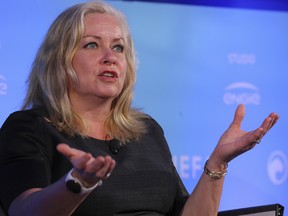
When U.S. President Donald Trump first targeted the Canadian auto industry with tariffs it cost Linda Hasenfratz her status as a billionaire.

THIS CONTENT IS RESERVED FOR SUBSCRIBERS ONLY
Subscribe now to read the latest news in your city and across Canada.
- Exclusive articles from Barbara Shecter, Joe O'Connor, Gabriel Friedman, and others.
- Daily content from Financial Times, the world's leading global business publication.
- Unlimited online access to read articles from Financial Post, National Post and 15 news sites across Canada with one account.
- National Post ePaper, an electronic replica of the print edition to view on any device, share and comment on.
- Daily puzzles, including the New York Times Crossword.
SUBSCRIBE TO UNLOCK MORE ARTICLES
Subscribe now to read the latest news in your city and across Canada.
- Exclusive articles from Barbara Shecter, Joe O'Connor, Gabriel Friedman and others.
- Daily content from Financial Times, the world's leading global business publication.
- Unlimited online access to read articles from Financial Post, National Post and 15 news sites across Canada with one account.
- National Post ePaper, an electronic replica of the print edition to view on any device, share and comment on.
- Daily puzzles, including the New York Times Crossword.
REGISTER / SIGN IN TO UNLOCK MORE ARTICLES
Create an account or sign in to continue with your reading experience.
- Access articles from across Canada with one account.
- Share your thoughts and join the conversation in the comments.
- Enjoy additional articles per month.
- Get email updates from your favourite authors.
THIS ARTICLE IS FREE TO READ REGISTER TO UNLOCK.
Create an account or sign in to continue with your reading experience.
- Access articles from across Canada with one account
- Share your thoughts and join the conversation in the comments
- Enjoy additional articles per month
- Get email updates from your favourite authors
Sign In or Create an Account
or
Article content
The majority of Hasenfratz’ net worth is concentrated in Linamar Corp., the auto parts and industrial equipment manufacturer her father founded and she’s run for more than two decades. After the first round of tariffs was announced last year — including levies on autos specifically — Linamar’s stock plunged and her fortune dipped to around US$800 million.
Article content
Article content
Article content
But now Linamar’s shares have rebounded to near record highs, and Hasenfratz’ net worth has hit US$1.8 billion, according to the Bloomberg Billionaires Index. These changing fortunes may point to both a limit to Trump’s ongoing trade assault on Canada, and a potential way forward for the country’s beleaguered manufacturers.
Article content
By signing up you consent to receive the above newsletter from Postmedia Network Inc.
Article content
“Tariffs are very much a short-term problem,” Hasenfratz, 60, who is Linamar’s executive chair, said in an interview with BNN Bloomberg Television. “The vast majority of our business, there’s absolutely no tariff.”
Article content
Shares of the Guelph, Ontario-based company have climbed about 27 per cent this year in Toronto — outpacing the 16 per cent advance of the benchmark S&P/TSX Composite Index — despite a one-day dip on Thursday after reporting second-quarter earnings that fell short of analysts’ estimates.
Article content
Hasenfratz didn’t respond to a request for comment about her net worth or the company’s performance.
Article content
Tariff free
Article content
Key to Linamar’s success over the last year has been that auto parts are exempt from the 25 per cent tariff applied to assembled vehicles, so long as the parts are compliant with the existing trade deal between the U.S., Canada and Mexico. That means products that account for more than 60 per cent of Linamar’s earnings are sold tariff free.
Article content
Article content
While Trump declined this year to renew that existing trade deal, it remains in place for another 10 years. The new round of 50 per cent tariffs Trump is currently threatening against a range of other Canadian goods also leave auto parts out.
Article content
Article content
While the U.S. administration has been explicit in its hopes to reshore Canada’s vehicle assembly plants, doing the same with Canada’s much bigger parts manufacturing industry would be costly for both U.S. car makers and consumers.
Article content
“On the parts production side I see it very hard for that to be displaced wholesale from Canada to the U.S.,” said Jonathan Goldman, a Bank of Nova Scotia analyst who has a hold equivalent on Linamar’s stock. “Even if somebody else did make it you can’t just go across the street and get it. You have to redesign the entire car cause it all works together.”
Article content
With the tariff threat to its business diminishing, Linamar has been able to turn the disruption to its advantage. It has made three acquisitions in recent years, two in Germany and one in the U.S., from companies thrown into distress by the industry’s broader upheaval. That’s added some technological capabilities to Linamar’s product portfolio, while helping boost sales to a record in the most recent quarter.
 English (US)