
 2 hours ago
3
2 hours ago
3

With more people reading manga and Webtoons (aka vertical scroll comics) than ever before, Beat’s Bizarre Adventure gives three writers an opportunity each week to recommend some of their favorite books and series from Japan, Korea, and elsewhere. This week we have science fantasy, snake gods, and, of course, menopause.
 Version 1.0.0
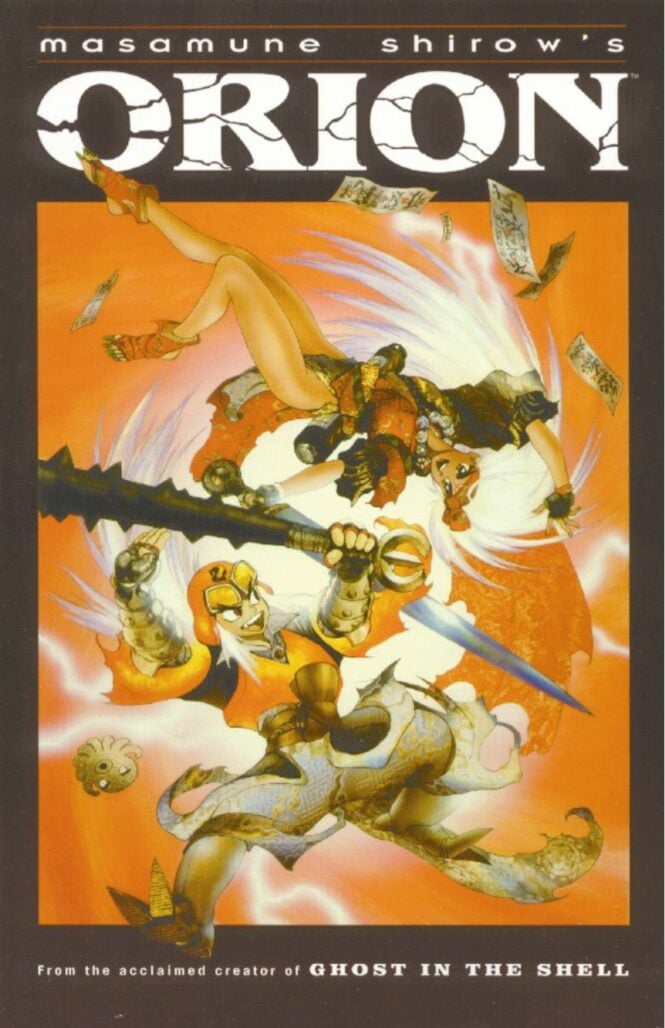
Orion
Writer/Artist: Masamune Shirow
Translation: Frederik L. Schodt and Toren Smith
Letterer: Tom Orzechowski and Molly Kiely
Publisher: Dark Horse
Masamune Shirow is the cyberpunk manga artist. Works such as Appleseed, Dominion Tank Police and Ghost in the Shell defined an aesthetic. Even if his recent work has been overtaken by a slick, oily Photoshop look, his science fiction comics remain required reading for fans of the genre.
His greatest manga, though, isn’t totally a sci-fi book. Orion fuses hard science fiction, fantasy, and eastern religions into a wacky comedy about the possible end of the world. It also features some of his densest and most dynamic art. There is nothing else like it in Shirow’s body of work.
In this series, the sorcerers of the Yamato People’s Empire devise a spell that will swallow and then eliminate the universe’s negative karma. Unfortunately, this spell also threatens to destroy the planet. Two individuals might tip the balance: Susano the God of Darkness, who is ready to destroy the world, and Seska, a bratty sorceress who wants to rule the empire with her new godlike powers.
The world of Orion is governed by complex laws that are more like physics than sorcery. Talismans use magic to accomplish everyday things. On a grander scale, complex equations explain the fundamental forces of the universe while making summoning possible.
Visually, Orion showcases Shirow as a pure action artist. There’s a screwball energy to the book where he wants to see how much destruction that his two protagonists can create. There are goofy character designs, wacky gags and even jokes at the expense of the comic’s complicated world-building once it gets going. This series never takes itself too seriously.
Orion is an outlier in the long career of Masamune Shirow. But what an outlier! While he has yet to return to the fantasy genre, maybe after doing this book, he felt that he didn’t need to. Where else do you go in a genre after blowing it up? — D. Morris
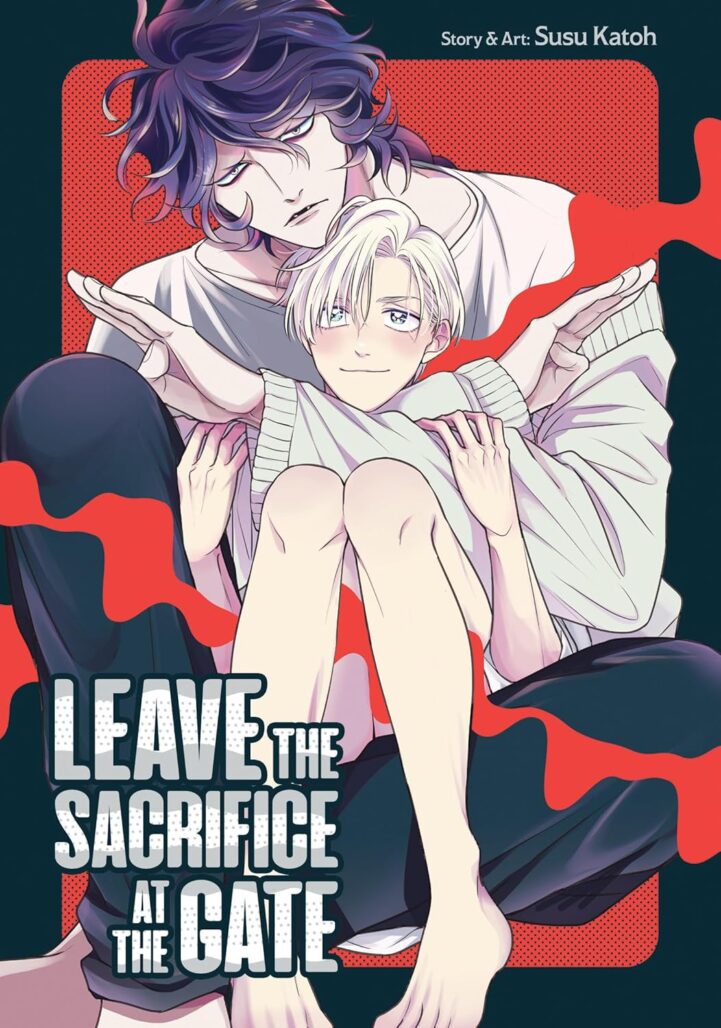
Leave the Sacrifice at the Gate
Writer/Artist: Susu Katoh
Translation: Caroline Winzenried
Adaptation: Cae Hawksmoor
Lettering: Toppy
Publisher: Seven Seas
Uzumaki Nanao has been training all his life to renew his family’s covenant with the god of the shrine. He’s studied diligently, taken care of his health and body, and is in tip-top shape to be eaten by a snake god, if he says so himself. But the snake god, Daija, is not in the least bit interested! Nanao is dead set on presenting himself as the premium meal on a silver platter and getting between those fangs. So why is this dreary giant eating ramen and cola day in, day out?
Susu Katoh‘s Leave the Sacrifice at the Gate is by no means a new release, but a title I just got the chance to read. Its continuation is currently on hiatus, and it’s the only work available in English from the creator to my knowledge. I have to wonder why!
Katoh’s art is immaculate. The characters’ expressions are whimsical or emotive when needed, and their super-deformed versions are adorable. Leave the Sacrifice at the Gate mixes fantasy with the mundane, but does so in a relaxed way. There is no grand lore behind the gods or the Uzumaki family, or pages and pages of rules and customs to read. Just a snake god who’s also a shut-in nerd, a charming high school student operating on a single brain cell, cute snakes, and good vibes.
My only gripe with this volume was that Katoh seemingly had so many plot beats they wanted to include. As a result, we have a high-paced story with not much depth except for maybe the romance between Daija and Nanao. Still, the book made me laugh, and I had a lot of fun reading it, so I consider myself satisfied. It was also interesting to read Katoh’s take on human-snake-hybrid / human sex! Safe to say, notes were taken.
I recommend Leave the Sacrifice at the Gate for readers who are looking for an all-in-one cozy, fun and steamy read. Also, if you ever feel like spacing out to something, Katoh recommends doing so while watching a video of a snake shedding its skin! — Merve Giray
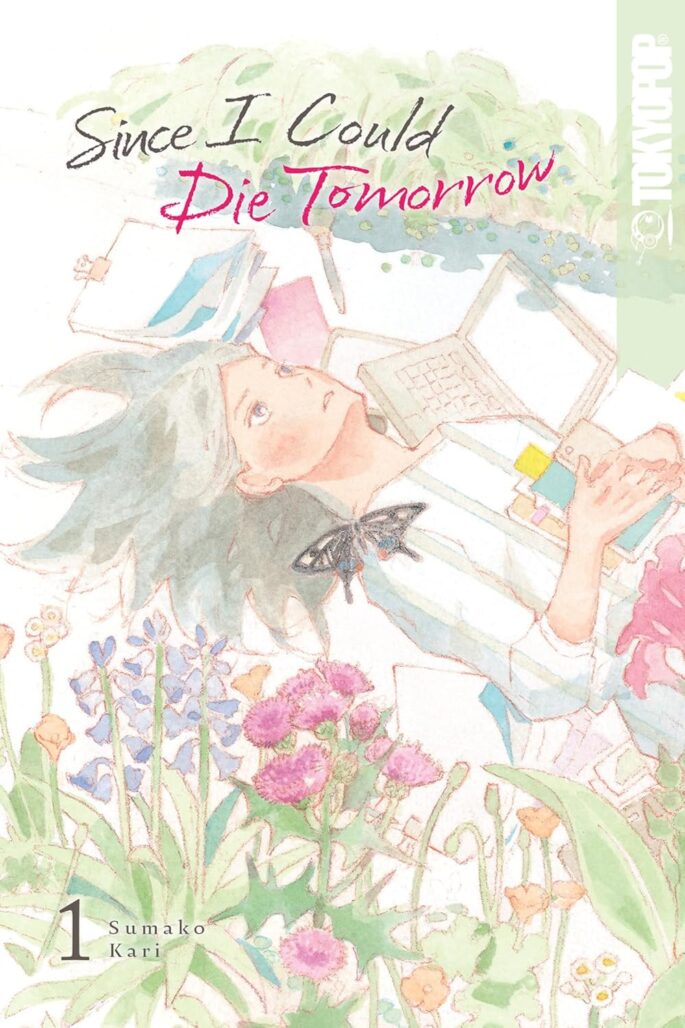
Since I Could Die Tomorrow
Writer/Artist: Sumako Kari
Translation: David Bove
Copy Editor and Editorial Associate: Becca Grace
Retouching and Lettering: Vibrraant Publishing Studio
Cover Designer: H. Qi
Editor: Lena Atanassova
Publisher: Tokyopop
Sawako Honna is a hard-working employee at a film promotion company. She loves movies and her job, even though she’s left picking up the slack for her more useless coworkers. But when she starts to go through menopause, she realizes that her 40s will be different from her 20s and 30s. What to do with her life now that her back is stiff and late-night heart palpitations have her fearing death? That’s the question at the heart of Sumako Kari’s four volume series Since I Could Die Tomorrow.
Honna’s story expands to include her frustrated adult peers. One of her former classmates, Toko Nozaki, is starting a part-time job at a fast food restaurant to pay the bills, yet is nervous about being judged by customers and her young coworkers. Another, Sara Narukami, is living at home with her mom after an office romance and suicide attempt derailed her career. Kari does a great job depicting these characters and their struggles without softening them. They come off as three-dimensional, contradictory people rather than an object lesson meant to teach the audience about what it’s like to grow older.
In fact, one of the most interesting characters isn’t a 40 year old woman at all! Honna’s friend Tomoyuki Arioka is a man who was recently diagnosed with cancer. The series keeps teasing a relationship between him and Honna and yet every romantic scenario is hilariously derailed by his thoughtfulness. At the same time, Arioka reminds us of Kari’s core theme: if you knew you only had so much time to live, what would you do, and how would you do it? Since I just lost a relative of mine this weekend to terminal illness, I was hit particularly hard by Arioka’s story in particular. (Not to mention Narukami’s pachinko addiction…)
Since I Could Die Tomorrow can be a tough read at times, and not just because of its subject matter. Kari jams every page with panels and dialogue. She also has a tendency to switch perspective characters without warning as well as jumping backwards and forwards in time. Everything comes together eventually, but it’s not necessarily a smooth reading experience. Even so, I’m impressed by Kari’s skills at characterization, as well as her eye for real life moments that rarely come up in manga. — Adam Wescott
Follow Beat’s Bizarre Adventure to get weekly manga and webtoon recommendations!
 English (US)