
Published Oct 31, 2026, 11:01 AM EDT
“Austin’s body is responding to real action in real time.”
 Image: 20th Century Studios
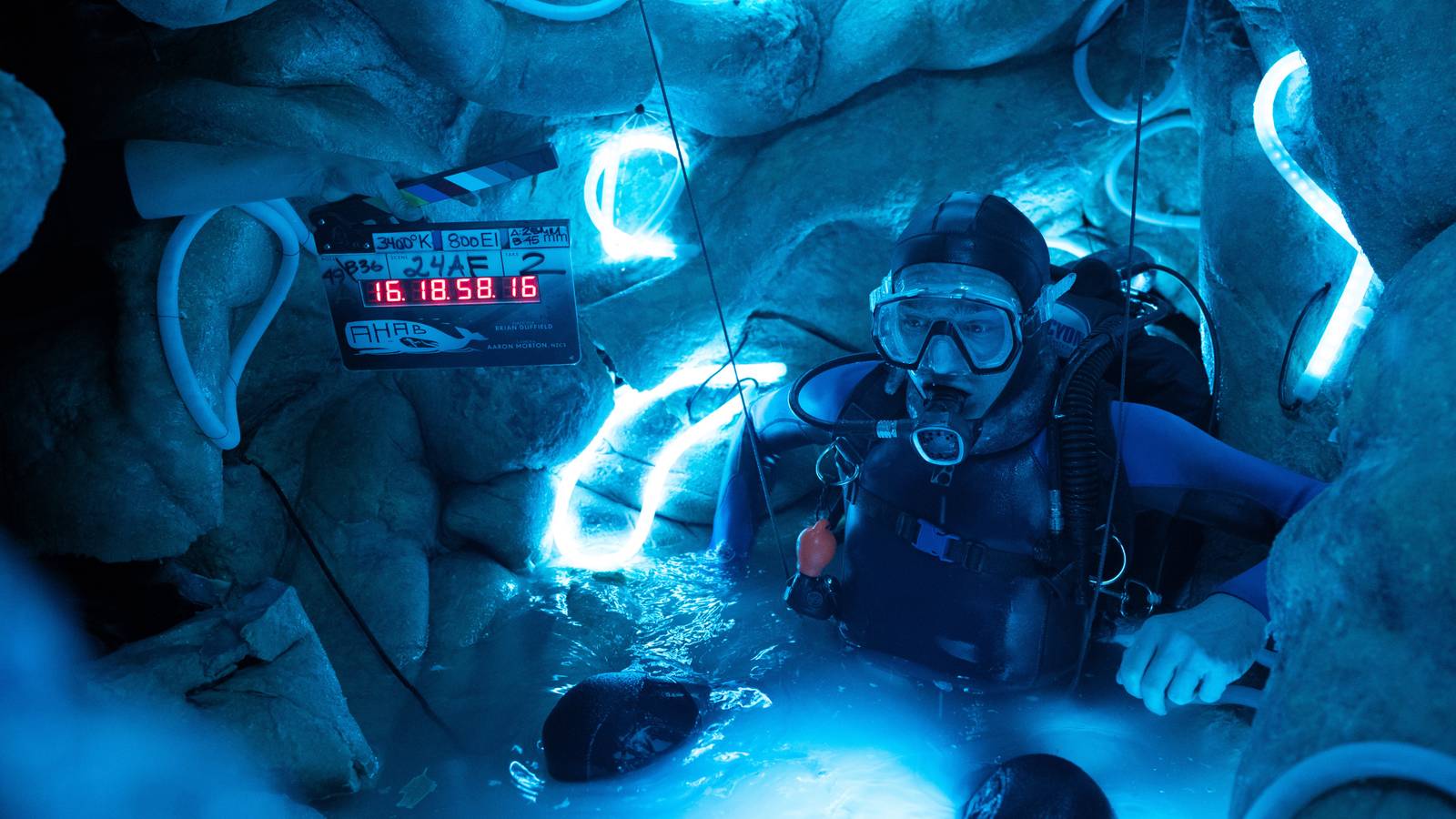
In Brian Duffield’s adaptation of Daniel Kraus’ survival thriller Whalefall, Jay Gardiner (Austin Abrams) is swallowed by a sperm whale while scuba diving and has to desperately fight to escape its gullet. It’s a wild concept, but Kraus and production designer Ramsey Avery sell it by making Jay’s plight as realistic as possible. That involved building a 35-foot-long whale head and four different stomach sets that could be jostled, climbed, and filled with goop simulating digestive juices.
“It was super important that Austin felt like he was in these environments and his body had to respond to them,” Avery told Polygon in a virtual interview. “All that motion on camera is motion that we’re making. It’s not animated. That means Austin’s body is responding to real action in real time.”
One set was built on a rig to create a rocking motion, while another was part of a cylinder akin to a washing machine so Austin could be tossed around. Another was constructed on a seesaw so it could be tipped to soak Abrams in methylcellulose, an organic slime that simulated the whale’s stomach acid. Puppets were used for the giant squid that grapples Jay, pulling him into the whale’s mouth.
“Some of the tentacles had wires in them, and a couple of them actually had a rig inside that could make it squirm, which was creepy as all get out,” Avery said. “They could actually wrap around his neck or head, so that could be on camera, and then visual effects supervisor Guillaume Rocheron would come in and make the movement like a squid tentacle.”
 Image: 20th Century Studios
The whale’s throat was porous and made with antibacterial foam to keep it from getting moldy. Giant kiddie pools were set up to keep the stage from flooding.
“Any time you introduce the idea of water on a set, the producers give you the hairy eyeball,” Avery said. “Water is just like the hardest thing to manipulate. It's even harder than snow. Water goes wherever water wants to go. You cannot really truly control water.”
Scientists helped bring the sea creatures to life
 Image: 20th Century Studios
Filming was a claustrophobic affair. Abrams, two cameras, a sound boom, and the puppeteer operating the tentacles all had to be in a six-by-eight-foot space. Rocheron added extra tentacles with VFX because not everything could physically fit in the space, which was based around scientific measurements of an 80-foot sperm whale.
“The only way we know this is that they beach themselves when they're sick or they're ailing, or they've been hit by a ship,” Avery said. “We knew how big a stomach was based on the length of a whale. We did multiple scale tests of the squid to see which was the right size that worked best in the stomach with a guy who was the size of Austin.”
While he was building the set in New Zealand, Avery consulted with Dr. Joy Reidenberg, a comparative anatomy research scientist and Society for Marine Mammalogy fellow. They would meet for 6 a.m. Zoom calls, where Reidenberg would take Avery step by step through the whale dissections she’d performed and explain how their bodies worked. She guided Avery and his team through the construction of a six-foot-long whale tongue and the teeth that Jay climbs to try to escape.
 Image: 20th Century Studios
Avery also consulted with marine biologist Dr. Steve Haddock, who specializes in bioluminescence, to design the glowing jellyfish Jay uses to light his way. Haddock suggested three species that would provide the right amount of illumination, and Avery’s team picked one that would fit neatly in Jay’s hand. The actual prop was made of silicone with a programmable LED inside that could flicker as Jay desperately tried to keep the creature alive.
“We didn't storyboard a lot of the movie because it was such a living entity, constantly changing shape,” Avery said. “Brian and Aaron Morton, the [director of photography], would get into the set or a mock-up of the set and just start taking pictures of how they wanted the sequence, and that became our storyboards.”
The first thing that Abrams did to prepare for the role was learn how to scuba dive and take a trip to the Caribbean to swim with a sperm whale. While a stunt double stood in for some scenes, Abrams handled most of the diving himself. He swam through the kelp forests around Catalina Island in California and scaled an underwater cliff built within a tank that was 60 feet wide and 25 feet tall.
The entire process of building the sets and making the movie took nine months, and Avery said he often lost sleep dealing with challenges like how to keep paint from coming off props soaking in chlorinated water (they dyed moss) and how to find enough room to shoot Abrams tumbling around in a tank (they used a hydraulic lift to make his movement look faster than it actually was).
“It was super challenging, but the movie kind of lived or died based on whether the whale stomach really worked,” Avery said. “That’s silly, because Austin’s performance is what actually makes the movie work. But Austin needed that environment to be able to act in. You’re leading a team from the art department, and you have to do it with a sense of fun and a sense of respect.”