
.jpg) 15 hours ago
3
15 hours ago
3
Article content
(Bloomberg) — Asian oil refiners are staring down deep losses after the Middle East war caused the benchmark Dubai price to soar, upending their hedging positions, according to traders.

THIS CONTENT IS RESERVED FOR SUBSCRIBERS ONLY
Subscribe now to read the latest news in your city and across Canada.
- Exclusive articles from Barbara Shecter, Joe O'Connor, Gabriel Friedman, and others.
- Daily content from Financial Times, the world's leading global business publication.
- Unlimited online access to read articles from Financial Post, National Post and 15 news sites across Canada with one account.
- National Post ePaper, an electronic replica of the print edition to view on any device, share and comment on.
- Daily puzzles, including the New York Times Crossword.
SUBSCRIBE TO UNLOCK MORE ARTICLES
Subscribe now to read the latest news in your city and across Canada.
- Exclusive articles from Barbara Shecter, Joe O'Connor, Gabriel Friedman and others.
- Daily content from Financial Times, the world's leading global business publication.
- Unlimited online access to read articles from Financial Post, National Post and 15 news sites across Canada with one account.
- National Post ePaper, an electronic replica of the print edition to view on any device, share and comment on.
- Daily puzzles, including the New York Times Crossword.
REGISTER / SIGN IN TO UNLOCK MORE ARTICLES
Create an account or sign in to continue with your reading experience.
- Access articles from across Canada with one account.
- Share your thoughts and join the conversation in the comments.
- Enjoy additional articles per month.
- Get email updates from your favourite authors.
THIS ARTICLE IS FREE TO READ REGISTER TO UNLOCK.
Create an account or sign in to continue with your reading experience.
- Access articles from across Canada with one account
- Share your thoughts and join the conversation in the comments
- Enjoy additional articles per month
- Get email updates from your favourite authors
Sign In or Create an Account
or
Article content
The loss of Persian Gulf supply has spurred sharp rallies in the region’s oil grades that feed into the Dubai benchmark, which derivatives are priced off. Refiners typically take short positions — wagers that profit if prices fall — on related derivatives in the months prior to buying crude, as part of typical feedstock cost management, said the traders, asking not to be named as they’re not authorized to speak to the media.
Article content
Article content
Article content
Hedging structures “work as long as crude cargoes arrive, runs are maintained, product availability is certain, and is sold into the market,” said Sumit Ritolia, lead research analyst for refining and modeling at analytics firm Kpler Ltd. “However, the current disruption is breaking that linkage. A strategy designed to reduce risk is turning into a source of financial pressure.”
Article content
By signing up you consent to receive the above newsletter from Postmedia Network Inc.
Article content
Chinese and Japanese refiners are likely among those worst hit, given their heavy reliance on Middle Eastern crude supply, now in jeopardy as the war rages on. Some processors could be facing losses in the hundreds of millions of dollars, the traders said.
Article content
Many Middle East oil cargoes have been effectively lost, given the near-total halt on oil tanker traffic through the Strait of Hormuz since the war started at the end of February.
Article content
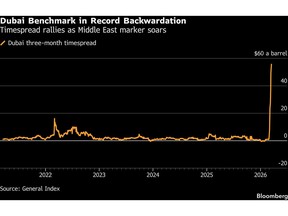
There’s been an unprecedented surge in the three-month spread for over-the-counter Dubai swaps contracts. They’re now around $55 a barrel in a bullish backwardation pattern, more than three times higher than the previous peak in 2022, according to General Index data. The gauge was around $1 in backwardation before the war, and was in the opposite contango structure as recently as January.
Article content
Article content
The refiners likely placed their hedges based on levels in January and February, the traders said.
Article content
“With delayed or non-materializing crude cargoes, refiners are left holding short-paper positions without the corresponding physical barrels,” Ritolia said. “This creates a mismatch where hedges remain active, but the underlying exposure they were meant to offset is absent.”
Article content
Part of the reason for the elevated Dubai benchmark price was the removal of some Middle Eastern crudes, which need to transit the Strait of Hormuz. That’s prevented a portion of the supply from the Persian Gulf from being used to price the regional benchmark in a trading window run by S&P Global Energy. That has made the benchmark more vulnerable to outsized moves caused by any single player, the traders said.
Article content
“Platts Dubai continues to reflect the value of Middle Eastern sour crude trading in the spot market, informed by robust activity in the Platts Market on Close assessment process,” S&P Global Energy said in a statement. “While the underlying deliverable crude grades have evolved in line with market conditions in recent weeks, Platts has adapted the benchmark and continues to actively engage with market participants on its Dubai crude methodology.”
Article content
Even if the war was to end quickly, and Hormuz was to reopen, it would still take the physical crude supply chain about six to eight weeks to get back to normal, according to Kpler’s Ritolia. “Meaningful supply adjustments would likely only appear from late April or May onwards.”
Article content
 English (US)