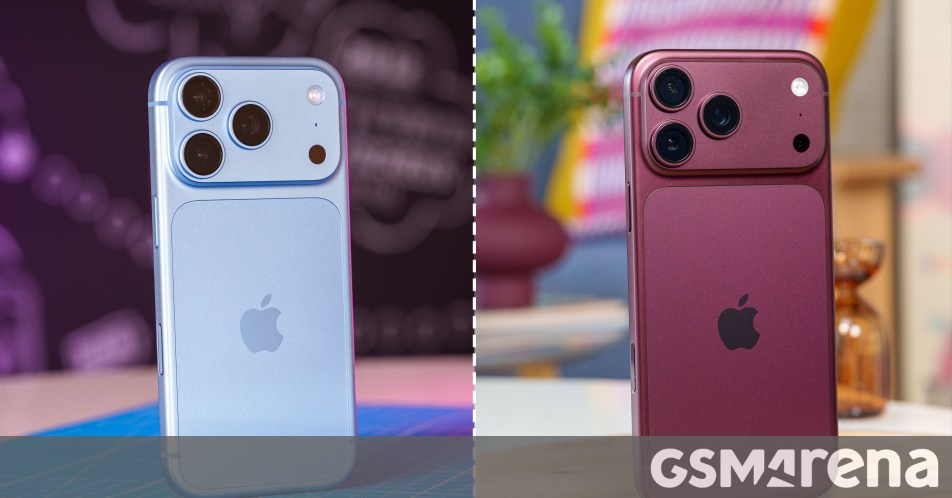
It's time for an upgrade, and you are eyeing the new iPhone 18 Pro series. But which one to get? The smaller iPhone 18 Pro or the larger iPhone 18 Pro Max? Sometimes it's not just about screen size; it's also about features and performance. The Pro Max has historically been better at endurance and has offered one or two exclusive features.
So what else is the 18 Pro Max's price premium buying you except a larger screen size? Let's dive in and find out.
Table of Contents:
For starters, you can compare the complete specs sheets or directly continue with our editor's assessment in the following text.
Size comparison
When it comes to size, things are pretty straightforward. Get the much lighter and more manageable iPhone 18 Pro if you are into more compact phones, or get the 18 Pro Max if you enjoy the big-screen experience.
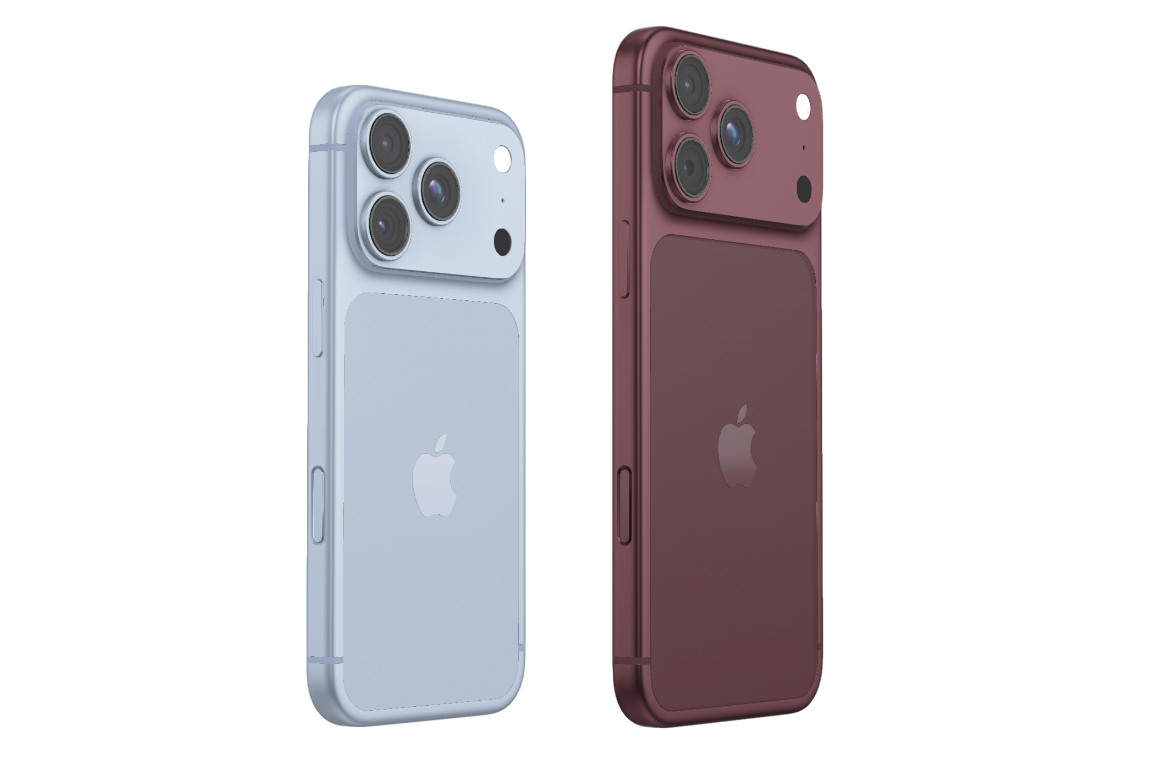
There's essentially no difference in the build quality or ingress protection between the two devices. There's not even a color difference, as both devices are offered in Black, Silver, Glacier and Burgundy.
Display comparison
There's no difference in the display properties and features either. The only thing that sets them apart is size. Size should be your only determining factor in this case.
Battery life
The iPhone 18 Pro Max has a significantly bigger battery than the regular 18 Pro, so it's no surprise it achieves higher results in our battery tests. We tested the versions with physical SIM card slots and smaller batteries (5,391 mAh vs. 4,056 mAh), but the capacity gap is about the same with the eSIM-only variants (5,567 mAh vs. 4,288 mAh).
Anyway, the 18 Pro Max beat the 18 Pro in every battery test scenario, but we saw the biggest improvements in the web browsing and 4G call scenarios.
Charging speed
The iPhone 18 Pro Max charging this year is not just faster than its predecessor's; it's actually fairly competitive now. It's also a tad faster than the iPhone 18 Pro at the 15 and 30-minute marks, but slows down toward the end of the charging cycle. Still, it beat the regular Pro by 7 minutes, which, granted, isn't something to write home about, but it's still technically faster.
However, the 12 and 13 percentage point difference in the first 15 and 30 minutes of the charging cycle is arguably more important when you are in a hurry. Being able to top up faster in the first 30 minutes of the charging cycle is arguably what counts the most.
Speaker test
The two iPhones offer roughly the same sound tuning, but since the Pro Max has larger echo chambers, music tracks sound a tad more desirable and are considerably louder, too. The bass is slightly more prominent, so music sounds fuller and warmer.
Performance
Both devices run on the same Apple A20 Pro chipset based on the 2nm manufacturing node, offering a substantial improvement in performance and efficiency over the previous generation. As expected, there are no major differences in how the two devices perform not only in day-to-day tasks, but also in synthetic benchmarks.
Both devices ship with 12GB of RAM and 256GB of internal storage by default and go up to 2TB of storage.
Benchmark performance
Unsurprisingly, the iPhone 18 Pro and 18 Pro Max show near-identical performance across the board. There are some slight deviations, but they seem to be well within the normal margin of error.
The Pro Max does have one advantage, albeit small. Our stress tests show modestly better sustained performance over the smaller Pro. It's probably down to the much bigger vapor chamber that Apple was able to fit inside the Pro Max.
Camera comparison
Gone are the days when the two sizes of Pro iPhone had different camera setups and the 18 Pro and 18 Pro Max feature identical imaging hardware. Both 2026 models come with a new variable aperture lens on the main camera (in front of a 48MP 1/1.3" sensor) and not a lot more in terms of changes compared to the previous generation.
The telephoto camera on each of them has a 100mm equivalent lens providing 4x optical zoom. The 13mm ultrawide, meanwhile, provides pretty extreme coverage autofocus. The sensors on these cameras have a 1/2.55" optical format and 48MP nominal resolution.
Also unchanged is the selfie camera, with an 18MP sensor that lets you shoot in both portrait and landscape orientation regardless of what orientation the phone is physically in.
Image quality
Daylight
The same hardware produces the same images on both phones, with shot-to-shot variation being more likely than finding an actual pattern of difference between the two models.
You'll get fairly typical iPhone output with conservative but not dull colors, great dynamic range, and very good detail in the default 24MP resolution at 1x zoom.
At 2x zoom the main camera still delivers very good results, albeit at 12MP only.




Daylight comparison, main camera (1x): iPhone 18 Pro • iPhone 18 Pro Max




Daylight comparison, main camera (2x): iPhone 18 Pro • iPhone 18 Pro Max
The 4x telephoto cameras capture good shots, but it's hardly exciting stuff if you compare them to proper top-tier cameraphones in the Android world.
If you are comparing quality between the two sizes, however, it's all the same, whether you're shooting at the native 4x or twice that.




Daylight comparison, telephoto camera (4x): iPhone 18 Pro • iPhone 18 Pro Max




Daylight comparison, telephoto camera (8x): iPhone 18 Pro • iPhone 18 Pro Max
Similarly, the ultrawides will get you identical results whether you go Pro or Pro Max. We could theorize that on the smaller size model you might be able to maneuver around nearby subjects more easily, but that's just grasping at straws - there's hardly anything to separate the two phones.




Daylight comparison, ultrawide camera (0.5x): iPhone 18 Pro • iPhone 18 Pro Max
Low light
That parity naturally continues into the dark, with both phones capturing the same low-light photos. The vast majority of scenes won't get much Night mode action and will come out in 24MP at 1x zoom like the daytime ones. Slightly grainy, but detailed shots with good dynamic range and accurate colors from both models.
The 12MP 2x photos, meanwhile, are some of the best you can get from a wide main camera in these conditions (Androids included).




Low-light comparison, main camera (1x): iPhone 18 Pro • iPhone 18 Pro Max




Low-light comparison, main camera (2x): iPhone 18 Pro • iPhone 18 Pro Max
The telephoto images are good for the most part, though some more aggressive low-light processing probably wouldn't hurt, or you could try deliberately shooting in 12MP - the default 24MP results can be too soft. We're not particular fans of the 8x results, but you can't get any better on an iPhone, and it's the same on the Pro and Pro Max anyway.




Low-light comparison, telephoto camera (4x): iPhone 18 Pro • iPhone 18 Pro Max




Low-light comparison, telephoto camera (8x): iPhone 18 Pro • iPhone 18 Pro Max
Similarly, both the iPhone 18 Pro and 18 Pro Max will capture the same ultrawide photos - with largely underwhelming quality.




Low-light comparison, ultrawide camera (0.5x): iPhone 18 Pro • iPhone 18 Pro Max
Selfies
The selfies are yet another area where you can expect the same exact photos from both phones. Perhaps here too we could speculate that the smaller phone would be easier to hold with one hand and just maybe be easier to shoot, particularly in the dark, but it's not like we've been dropping Pro Maxes left and right when gathering review samples.




Selfies comparison: iPhone 18 Pro • iPhone 18 Pro Max
Video quality
Below we have a few frame grabs from the videos taken by the two phones at each focal length, so it's easier to compare them to one another.
The iPhone 18 Pros offer wide-ranging video recording capabilities. They can capture video in up to 4K at 60, 30, or 24fps with all of their cameras (the three rear ones and the front-facing one), and the primary cameras on the back can also do 4K120 at both 1x and 2x zoom.
You get Dolby Vision recording capability in all modes too, plus ProRes and Apple Log 2 options, though you will need to record to external storage for some of the higher fps modes to be able to work.
The latest-gen's Cinematic mode now maxes at 4K60, up from the 4K30 on the 17 Pros, and you get some manual controls (shutter speed, white balance, aperture), but these are again the same across both sizes.
Video quality is of course the same between the two phones, with well-matched output from all three cameras, great global properties and very good detail.



Daylight video screengrabs, iPhone 18 Pro: 0.5x • 1x • 4x



Daylight video screengrabs, iPhone 18 Pro Max: 0.5x • 1x • 4x
In the dark, this generation also suffers from the usual visible internal reflections from bright lights shining into the main and telephoto cameras, with the ultrawides not affected by it. Main camera clips are very good, and so are the ones from the telephoto cameras, but the ultrawides are just barely okay.



Low-light video screengrabs, iPhone 18 Pro: 0.5x • 1x • 4x



Low-light video screengrabs, iPhone 18 Pro Max: 0.5x • 1x • 4x
Verdict
If you are here reading this piece, size probably isn't your only deciding factor. If it were, you would have already probably gotten the 18 Pro for the compact dimensions or the 18 Pro Max for the bigger screen.
Size aside, the iPhone 18 Pro Max has a few clear advantages over the 18 Pro - longer battery life, faster charging, and louder, better-sounding speakers. These aren't insignificant differences, though whether they justify the price premium depends on your priorities. That premium is €150 in Europe and a more modest $100 in the US. The smaller iPhone 18 Pro, meanwhile, delivers essentially the same flagship experience, with identical camera hardware, chipset and display quality, all while being easier to handle and cheaper to buy.
Ultimately, the choice comes down to the size of your pockets - both literally and figuratively.
- The smaller dimensions and lightweight design.
- The lower price.
- The similar user experience.
Get the Apple iPhone 18 Pro for:

- The longer battery life.
- The faster charging.
- The louder and a tad nicer speakers.
- The bigger screen.