
.jpg) 1 hour ago
2
1 hour ago
2
A few glasses of alcohol are enough to start fragmenting the way the brain works, leading to more localized information processing and reduced brain-wide communication, a new study has discovered.
While plenty of previous research has looked at the ways booze changes the brain, little of it has considered the network-wide effects. The brain is, of course, a delicately balanced and incredibly intricate organ, and any shifts in chatter between brain regions are going to have impacts on emotions and behavior.
The researchers behind the study, led by a team from the University of Minnesota, believe that their findings could go some way to explaining why different people can feel different levels of drunkenness at the same breath-alcohol level.
"At the network level, alcohol significantly increased local efficiency and clustering coefficient, consistent with a less random and more grid-like topology," write the researchers in their published paper.
"Notably, these increases, as well as corresponding decreases in global efficiency, significantly predicted greater subjective intoxication."
The researchers recruited the help of 107 healthy participants, aged between 21 and 45. Across two sessions, they were either given a drink designed to raise their blood-alcohol level to the US limit for driving (0.08 grams per deciliter), or a placebo drink.
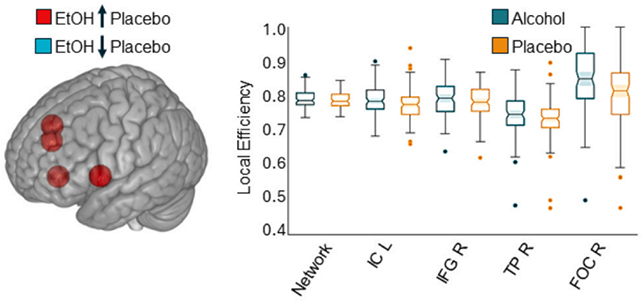 Local connectivity in brain regions was boosted by alcohol intake. (Biessenberger et al., Drug Alcohol Depend., 2026)
Half an hour after imbibing, the participants went into an MRI scanner, where their brain activity was mapped. Using a variety of mathematical approaches, the researchers calculated communications between 106 different brain regions.
Overall, brain areas became more insular and less well connected to the rest of the brain, though the effect wasn't consistent over every region. It's a similar idea to traffic circling around one particular neighborhood rather than traveling city-wide.
Although the volunteers were all about as drunk as each other, some felt more intoxicated than others. The researchers found that this feeling of drunkenness was related to how disconnected their brain regions had become.
What's more, the network changes seen here – the breakdown between different brain regions – go some way to explaining how too much booze can start to cause blurred vision, difficulty walking in a straight line, and other well-known effects.
One of the regions most affected by the decreased global connectivity, for example, was the occipital lobe. It's here that the brain processes visual data fed in by our eyes, and these changes likely mean this data is less readily available to the rest of the brain.

"Our results that information transfer becomes more isolated and less integrated are consistent with alcohol's known influence on reward/aversion, inhibitory control, and stimulus valence," write the researchers.
However, this wasn't something the team tested directly; rather, the study infers it based on the computational models applied to the brain scans.
It's also worth noting that these findings only apply to brains at rest, not involved in any kind of activity, and it would also be interesting to see these impacts over longer periods.
The researchers also suggest, based on previous studies, that people with acute and chronic alcohol problems might see different changes in their brain maps when they get drunk: less of a fixed grid-like layout, less local clustering, and a more randomized and disorganized network overall.
There's lots more here for future studies to dig into as well. The researchers say future work should include broader groups of participants and look more directly at the effects of brain network disruption on people who are less physically and mentally healthy than the participants in this study.
Related: Wild Chimps Consume The Equivalent of a Beer a Day, Study Finds
"Given rapid changes in population demographics and increasing rates of drinking among older adults, studies of the functional neural correlates of acute alcohol use across the lifespan, in populations with heavier drinking patterns, and a broader range of negative affective symptomatology are needed," write the researchers.
The research has been published in Drug and Alcohol Dependence.
 English (US)