
 1 hour ago
3
1 hour ago
3

The Planned Parenthood clinic in Pullman, Washington. Abortion pills will be offered in advance for future use at Planned Parenthood clinics in Washington state and Hawaii. Don and Melinda Crawford/Universal Images Group via Getty Images hide caption
toggle caption
Don and Melinda Crawford/Universal Images Group via Getty Images
When abortion restrictions are in the news, as they have been for several weeks, research shows that many Americans take that as a signal to stock up on abortion medications even if they're not pregnant.
Now, for the first time, a Planned Parenthood affiliate is offering what's called the "advance provision" of abortion medication. The initiative, shared exclusively with NPR, launched Thursday and is called "Just In Case Abortion Pills." It means people can have the abortion pills mifepristone and misoprostol on their shelf to be used in the future if they want to end an early pregnancy.


"As evidence supporting this model of care has continued to grow, and with supportive policy environments in Washington and in Hawai'i, this really is the right time for us to step into this space," says Rebecca Gibron, president and CEO of Planned Parenthood Great Northwest, Hawai'i, Alaska, Indiana and Kentucky.
A range of telehealth organizations have offered prescriptions of abortion medication in advance for the past several years. Elisa Wells, co-founder of the website about medication abortion called Plan C, says this move by a Planned Parenthood affiliate is significant.
"The idea that you can get abortion pills by mail or that you can get them in advance is really new to a lot of people," she says. "So having a group like Planned Parenthood that does have such trust and name recognition adding those services is really important." She points out that the geography of both Hawaii and Washington make it so that getting care quickly can be a challenge, and since days and hours matter during pregnancy, stocking up in advance might be especially important.
She adds that the safety record of the two medications usually used together for abortion is well established, and that it's legal for patients to have abortion medication on hand in 49 states (Louisiana is the exception; the state made the medications controlled substances in 2024.)
Most of the other places that offer abortion pills in advance are exclusively telehealth, but Planned Parenthood patients will also be able to get the medication in person at one of their 16 health centers in the two states.
"Not only are we available to you today to get you that medication to have it on hand, but also at whatever point during the process you need us," says Dr. Colleen McNicholas, chief of medical affairs at the same Planned Parenthood where Gibron works. If a patient gets the pills and then goes to use them 11 months later, "we are still available to them as their provider to answer those questions, to review — how do I know how far along I am? What do we expect?" she says.
Same day abortion
News about abortion restrictions prompted Whit to get abortion pills in advance four years ago. "It kind of all started like back when the draft of the Roe decision was leaked in May of '22," she says. "I was actually living abroad at the time, so I was glued to my phone, like, 'Oh my God, what's happening in the States?'"
Whit asked NPR to use her first name only to discuss a sensitive medical decision that she hasn't shared with everyone in her family. She's now 29 and lives in the Chicago area. Back in 2022, following the reproductive rights news, she learned she could order abortion medications without being pregnant, just to have on hand.
"I was like, 'Oh, that's really interesting. I didn't know I could do that,'" she says. She used an international organization called AidAccess. "I filled out a form online, answered questions and said these are for advanced use."
She moved back to the U.S, got into a serious relationship. She says she thought often about the pills in her closet. Then, about a year later, she ended up using them.
"I think it was like four days after a missed period or something — right away I was able to find out [I was pregnant] and then I took them that day," she says. "It was literally like a period, and I'm just like, 'Wow, everybody should be able to have that experience.' It doesn't have to be this big, treacherous thing."
She has since reordered and so has more abortion medication in her closet in case she needs it again. The medication has a shelf life of about two years, depending on the brand, and the expiration date is printed on the packaging.
Critics call it "stockpiling"
For anti-abortion rights advocates, this practice is alarming. "American women are stockpiling the abortion pills through advanced prescribing from abortion companies and providers," Republican Senator Cindy Hyde-Smith of Mississippi, who chairs the Senate Pro-Life Caucus, said in a 2024 hearing with then-Food and Drug Administration Commissioner Robert Califf.
"My husband has a doctor's appointment Friday morning for a sinus medication that he can't get refilled until he sees a doctor," she said. "It blows me away that you can get this with no doctor oversight, and it is a drug that will literally cause you intentionally to have an abortion and end your pregnancy and the life of that child."
Califf replied that doctors have discretion when it comes to prescribing medications. "We don't advocate stockpiling as a method, but we don't regulate the practice of medicine," he told Hyde-Smith.
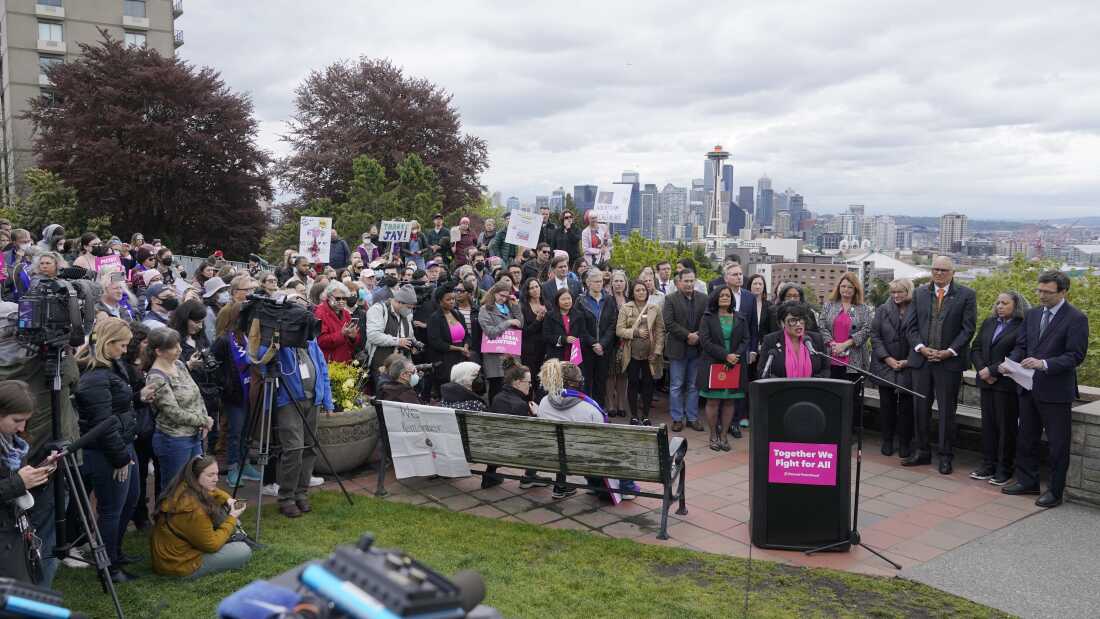
Jennifer Martinez, board president of Planned Parenthood Alliance Advocates, speaks at a rally in May 2022 in a park overlooking Seattle. The officials gathered asserted that Washington state would keep access to abortion legal. Ted S. Warren/AP hide caption
toggle caption
Ted S. Warren/AP
Trump's FDA has done very little to restrict use of abortion medication thus far, to the frustration of his anti-abortion supporters. The Republican-led Congress did succeed in cutting Planned Parenthood off from Medicaid funding for one year, but that funding will be reinstated in July unless Congress passes a new law. The Department of Health and Human Services did not respond to NPR's request for comment on the advance provision of abortion medication.
"These medicines are available over the counter in other countries, and so they're very safe, they're very effective, and they can be self-managed," says Anna Fiastro, research scientist at the University of Washington School of Medicine. "The [World Health Organization] has guidance for self-managed use of these medicines through the first trimester. So having them really accessible and in people's medicine cabinets is a very safe, effective option."
How widespread
Fiastro says it's extremely hard to measure how many patients have these medications in their cabinets, but the idea seems to be catching on, especially among residents in states with abortion bans.
"It makes a lot of sense and is really interesting to people," she says, citing her own research. "It allows people to end an undesired pregnancy and move forward without having to even wait for the pills in the mail to come, or taking on really costly and time consuming travel."
In her research, patients cite cost as a barrier, since they're not using insurance to offset the price. For patients in Washington and Hawaii who go to Planned Parenthood, the cost will be $100 if they're adding it onto another appointment like a well-visit or an STI test, and $150 for a standalone appointment, although financial programs are available for patients who can't afford that cost.
The cost is not deterring many people worried by legal challenges to mifepristone, most recently the case brought by Louisiana against the FDA over the rules that allow the medication to be prescribed remotely and sent through the mail. Right now, the Supreme Court has put any immediate change to access on hold while the case plays out in the lower courts, but it's far from resolved. There are also other legal challenges to mifepristone access.
Elisa Wells of Plan C says news about the Louisiana case has caused an uptick in traffic on their website, and providers tell her there's been an uptick in requests for advance provision, which she says makes sense. "We don't know what the outcome will be, so it might make sense to get pills now in case there is a bad decision in that court case that limits access to mifepristone by mail," she says.
She predicts the use of advance provision will spread, even as the legal threats against abortion medication continue. "Abortion pills are everywhere, they're safe, they're effective, and they're pretty much unstoppable," she says. "The genie is out of the bottle."
 English (US)