
.jpg) 1 hour ago
3
1 hour ago
3
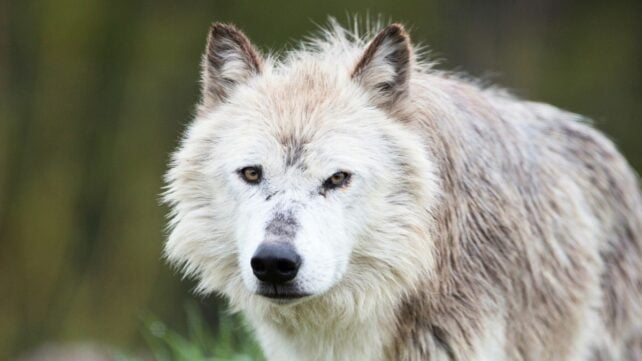 Still a very good boy. (Michael Russell/Moment/Getty Images)
Biology teachers around the world commonly introduce their students to the concept of 'trophic cascades' with an example from Yellowstone National Park in the United States.
It starts with the removal of wolves, and ends with the collapse of a forest.
Returning wolves to the ecosystem has been hailed as a remarkable success in bringing the forest back.
But a team of biologists and geographers say that claim may have been overstated.
Let's start from the beginning.
In the 1920s, gray wolves (Canis lupus) were eradicated from Yellowstone National Park as a result of hunting programs run by the government.
Among the wolves' prey are wild elk (Cervus canadensis), herbivores that gnaw at aspen and cottonwood saplings, and trample exposed soils with their hooves.
When natural predators such as wolves kept the elk numbers down, damage from their chewing and trotting was limited. But in the absence of predators, their population swelled, and their taste for saplings led to overgrazing.
The skyline of quaking aspen trees (Populus tremuloides) that once defined Yellowstone began to fall, as the mature trees reached the natural end of their lives. But with no new mature trees to take their place, the landscape was dramatically changed.
Species that rely on mature aspen, like beavers and cavity-nesting birds, were left stranded. Without wolves, the ecosystem was falling apart.
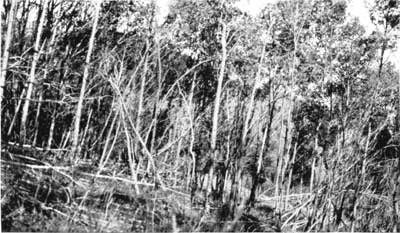 A photo taken in 1933 shows Yellowstone aspen groves stripped of bark and leaves by elk. (National Park Service, 1935)
After decades of campaigning, a population of grey wolves from Jasper National Park in Canada was introduced to the park in 1995, in the hope their numbers would restore the forest to its former glory.
In July 2025, a team of scientists led by Oregon State University ecologist Luke Painter announced that the reintroduction of grey wolves had triggered a surprisingly strong trophic cascade compared to similar scenarios in other ecosystems.
This revolved around fieldwork measuring stands of aspen trees and their height, with the assumption that trees taller than a certain height are somewhat in the clear from trampling herbivores when it comes to long-term survival.
Now, a separate team of scientists led by wildlife ecologist Daniel MacNulty from Utah State University has called that research into question, publishing their rebuttal in the same journal as Painter and team: Forest Ecology and Management.
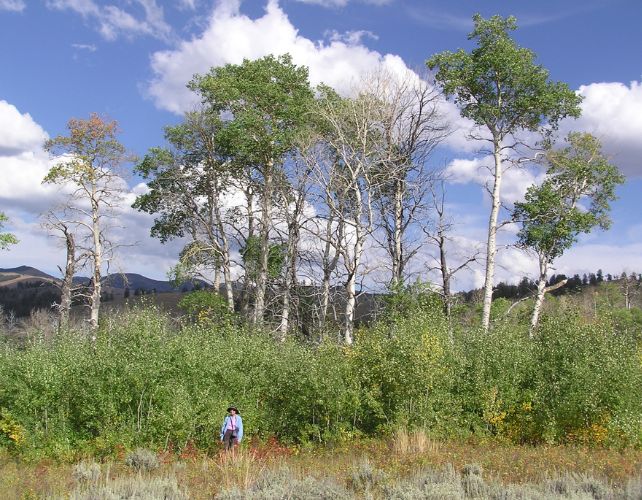 Overstory aspen trees were a common sight in Yellowstone National Park, before wolves were removed. (Oregon State University)
They first raised criticisms in a letter to the editor of a different journal in November 2025, but now they've presented a full paper on the matter.
"Painter et al. claim that large-carnivore recovery in Yellowstone National Park has produced a strong trophic cascade compared to other systems, citing a 152-fold increase in aspen sapling density and widespread recruitment of new trees," MacNulty and team write.
"We show that these conclusions substantially overstate the cascade's strength because of key methodological and interpretive flaws."
While this kind of criticism may be hard to swallow, it's actually a sign of science in action – a healthy back and forth that helps advance or refine our understanding as evidence evolves or is reanalyzed.
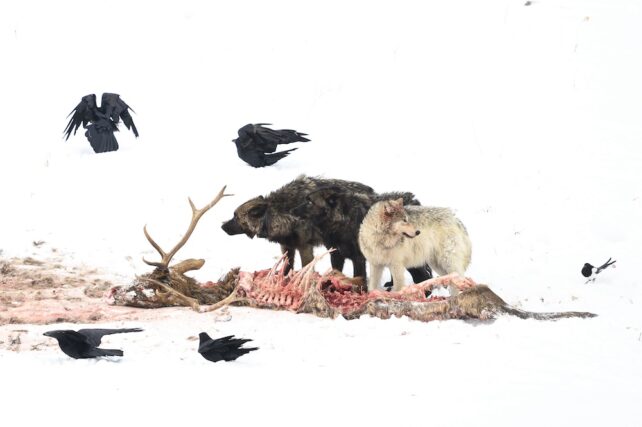 Two gray wolves stand over the bloodied remains of a bull elk in Yellowstone National Park. (Jared Lloyd/Getty Images)
MacNulty and team point out that the baseline density of trees in Painter et al.'s dataset was miscalculated. This means that the reported 152-fold increase in aspen sapling density (observed between 1998 and 2021) is more like a 17.5-fold increase.
There were other problems with the data analysis, too. Treating measurements from the same stands of trees as if they were independent samples, for instance, resulted in a greatly overstated effect size, MacNulty and team claim.
They also point out that Painter et al.'s use of mean-based metrics resulted in a small minority of plots disproportionately influencing the outcomes, and that the presence of one or two tall stems within a plot is not evidence of widespread tree recruitment, as was reported.
"Finally, their assumptions that stems of two meters or more have escaped browsing, and that reduced browsing alone drives height growth, are contradicted by long-term data" showing substantial browsing above those heights, MacNulty and team write.

They're careful to note that this critique does not undermine the importance of large predators in ecosystems, but rather highlights the importance of scientific rigor when it comes to studying a subject as complex as an ecosystem.
"Predator effects in Yellowstone are real but context-dependent – and strong claims require strong evidence," MacNulty said in an earlier press release.
There's no doubt the reintroduction of wolves had an impact on Yellowstone's ongoing forest recovery; it's just not quite as strong as Painter's team (and we) originally reported.
"The evidence supports the occurrence of a trophic cascade in Yellowstone, but not the magnitude of strength claimed," MacNulty and team conclude in their latest correspondence.
"Accurate assessment of trophic cascade strength in Yellowstone is vital to ensure that this iconic system reliably informs ecological understanding and restoration practice."
Related: There's One Super Predator in Africa That Instills More Fear Than Lions
MacNulty and team's 2026 response to the 2025 study has been published in Forest Ecology and Management. Their 2025 letter to the editor was published in Global Ecology and Conservation.
 English (US)