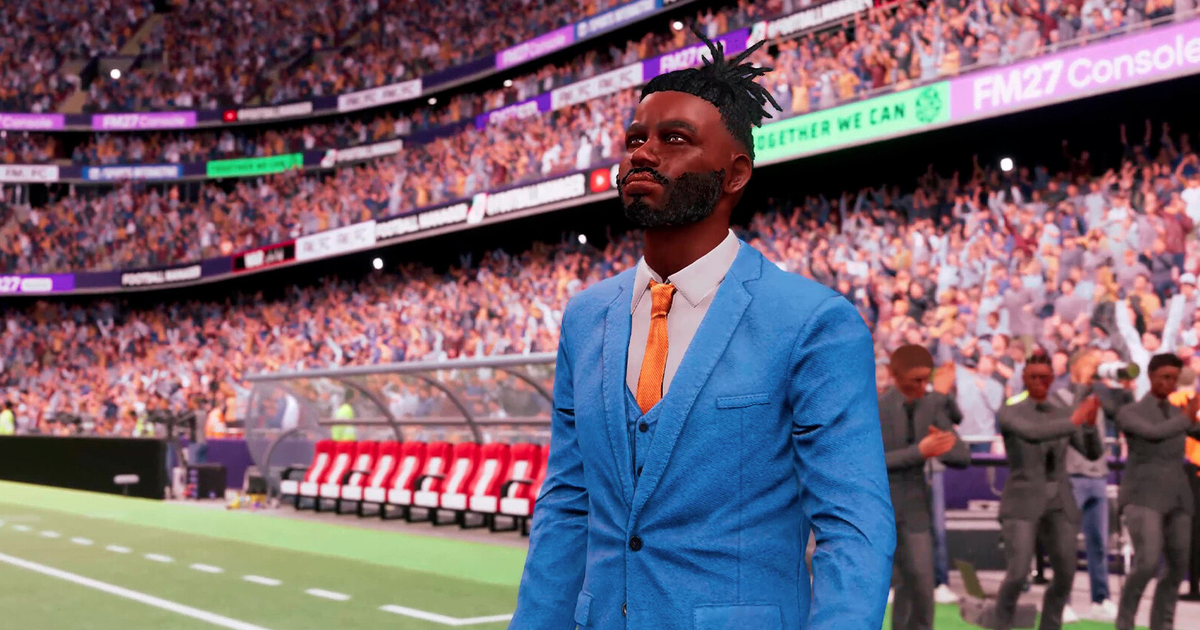
Welcome back, Football Manager. I've only played half a day or so of it, whistling through my inductions, board meetings and opening transfer window, but already the positive signs are there. Football Manager 27 is a big, much-appreciated step in the right direction. In a way it's a step back - this is essentially the game I wish FM26 had been - but sometimes that's necessary. One back, two forward. At least it's genuine progress. This is a Football Manager game again.
If that "game I wish FM26 had been" line has raised an Ancelotti-eqsue eyebrow, here's what I mean by it: FM27 has got rid of most - if not quite all - of the cards-and-tiles UI that gave FM26 its notoriety. It's dramatically easier, faster, and more sensible to navigate, though I still think there are places to improve. But it's also maintained the best part of last year's entry, in the majorly overhauled in- and out-of-possession tactics systems. And it's built on that system smartly: elements are tinkered with and made clearer; other parts are expanded, and a new system added entirely, in something called "tactical effectiveness". This sounds almost comically dry but, in true Football Manager fashion, that's the good stuff. This is a really smart system, one that brings with it a huge boost to the role-playing side of the game. Combined with the rolling-back of various UI elements to more traditional FM fare, it makes me feel about as optimistic as I have been for this series for a little while.
It's worth focusing on last year's game for a moment. "We had a lot of technical challenges to solve," explains Rémy Boicherot, FM27's head of design, to me in an interview at Sports Interactive's head office in East London. Part of that was porting the interface to the new engine itself, with last year's game moving to Unity for the first time, and requiring that unprecedented year's delay as a result. The other was with "new graphical data," as Boicherot puts it. "It's a huge undertaking to transfer technology, and this is what we had to focus on last year to release the game." The studio's feedback rounds with players have since brought up two big points of improvement they hoped to make this year. The first, unsurprisingly, was the UI. The second, a little more interestingly, was the question of immersion. "The sense of feeling lost in that world."
With FM27, and those technical challenges seemingly now overcome, "we just focused on gameplay and making sure that the game resonated with our community," Boicherot continues. "We focused all our efforts into this. It was really a consolidation year. We still used a lot of these new philosophies to empower the interface, but with more of a familiar feel, and with just more efficiencies all throughout."
Ant Farley, senior features manager at Sports Interactive, put it similarly. "We were building from scratch," he said, which meant "everything needing to be built from the ground up, and just the volume of work that that entails and the technical complexity of that mammoth task. You can zero in on [the fact] that didn't give us much room to iterate."
He says the dev team, as a result, "realised that FM26 is a game that's good if you're very focused on your own team, and becomes [one with] quite an amount of friction when you're trying to be part of that wider world, starting to browse around." That realisation came "very early on," he says: "We really need to work on this, and the tiles and the remit of the tiles, I think is the really important significant change there… I think on paper the notion of a tile as being both navigation and information is really quite powerful. But what I think we did was, we reload on it for navigation, rather than it being a kind of secondary purpose for it. It became their primary purpose in a lot of places, and what that means then is, you're constructing screens in a way that imbalances the information to some extent."
The improvements are immediately evident. The navigation bar is more sensibly organised, the "portal" now more closely resembles your old inbox, with a bit of colour-coding thrown in. In the simplest terms, I found myself running down far fewer navigational cul-de-sacs than with FM26.
There are still snags, of course. Personally, I think the entire cards-and-tiles system should be left behind now, rather than just most of it. There are just very few circumstances under which a pop-up window is more useful or efficient than navigating to a full page. Boicherot's view here is that certain systems, such as messages from in-game people, suit the pop-up windows better - he may be right, though for me the two are essentially competing UIs overlaid on one another. The classic FM experience - not a spreadsheet, as people like to call it, but really a kind of web browser, where you can seamlessly move from your email inbox-cum-to-do-list to a series of interlinked wiki pages via hyperlinks and a clearly defined navigation bar - remains unbeaten. It's a single, intuitive and widely recognised visual language: underlined text takes you to a page on that topic, while dropdown menus and the nested ones within them take you to the most essential hub pages you'll visit most often. The tiles system only muddies the waters.
Thankfully the team, such as Boicherot, still seems to largely agree. "As a player, you don't want to think about the UI," he says. "Every time you watch a show, you don't want to learn how to use a [remote] control again. So with FM, we just wanted to get that familiar feel again." The studio had a "whole dedicated strike team" to resolving the issue, while the wider team, he says, has coupled that rework with the new drive for immersion, and in turn essentially adapted most of the compositions of the game's various screens to focus on "dynamic elements, on player stats, on the latest matches, who's hot, who's not, who's performing, underperforming. We have quite a lot of news stories as well. We wanted to make sure that we had better journalists in-game, reporting on more interesting stories, and basically giving you a better window to the world."
It's all good progress, ultimately, even if I still have my foibles with the card system's leftovers. And those new additions are really the things I want to talk about - and which I can tell Sports Interactive's developers are keen to talk about as well. Don your anoraks, then. It's time to talk about tactical effectiveness.
The system works like this: replacing the old and somewhat ignorable gauge for your team's tactical familiarity, there's now a gauge called tactical effectiveness. That gauge is influenced by four sub-categories: tactical understanding; player ability; player buy-in; and next match info. Those are then influenced by another layer of influence beneath them. Tactical understanding, for instance, depends on a combination of your player's understanding of their in-possession shape, passing style, build up, chance creation, out-of-possession shape, line of engagement, pressing intensity, and the pressing trap. You'll recognise most of those as tactical settings you can tinker with, which we'll come back to shortly. And even that layer, at times, has things that influence it again. Chance creation, for instance, is dictated by the training contribution, match exposure, players' tactical ability (which I understand from Sports Interactive developers to be influenced by their adaptability, teamwork and other attributes), and the tactical complexity of what you're asking them to do.
Sports Interactive says this is a result of direct conversations they've had with their connections in the Premier League and wider parts of the professional game. Fundamentally, Boicherot says, the previous tactical familiarity system was "quite simplistic" in comparison to what real managers were thinking about. "We also looked at Pep Guardiola's approach at City. [It] was very much, spend quite a lot of money on players, and then you don't see them play for quite a while until he knows that they're ready. And when he puts them on the pitch, they are effective. They just understand how to implement his vision directly on the pitch, and that was something that we felt we couldn't capture with the old system."
All of this is presented in a slightly underwhelming screen of several plain columns with a list of the above factors on them, which is a bit of a shame, but the impact it already had on my thinking in just a few hours with the game was huge. This is, ultimately, a role-playing mechanic, acting as a kind of bridge over the gap between how you think about tactics in Football Manager, and how a real manager might think about them in the real world. The biggest impact happens in how you think about the game - which, in a way, is where a lot of the playing of Football Manager really happens.
Beyond Boicherot's case of Pep's new players, an example given in a brief introduction was a good one: the "new manager bounce" - the notion that a team, after a previous, underperforming manager gets the sack, suddenly has a short-term improvement in results. Technically this is a bit of a myth; the data apparently suggests changing gaffers doesn't actually lead to a noticeable short-term uptick in results on average. But when it does happen, the theory is that these new managers tend to go "back to basics" with their tactics, simplifying instructions for bogged-down, low-morale players and letting them play their game with a bit more freedom.
Take Michael Carrick, for instance, from my trusty old management basket case Manchester United. Previous manager Ruben Amorim's system was complex and demanding, requiring both immense fitness and a large amount of tactical understanding and adherence from his players. Michael Carrick, then an interim, came in and seemingly reverted the team to something far simpler, and the short term impact was an immediate uptick in results. He put Bruno Fernandes back in the number 10 role, reverted to a familiar 4-2-3-1 formation, gave a relatively large amount of creative freedom to more creative players, and set them up in more of a fluid counterattacking mid-block as opposed to Amorim's structured, finely-tuned high press. And initially they did well! And now this season, after opponents had all summer to work through their opposition analysis and realise the tactical plan was actually quite simple, they've been "found out", as the football cliché goes - with results flipping into disaster territory.
FM27's tactical effectiveness system is designed to do something similar (although perhaps not quite as drastically as the Carrick disaster). Simple tactics, such as going long to a target forward, staying compact and hitting teams on the counter, are more easily grasped and implemented by players, leading to better short-term results. Complex pressing, inverting fullbacks, and intricate tiki-taka football meanwhile will likely take far longer to master, potentially leading to early-season struggles as the team learns your fancy, armchair-tactico system. And so in comes the role-playing: do I gamble on tactical purism for a higher long-term ceiling? Or do I secure my short-term future and attempt to gradually transform the team over time? Will fans accept my route one football, even if it gets me immediate results? Will players feel comfortable playing it?
This is where other, interlinking systems come in, and now my anorak is positively bristling. Training has also had quite a major rework, for instance. Training sessions have new categories: tactical understanding, match preparation, footballing development, and physical and recovery. Many of the sessions are familiar, but their recategorisation is important. Previously, we're told, sessions were primarily seen as a means of improving players' attributes - "Defending: Engaged" improved things like tackling and heading, for instance - while a few others helped with tactical familiarity or match fitness, without a clear gauge of their effectiveness.
Now, all of the sessions that come under "tactical understanding" will, you guessed it, help with the "tactical understanding" aspect of overall tactical effectiveness. And knowing that the gauge for, say, your team's understanding of your preferred passing style is in the orange will immediately indicate to you that you need to schedule a few more "Passing Style" training sessions. That then needs balancing with developmental sessions, match preparation sessions such as set pieces - now broken down into individual ones such as corners, free kicks, and so on - and recovery. It's another aspect influenced by actual conversations with those in the real game. Farley highlights the modern emphasis on "tactical periodisation," the approach of making training sessions resemble matches in various ways, down the certain "game state" such as being 1-0 down, consolidating a lead, and so on.
"It's going back a few years now," Farley continues, offering one example of how the team learned from the real game, "but we were very fortunate - I won't name the manager - we had a manager do a 'foot talk' for us, where they were talking about that tactical periodisation, and that kind of, almost playbook, American football-style of: now execute this plan. And that being something they would communicate from the touchline. And it was during covid, behind closed doors games, right? So then when I next watched this team play and you have the benefit of there being no crowd noise and everything, you really actually see it in action with that insight."
Beyond that, there's now an impact on your squad-building, too. Recruiting effectively now means considering your scout's take on a player's tactical suitability - are they likely to fit a high-pressing, high-technicality style such as Guardiola-like tiki-taka? Would James Tarkowski suit a high defensive line? Does Rayan Cherki want to play park-the-bus football? Bruno Fernandes, clearly sensing the importance of the topic with FM27's impending release, made his thoughts quite clear on what he thinks about not pressing opponents after Manchester United's humbling defeat to Como just the other week. This is the tactical effectiveness system personified.
"Take Thierry Henry moving from Arsenal to Barcelona," Boicherot suggests. "There was a big, big adoption time, right? But others are a bit more efficient with different types of player roles. It depends on their attributes, their stats, on their adaptability." It's essentially a melding of soft skill man-management with the modern, analytic side of the game - the type of blend that makes the very best coaches in the world so effective.
If you hadn't guessed, I'm a fan. It's a wonderful way to bring the type of gap-filling I'd already been doing with my imagined narratives into the reality of Football Manager itself. Beyond it, there are more tweaks that get the nod, too. Touchline shouts return, having been patched in apologetically to FM26, but now they're accompanied by a nifty feature that runs in tandem called Tweaks. These are basically one-touch tactical shortcuts you can instigate without leaving the in-match screen, shouts-style, to get your team to push up, or step off the press, or, much to my enjoyment, send the goalkeeper forward for set pieces. Notably Sports Interactive opted to make these tweaks stay active after you make them, until you consciously turn them back off again, as opposed to operating on a timer. The theory there being that the decision to turn them off is often as interesting as the decision to implement them in the first place.
"We wanted to capture a bit more of a 'duel' type of experience against the opposing team manager," Boicherot explains. "How do you want to disrupt your opposition in a quick way, really trying to capture the kind of quick instructions you tell your captain on the sideline and let them go and implement."
International management also gets a welcome bit of attention, with training now properly implemented for that, as does the 2D engine, which has had a lovely visual revamp that still maintains a pleasingly retro tinge. There are reworks to how players' running speed works, which interlinks with fatigue and even the types of runs they might attempt. Tied to that is a new instruction for how a forward should attack the box, all this together theoretically giving slower forwards greater influence on the game. And the onboarding experience has been tinkered with once again, with more manager customisation options and tweaks to how your traits and attributes are set up.
The headline changes, though, are where FM27 is at its best so far. It is easier to play and navigate, "faster to the fun," as well-trained UX developers often like to say, and has genuine potential to be the most tactically interesting and nuanced game in the series to date. Shuffle away the last of those remaining cards, and this could be a seriously good year. Thank goodness for that.