
.jpg) 1 hour ago
1
1 hour ago
1
Article content
Donald Trump says British Prime Minister Keir Starmer is “no Churchill.” This after the U.K. declined to let the U.S. use its air bases in striking Iran — at least not until Iran struck back, so that further actions could be categorized as defensive and therefore not in violation of international law, whatever that is. “This is not Winston Churchill we’re dealing with,” Trump said from the couch in the Oval Office.

THIS CONTENT IS RESERVED FOR SUBSCRIBERS ONLY
Subscribe now to read the latest news in your city and across Canada.
- Exclusive articles from Barbara Shecter, Joe O'Connor, Gabriel Friedman, and others.
- Daily content from Financial Times, the world's leading global business publication.
- Unlimited online access to read articles from Financial Post, National Post and 15 news sites across Canada with one account.
- National Post ePaper, an electronic replica of the print edition to view on any device, share and comment on.
- Daily puzzles, including the New York Times Crossword.
SUBSCRIBE TO UNLOCK MORE ARTICLES
Subscribe now to read the latest news in your city and across Canada.
- Exclusive articles from Barbara Shecter, Joe O'Connor, Gabriel Friedman and others.
- Daily content from Financial Times, the world's leading global business publication.
- Unlimited online access to read articles from Financial Post, National Post and 15 news sites across Canada with one account.
- National Post ePaper, an electronic replica of the print edition to view on any device, share and comment on.
- Daily puzzles, including the New York Times Crossword.
REGISTER / SIGN IN TO UNLOCK MORE ARTICLES
Create an account or sign in to continue with your reading experience.
- Access articles from across Canada with one account.
- Share your thoughts and join the conversation in the comments.
- Enjoy additional articles per month.
- Get email updates from your favourite authors.
THIS ARTICLE IS FREE TO READ REGISTER TO UNLOCK.
Create an account or sign in to continue with your reading experience.
- Access articles from across Canada with one account
- Share your thoughts and join the conversation in the comments
- Enjoy additional articles per month
- Get email updates from your favourite authors
Sign In or Create an Account
or
Article content
Article content
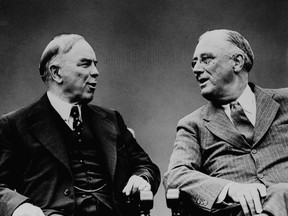
Maybe not, Starmer could have shot back, but you’re no Franklin Roosevelt.
Article content
Article content
By signing up you consent to receive the above newsletter from Postmedia Network Inc.
Article content
Whether out of good breeding or good sense he did not. But he would have been right. Unlike Trump, FDR won large majorities of the popular vote, controlled both houses of Congress by large margins, brought in his social revolution via legislation, not executive order, so that it had a better chance of lasting, and was famous for his fireside chats: radio talks in which he explained complicated matters in simple terms ordinary Americans could understand.
Article content
On the other hand, like Trump, FDR faced stiff resistance to U.S. involvement in foreign wars. But he managed to get aid to Churchill’s Britain via finesse and ambiguity until Japan greatly simplified his job with a surprise attack on Hawaii early one sleepy Sunday morning in December 1941 — the kind of surprise attack that, during the Cuban Missile Crisis, Robert F. Kennedy, Sr., told his brother, President John F. Kennedy, was immoral and un-American. (RFK, Jr. so far has not objected to the Iran strike.)
Article content
The irony is that Starmer himself favoured letting the Americans use the bases in their surprise first strike but couldn’t carry his national security group with him. His failure was not of strategic vision but of the tactical ability to persuade his colleagues.
Article content
Article content
These comparisons with World War II leaders raise the question whether our own Prime Minister Mark Carney is a modern-day Mackenzie King — not the grumpy old bachelor who held seances and took policy advice from his dead mother (whose advice, incidentally, was usually pretty good) but the shrewd, careful and often creatively ambiguous politician who succeeded in steering an ethnically divided country through the stresses of total war.
Article content
If you ask AI what statement King is most famous for, it’s his 1942 declaration “Conscription if necessary but not necessarily conscription,” which is hardly Churchillian in its clarity. But we forget how divided Canada was. When King George VI and Queen Elizabeth (later the Queen Mum) visited Quebec City on their summer 1939 North American tour, the first visit ever by a reigning monarch, Quebec premier Maurice Duplessis skipped the official lunch, claiming, King biographer Allan Levine writes, that he had to “attend to a personal matter.”
Article content
And during the parliamentary debate on a Canadian declaration of war in September of that year, several Quebec Liberals spoke against, along with the leader of what became the NDP, though no recorded vote was taken. Before the debate King had promised his Cabinet there would be no conscription for foreign service. He wanted to keep his party together but also worried that conscription would spark literal riots, as it had in 1917.
 English (US)