
I’ll let you in on a secret: I often tell people that summer is the best time to visit Stockholm. Clouds drift across impossibly blue skies, we skip around midsummer maypoles singing folk songs and cruise the waterways, bobbing and weaving through the archipelago’s 30,000-plus islands.
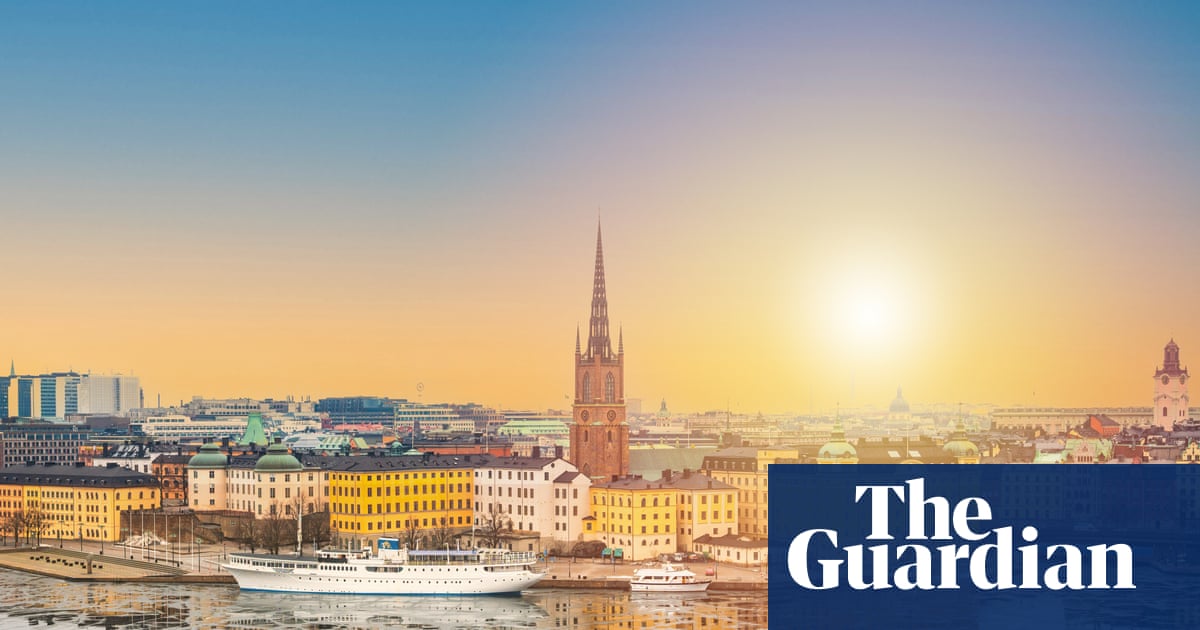
That’s mostly because I want to keep December in Stockholm to myself. Soft white snow dusts buildings of ochre and burnt sienna like icing on a cake. Festive candles light up pavements leading to cosy cafes, where the earthy, buttery smell of seasonal saffron buns (lussekatter) replaces cinnamon buns for fika, our revered tradition of coffee and cake.
When the holiday season rolls around, uber-cosmopolitan Stockholm – known for its minimalist ergonomic designs and a startup scene to rival Silicon Valley – turns nostalgic. This means embracing festive traditions, retreating into the warmth, and collectively preserving insider rituals such as switching on the TV at 3pm every Christmas Eve to watch old Kalle Anka (Donald Duck) cartoons together as a nation.
This is the softer, human side of Stockholm I love so much, when the city wears mys (the Swedish art of getting cosy with loved ones) on its sleeve, while slipping and sliding on ice, shattering its veneer of Scandi perfection.
Swedes greet the arrival of midwinter with only slightly less enthusiasm than they celebrate midsummer. When darkness falls by 4pm, every glimmer of light – natural or artificial – is revered. In Sergels torg, the square at the heart of the city, the Kristallvertikalaccent, a towering glass monument, is lit up like an alien obelisk seeking extraterrestrial contact. Hockey puck-shaped candle holders flicker along pavements all over town, alerting pedestrians to patches of black ice and adding to the cosy ambience. The tradition was borrowed from the 16th-century Spanish ritual of lighting bonfires along the roads to lead people to Catholic midnight mass services.
Large paper stars and wooden Advent candelabras illuminate windows. But the seasonal spectacle to beat all others is that of Nordiska Kompaniet, the oldest luxury department store in town. It’s worth squeezing through the crowds to see the animated window displays of toy trains, nutcrackers and other fantastical creations. Last year’s display commemorated 80 years of Astrid Lindgren’s iconic red-haired children’s book character Pippi Longstocking.
Early December brings light shows projected across our imposing City Hall (Stadshuset), with its long stem tower and sea foam-green roof. This is done in celebration of the Nobel prize laureates before they are honoured inside with a lavish banquet attended by the king and queen of Sweden.
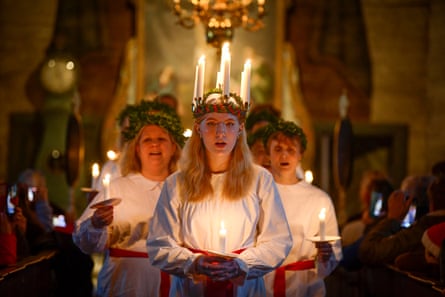
By mid-December, parents are dashing from store to store to find white gowns, crowns of light, tall paper cones, gingerbread man outfits and mini Santa suits for their kids as they prep in excitement to be part of their school’s St Lucia’s Day activities on 13 December.
Children chosen to portray Sankta Lucia often wear a crown of battery-powered candles in honour of the Sicilian Christian martyr, who died in AD304 and is celebrated as the bearer of light. The Swedish tradition dates back to the 1920s, when a newspaper elected an official “Lucia” to represent the saint. Lucia concerts are held all over town, with the most iconic procession held at Storkyrkan cathedral next to the Royal Palace.
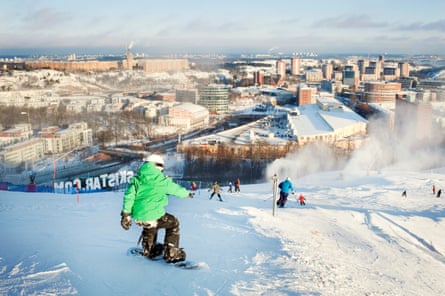
When the harbour freezes over, its surface reflecting city lights like twinkling stars, our ice skates come out. If, like me, you’d rather not risk taking your children skating on frozen bodies of water such as lakes Mälaren or Källtorp at Hellasgården, the inner city parks Kungsträdgården, Zinkensdamm and Vasaparken provide family-friendly ice skating rinks, sometimes with retro lights and disco music. But the winter activity my kids especially love is snowboarding right in Stockholm. The city has its own ski slope at Hammarbybacken, which is great for families and perpetual beginners like me. We pack hot chocolate and bags of mini cinnamon buns called gifflar for the slopes. Beyond layering up, everything is rented on location – from helmets and gloves to skis and snowboards.
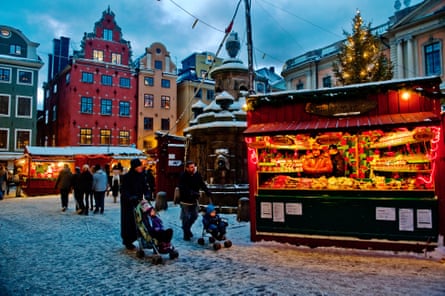
As December unfolds, sugary wafts of candied almonds, roasting in large woks over open flames, draw us to the centuries-old Stortorget Christmas market in the old town, Gamla Stan. As you move from one oxblood-red wooden stall to the next, you’ll find vendors selling gingersnap cookies (pepparkakor) to dunk into your warm glögg (mulled wine with added raisins and blanched almonds); jam preserves; smoked meats; Västerbotten cheese; and other treats for the Christmas smorgasbord.
after newsletter promotion
Speaking of the julbord (yuletide feast), no Swedish Christmas is complete without pickled herring (sill), meatballs (köttbullar), cured salmon (gravadlax), glazed ham, mini pork sausages (prinskorv) and Jansson’s temptation, a potato casserole dish with ansjovis (sweet pickled sprats). It’s an acquired taste that I’ve finally embraced.
Securing an invitation to a Swedish home for a Christmas dinner is akin to the holy grail, but if you happen to be in town over the festive period, you can find a restaurant or dinner cruise serving julbord via julbordsguiden.se. Failing that, Sweden’s largest Ikea, in Kungens Kurva, 20 minutes from town, also serves an affordable julbord throughout the holiday season.
The Christmas markets at Stortorget and in Kungsträdgården park are a great place to pick up quintessential Swedish ornaments, such as jultomtar, grey-bearded gnomes that look like members of ZZ Top, and the julbock, a Christmas goat made of straw and bound with red ribbon. Its symbolic Scandinavian roots date back to the 1800s when what would later become our modern-day Father Christmas was someone dressed like a goat handing out gifts.
The official residence of Sweden’s royal family, Drottningholm, runs a winter market in its grounds, focused mostly on artisans such as blacksmiths, woodcarvers and textile weavers. You can also hop on a ferry for the 20-minute crossing to Fjäderholmarna, known as “craft island”, for its ceramic and jewellery workshops.
My kids love travelling back in time at the world’s oldest open-air museum, Skansen. Founded in 1891 on the city’s lushest island, Djurgården, you’ll find traditional artisans dressed in period outfits weaving, smelting and baking, and classic Swedish falu (red) cottages, alongside a mini Christmas market.
For me, winter in Stockholm is a return to slowing down, cosying up with loved ones, staying grateful for the light and embracing tradition, while counting down the days until spring warms us again.
Where to stay
Downtown Camper (double rooms from £95) is a block from Sergels torg and has a rooftop wellness area with a sauna and heated pool, and a cocktail lounge with city views


