
.jpg) 1 hour ago
2
1 hour ago
2
A dramatic partial lunar eclipse will occur on Aug. 27-28, with almost the entire moon slipping into Earth's shadow.
At its peak, at 12:12 a.m. EDT (0412 GMT) on Aug. 28, 96.2% of the lunar surface will be covered by Earth's dark umbral shadow, leaving only a slender portion of the moon directly illuminated by the sun. The rest of the lunar surface may take on an eerie reddish-orange hue, creating an impressive 'almost blood moon'.
The eclipse will be visible from North and South America, Europe and Africa, though exactly how much you'll see will depend on your location (and clouds!). You can follow along with all the action with our lunar eclipse live blog.
Lunar eclipse timings
- The eclipse begins when the moon enters Earth's faint outer shadow at 9:23 p.m. EDT on Aug. 27 (0123 GMT on Aug. 28).
- Things get much more interesting at 10:33 p.m. EDT (0233 GMT), when the partial eclipse begins and Earth's dark umbral shadow starts to creep across the lunar surface.
- Maximum eclipse occurs at 12:12 a.m. EDT (0412 GMT) on Aug. 28, when 96.2% of the moon will be immersed in Earth's umbra.
- The partial phase ends at 1:51 a.m. EDT (0551 GMT), with the penumbral eclipse concluding at 3:01 a.m. EDT (0701 GMT).
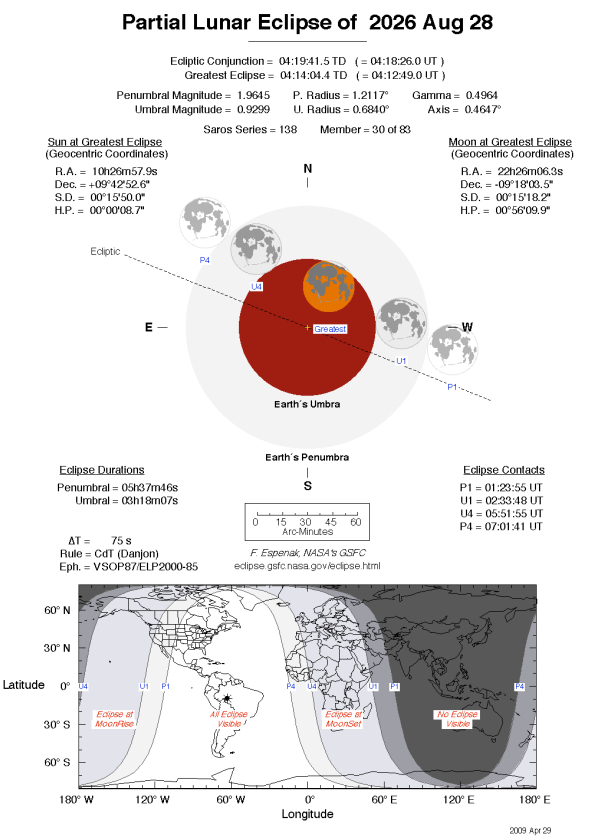
North and South America are particularly well-placed for the entire eclipse.
For European skywatchers, the eclipse takes place during the early morning of Aug. 28, with the moon setting while the partial eclipse is still underway. From London, maximum eclipse occurs at 5:12 a.m. BST, just over an hour before moonset.
How to view the lunar eclipse
Unlike a solar eclipse, you don't need any special equipment to view a lunar eclipse. Simply head outside and look up. If you own binoculars or a telescope, take a look through them for an even better view of Earth's shadow sweeping across the lunar surface.
If you're interested in trying to capture an impressive photograph of the lunar eclipse, check out our expert's guide on how to photograph a lunar eclipse, along with a roundup of the best cameras and lenses for astrophotography.
Editor's Note: If you capture a photo of the August lunar eclipse and want to share it with Space.com's readers, then please send your photo(s), comments, name and location to [email protected].
 English (US)