
.jpg) 1 hour ago
3
1 hour ago
3
Article content
Mark Carney is doing what no previous Canadian leader has done by accepting that President Donald Trump can impose tariffs despite the terms of the North American trade pact, the country’s former deputy prime minister said.

THIS CONTENT IS RESERVED FOR SUBSCRIBERS ONLY
Subscribe now to read the latest news in your city and across Canada.
- Exclusive articles from Barbara Shecter, Joe O'Connor, Gabriel Friedman, and others.
- Daily content from Financial Times, the world's leading global business publication.
- Unlimited online access to read articles from Financial Post, National Post and 15 news sites across Canada with one account.
- National Post ePaper, an electronic replica of the print edition to view on any device, share and comment on.
- Daily puzzles, including the New York Times Crossword.
SUBSCRIBE TO UNLOCK MORE ARTICLES
Subscribe now to read the latest news in your city and across Canada.
- Exclusive articles from Barbara Shecter, Joe O'Connor, Gabriel Friedman and others.
- Daily content from Financial Times, the world's leading global business publication.
- Unlimited online access to read articles from Financial Post, National Post and 15 news sites across Canada with one account.
- National Post ePaper, an electronic replica of the print edition to view on any device, share and comment on.
- Daily puzzles, including the New York Times Crossword.
REGISTER / SIGN IN TO UNLOCK MORE ARTICLES
Create an account or sign in to continue with your reading experience.
- Access articles from across Canada with one account.
- Share your thoughts and join the conversation in the comments.
- Enjoy additional articles per month.
- Get email updates from your favourite authors.
THIS ARTICLE IS FREE TO READ REGISTER TO UNLOCK.
Create an account or sign in to continue with your reading experience.
- Access articles from across Canada with one account
- Share your thoughts and join the conversation in the comments
- Enjoy additional articles per month
- Get email updates from your favourite authors
Sign In or Create an Account
or
Article content
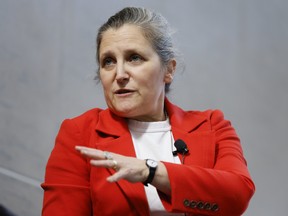
“Canada apparently will have lower tariffs on steel, aluminum, cars and car parts. But tariffs will be in place and Canada will accept the legitimacy of those tariffs. That’s a real Rubicon that it looks like will be crossed,” Chrystia Freeland said on Bloomberg Television’s Wall Street Week With David Westin, to which she is a regular contributor.
Article content
Article content
Article content
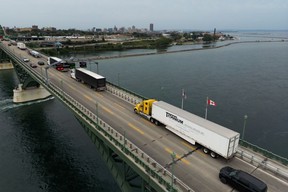
United States and Canadian negotiators are meeting in Washington on Friday, trying to cement a deal to ease trade tensions between the longtime allies. The stakes are high: the Trump administration is set to impose new 50 per cent tariffs on hundreds of products from Canada at 12:01 a.m. New York time on Saturday, unless there’s a deal or another delay from the White House.
Article content
Article content
By signing up you consent to receive the above newsletter from Postmedia Network Inc.
Article content
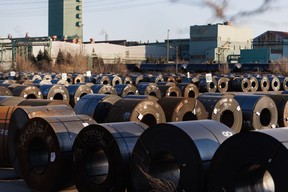
The countries are discussing an arrangement that would lower U.S. tariffs on imports of certain Canadian steel and aluminum items to 25 per cent from 50 per cent, and cut the headline duty on autos to 15 per cent, people familiar with the matter told Bloomberg News earlier this week. But the final agreement was not done as of Friday morning and the situation remains fluid.
Article content
In return, Canada would remove retaliatory measures such as its own counter-tariffs on U.S.-manufactured autos, the people said.
Article content
“The idea that tariffs on these sectors would be accepted by Canada, that is a really big deal,” said Freeland, who was deeply involved in the negotiations that led to the Canada-U.S.-Mexico-Agreement (CUSMA) during Trump’s first term. “That is a bad outcome for Canada to have permanent tariffs on our steel, aluminum, cars and car parts — really harmful for those sectors. But I think it’s a bad outcome for the United States as well.”
Article content
Article content
Canada has enjoyed decades of trade at near-zero tariffs with the U.S. The two countries exchanged $900 billion of goods and services last year, and Canada is the largest export market for many U.S. industries, including autos. Along with Mexico, the countries are part of CUSMA, which Trump called “the best agreement we’ve ever made” in 2020.
Article content
Article content
Article content
Freeland compared U.S. protectionism to Brexit, calling it “self-mutilating” because tariffs on primary metals weaken U.S. manufacturers by increasing their costs.
Article content
“Aluminum is basically electricity in solid form. So the U.S. is basically imposing a tax on electricity,” she said.
Article content
Freeland is partly responsible for Carney’s rise to power: in December 2024 she stunned the nation with her sudden resignation as finance minister, which proved to be a final blow that triggered the exit of Justin Trudeau. She ran against Carney for leadership of the Liberal Party and lost.
Article content
She was part of Carney’s first cabinet but resigned as a lawmaker in January.
Article content
Article content
Freeland suggested Carney is taking less favourable trade terms from Trump in return for reducing business uncertainty, while acknowledging that many Canadians will feel they’re being “treated pretty shoddily.”
 English (US)