Stained glass can transform ordinary sunlight into something extraordinary. But behind the vibrant colors and intricate designs lies incredible craftsmanship, patience, and dedication. Few people understand this better than Luis Porras, a stained-glass specialist who has spent decades mastering the delicate art of creating, restoring, and preserving these remarkable works.
Luis began his journey at just 16 years old, when he joined the historic Judson Studios in Los Angeles. After 25 years of learning and perfecting his craft there, he took responsibility for maintaining an extraordinary collection of more than 500 stained-glass windows and panels across Forest Lawn’s six Southern California memorial parks. Some of these artworks are centuries old, making his work essential to preserving their beauty and craftsmanship for future generations.
Bored Panda spoke with Luis about his fascinating career, the challenges of restoring historic stained glass, and the details that make these artworks so special. Scroll down to admire some of the remarkable pieces he cares for and learn what it takes to keep them looking their best.
More info: museum.forestlawn.com | Instagram | youtube.com
Meet Luis Porras, the stained-glass expert preserving centuries of artistry
Luis Porras stands in front of “The Last Supper Window” in Forest Lawn’s Great Mausoleum.
Courtesy of Forest Lawn.
For Luis, his fascination with stained glass began the moment he stepped inside Judson Studios as a teenager: “There’s a sign out front of Judson Studios marking it as a historical landmark, and when you walk into that building, the history is apparent. It’s like walking into the past. When I first walked in as a 16-year-old kid and saw these craftsmen working there, people who showed me around and what to do, it was a very eye-opening start to my stained glass journey. I was introduced to a world of art and of people from around Los Angeles and the world. I was so curious and excited about where I was going, and I wanted to soak up as much as I could. I didn’t know it then, but I was about to enter a new world. I began working with Douglas Judson on faceted glass and cementing, which is waterproofing the windows. Playing music early on in my youth, I always had love and affinity for the arts and the process of creativity, and that art and creativity is what drew me into stained glass.”
His journey began at just 16 years old at the historic Judson Studios
Luis Porras finishes the restoration on a panel from the Begonia Terrace Skylight.
Courtesy of Forest Lawn.
After 25 years at Judson Studios, Luis took on an extraordinary responsibility
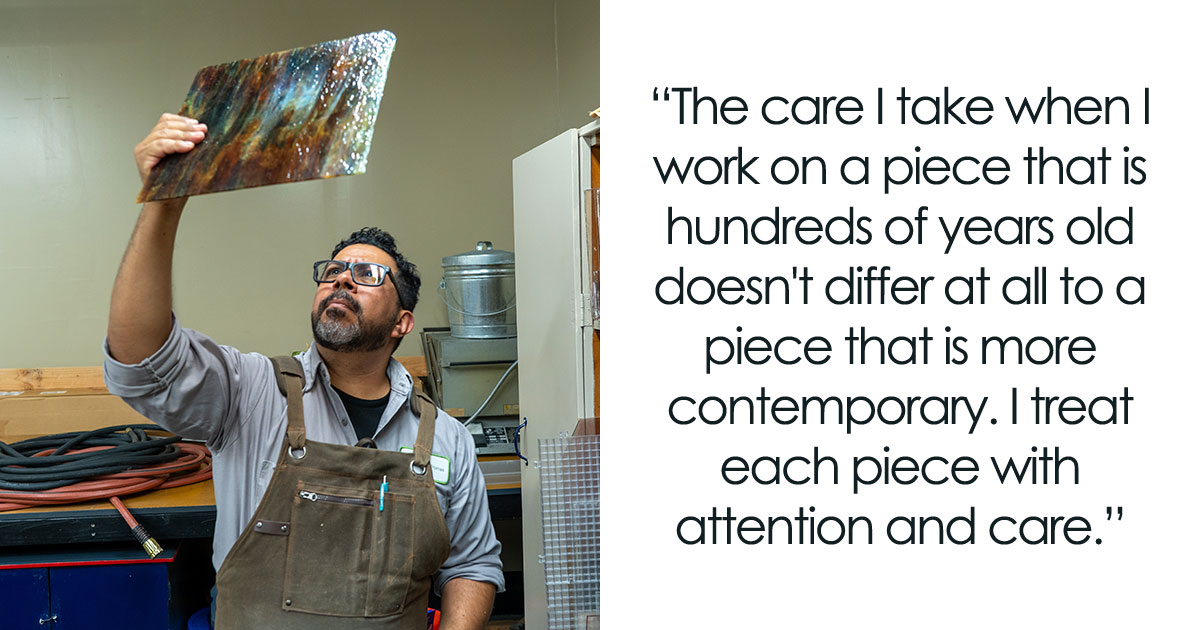
Luis Porras examines a piece of glass in his studio at Forest Lawn-Glendale.
Courtesy of Forest Lawn.
Although he has worked with stained glass for decades, the craft still offers new discoveries: “In the end, the technique and materials haven’t changed in 1,000 years, only more minor methods and tools. You can see the through line of stained glass windows created 500 years ago and today. It’s more the style and the artists that have changed. So I’ll be surprised by different designs and complexities of designs, or if it’s something I’ve never encountered like a diamond-shaped window. In the decades of working in stained glass, I am still surprised at what unique materials, pieces and techniques I find. There are so many different styles that stained glass can take on, and every piece is so unique. I’m constantly feeling a sense of rediscovery and like I am encountering something I personally haven’t encountered. The first time I worked on a Tiffany window, which is layered, I had learn how to do it. Sometimes when I encounter a certain type of bigger window, I will wonder why they used thin and small lead, rather than something thicker, to stabilize it. I often wonder why artists made choices they did.”
Today, he cares for more than 500 stained-glass windows and panels across six locations
Albrecht Dürer “Window of Saint Andrew and Saint Sixtus” by Hirschvogel Workshop (after drawing by Albrecht Dürer), c. 1502-1506.
Courtesy of Forest Lawn Museum.
Some of these remarkable artworks date back hundreds of years
William Randolph Hearst Collection Windows.
Courtesy of Forest Lawn Museum.
Luis shared what a typical working day involves, from inspecting historic artworks to responding to unexpected maintenance needs: “Caring for the vast collection at all Forest Lawn parks is quite a task and can feel overwhelming. I usually have one larger piece that I’m working on restoring, but I still manage all six parks. Besides having my own personal check list, which includes exploring the works and doing inspections, it’s checking my emails or text messages for any repairs being reported to me to fix at any of the locations. I have an exploratory practice. I move around the works and the parks, taking notes, spending time with the pieces to make assessments and observations. I pay attention to the location of window and what environmental factors impact it. If it’s in in direct sun, it will need to be restored sooner than others. If it rains, I do inspections to see if there are leaks.”
Despite their age, the techniques behind stained glass have changed surprisingly little
Narcissus Quagliata, “Brushstrokes of Space.”
Courtesy of Forest Lawn Museum.
Every window tells a different story through its colors, designs, and craftsmanship
“The Last Super Window” by Rosa Caselli-Moretti.
Courtesy of Forest Lawn Museum.
Of course, spotting potential problems before they become serious is an important part of preservation. Luis described the warning signs he looks for when determining whether a stained-glass window needs attention: “Whether I am inspecting a historic stained glass window or not, the protocol for inspection remains the same. I observe the lead for rust and oxidation or cracks and look for buckling or bowing of the window. These factors determine the extent of the repairs and if full or partial restoration is needed.”
Luis spends his days inspecting, maintaining, and restoring these delicate works
“The Last Supper Window” (detail) by Rosa Caselli-Moretti.
Courtesy of Forest Lawn Museum.
Even sunlight and changing weather conditions can affect their preservation
Poets’ Corridor Windows: “Wynken, Blynken, and Nod” by Western Decorative Glass.
Courtesy of Forest Lawn Museum.
Some of the windows in his care have survived for hundreds of years, while others were created much more recently. Despite their differences in age and style, Luis explained that his approach to restoring them remains consistent: “The care I take when I work on a piece that is hundreds of years old doesn’t differ at all to a piece that is more contemporary. I treat each piece with attention and care.”
Cracks, oxidation, and bowing are among the warning signs he looks for
Poets’ Corridor Windows: “Home Sweet Home” by Studio Polloni.
Courtesy of Forest Lawn Museum.
Whether a window is centuries old or relatively new, every piece receives the same care
“The Memory Window” by Charles J. Connick.
Courtesy of Forest Lawn Museum.
One particularly interesting challenge comes from finding suitable materials for historic restorations. Since certain colors and varieties of glass are no longer manufactured, Luis sometimes has to search for alternatives that closely resemble the originals: “It’s always a challenge to find matching glass for pieces that are hundreds of years old. Sometimes glass is out of production but, like clothes that are made in limited production, there are always pieces of glass that can come close. Fortunately, the lead materials are available.”
Finding replacement glass that matches historic colors can be especially challenging
Hall of Crucifixion-Resurrection Rose Window by Judson Studios.
Courtesy of Forest Lawn Museum.
Sometimes, the smallest details reveal the artists and studios behind these masterpieces
Hall of Crucifixion-Resurrection Window by Judson Studios.
Courtesy of Forest Lawn Museum.
Luis told us about the small discoveries that bring him particular excitement while working with these pieces: “The only unexpected details I usually discover are the name and year of the studio or artist that made the window. Usually they are in the bottom right-hand corner, and it’s always thrilling.” And not every restoration presents the same difficulties: “The curved skylight pieces have been, thus far, the most challenging to restore. To recreate the arch and make the pieces strong has been a task.”
Curved skylights are among the most technically demanding pieces to restore
“The Pilgrim of Love” by Los Angeles Art Glass Company.
Courtesy of Forest Lawn Museum.
One ongoing project involves a stained-glass skylight stretching across roughly 200 feet
Begonia Terrace Skylight.
Courtesy of Forest Lawn Museum.
One of his ongoing projects is the Begonia Terrace Skylight at Forest Lawn-Glendale, a remarkable stained-glass installation spanning about 200 feet (60 meters) of ceiling: “The challenges of working on the Begonia Terrace Skylight are reaching the window and removing/installing the panels.”
For Luis some pieces hold more meaning than others, yet he cares for them all the same
“Fairy Window.”
Courtesy of Forest Lawn Museum.
Creating stained glass is like assembling an intricate puzzle, piece by piece
Founding Fathers Window by Judson Studios.
Courtesy of Forest Lawn Museum.
Beyond the technical side of his profession, Luis has a deep appreciation for the artistic achievements represented in the collection: “Out of all the works in Forest Lawn, The Last Supper Window holds a special significance to me. It is such an achievement in craftsmanship, and the painting on the glass is just impeccable. It is a spectacular example of the craft.” Another extraordinary piece in the collection is the approximately 500-year-old Albrecht Dürer Window, based on drawings by the celebrated German Renaissance artist. Luis shared what makes this historic work stand out to him from the perspective of someone who understands the craft intimately: “The Albrecht Dürer Window is just exquisite. What makes it significant is simply the painting on the glass. It was done from a true master of the craft in an era of painting masters.”
Through his dedication, Luis helps preserve these extraordinary artworks for future generations
Modern Jesus Window in the Mausoleum of Christian Heritage.
Courtesy of Forest Lawn Museum.
And all of these works can be seen across Forest Lawn’s six locations in California
Mary Window in the Mausoleum of Christian Heritage.
Courtesy of Forest Lawn Museum.
One of the most captivating qualities of stained glass for Luis is the way its appearance changes depending on the light surrounding it: “’Painting with light’ is the experience of viewing a stained glass window. As light changes throughout the day, it changes the window as well. Remember the lead lines and paint are the negative space of the light that shines through. The position of the window is as important as where it faces, and both have an effect on the window.” While viewers naturally focus on the overall image, there is much more to appreciate when you look closely at a stained-glass artwork: “I would encourage viewers to look for the details in the craftsmanship and painting on glass. They tell the story of the piece.”
People may not fully realize the time and effort required to produce a stained-glass window. Luis explained why: “An aspect of stained glass making or a restoration that is commonly misunderstood is the time it takes to make a piece. The more glass pieces a window has, the more time it takes. Also, if painting is involved, that adds to the overall time it takes to make the window. It’s like a puzzle that needs to fit together, and is time consuming to create.” Finally, for anyone inspired to experience these artworks in person, Luis offered his recommendations for exploring the collection for the first time: “I encourage anyone visiting Forest Lawn for the first time to start at Forest Lawn-Glendale in the Forest Lawn Museum. There are some remarkable pieces there, including the Dürer Window, Hearst collection windows, and currently, Narcissus Quagliata’s Brushstrokes of Space. Then, I’d say to head down to the Great Mausoleum where viewers can just look around at all the windows in the hallways and corridors, and finish at The Last Supper Window to marvel at the masterpiece. Some pieces in the Glendale collection are available in a digital art guide via Bloomberg Connects as well.”