
.jpg) 12 hours ago
2
12 hours ago
2
Biologists have discovered a new species of pumpkin toadlet, an adorable, carrot-hued amphibian that fits on the tip of a pencil and inhabits the cloud forests of the Serra do Quiriri mountain range in southern Brazil.
Researchers identified the toadlet after observing the unique advertising calls produced by males to attract members of the opposite sex. The species — named Brachycephalus lulai after the Brazilian president Luiz Inácio Lula da Silva — has now been described for the first time in the journal Plos One.
Read More: Woman Consumed Eight Frogs Alive to Cure Her Back Pain, and Science Says This May Have Ancient Roots
A New Addition To The Family
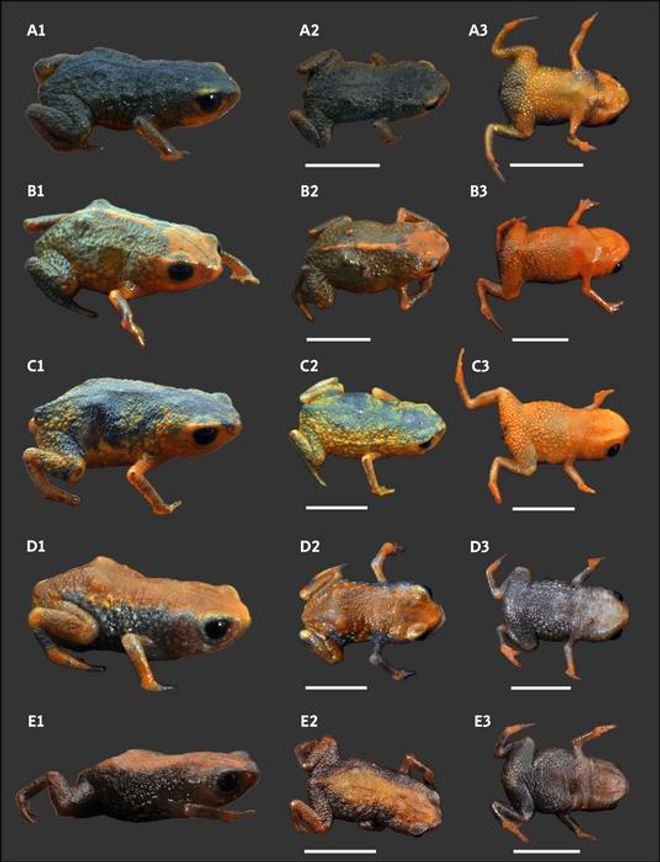
Variations of the pumpkin toadlet species
(Image Credit: Bornschein et al., 2025, PLOS One, CC-BY 4.0)
There are 42 members of the genus Brachycephalus on record, of which only seven were known prior to the year 2000. Notable examples are B. ephippium and B. pitanga, which are deaf to their own calls and boast bones that glow under UV light, according to a study in Scientific Reports.
These tiny amphibians are among the smallest tetrapods (four-limbed animals) on the planet. Males of the B. lulai species, for example, are just 8.9 to 11.3 millimeters (0.35 to 0.44 inches) long. Females are marginally bigger at 11.7 to 13.4 millimeters (0.46 to 0.53 inches).
In terms of appearance, B. lulai are a striking orange and bear distinctive brown and green patches. And yet, despite having a skin color that resembles a high-vis jacket, these toadlets are surprisingly hard to spot. It was their impressive vocal performance, not their looks, that led to their discovery. These calls are distinct from those of other Brachycephalus that live locally, comprising two notes, each containing up to four pulses.
Analysis of mitochondrial and nuclear DNA, combined with morphological and acoustic comparisons with other pumpkin toadlets, confirmed that this was indeed a new species.
The Cloud Forests Of Southern Brazil
B. lulai can be found scurrying through the leaf litter of southern Brazil’s Serra do Quiriri mountain range, a region marked by highland grasslands and high-altitude rainforests enveloped in mist (cloud forests).
Although the range of B. lulai is relatively compact, the species appears locally abundant in at least two areas: Pico Garuva and Monte Crista. The fact that these two locations are 3.9 miles (6.3 kilometers) apart means it is likely that there are also populations of B. lulai in the forested hillside between the two areas.
Calls To Ramp Up Conservation Efforts
More than 2.1 million species have been described by science to date, and thousands more continue to be added every year, according to the Natural History Museum. This process is being sped up by the development of DNA sequencing, which is enabling scientists to name new species like never before — take, for example, the nine new butterflies found hiding in London’s Natural History Museum earlier this month.
At the same time, scientists say we are witnessing extinction rates hundreds or thousands of times higher than the national average, according to the National Museum of Natural History.
Due to a lack of evidence suggesting otherwise, the study’s authors recommend classifying B. lulai as a species of Least Concern. Still, noting the relatively restricted range of this and other Brachycephalus species, the researchers recommend establishing a Refúgio de Vida Silvestre (RVS) Serra do Quiriri to protect the toadlet and other regionally endemic species.
“Although Brachycephalus lulai sp. nov. is currently classified as Least Concern, this status is based on the absence of observed ongoing decline and the apparent lack of plausible future threats. Nevertheless, it is essential to continue systematically monitoring this scenario,” the study’s authors wrote.
“The new species is found close to other endemic and threatened anurans, justifying a proposition for the Refúgio de Vida Silvestre Serra do Quiriri, a specific type of Integral Protection Conservation Unit that would not necessitate expropriation of land by the government. This unit would help ensure both the maintenance and potential improvement of the conservation status of these species,” the study authors concluded.
Read More: This Frog’s Secret Power? Eating Venomous Murder Hornets Like Popcorn
Article Sources
Our writers at Discovermagazine.com use peer-reviewed studies and high-quality sources for our articles, and our editors review for scientific accuracy and editorial standards. Review the sources used below for this article:
- This article references information from the recent study published in Plos One, A new species of Brachycephalus (Anura: Brachycephalidae) from Serra do Quiriri, northeastern Santa Catarina state, southern Brazil, with a review of the diagnosis among species of the B. pernix group and proposed conservation measures
- This article references information from the recent study published in Scientific Reports: Intense bone fluorescence reveals hidden patterns in pumpkin toadlets
- This article references information from the Natural History Museum: What is a species, and how many species are there?
- This article references information from the Natural History Museum: Nine new butterfly species discovered by scientists tackling taxonomic tangle
- This article references information from the National Museum of Natural History: Extinction of Plants and Animals
 English (US)