
.jpg) 3 hours ago
3
3 hours ago
3
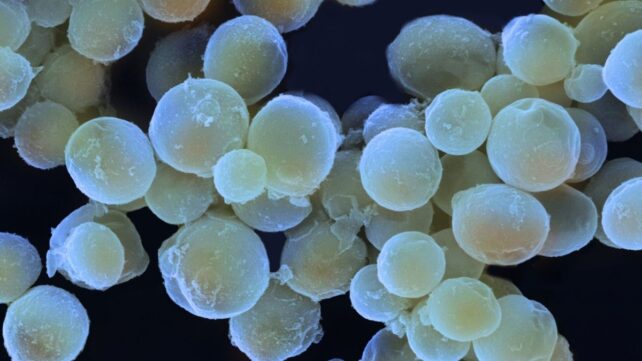 Fungi in the Arctic sediments could look a bit like this. (David Spears FRPS ASIS FRMS/Corbis Documentary/Getty Images)
Hidden inside tree trunks, between grains of soil, deep within our bodies, and below our feet, fungi seem to wind their way into everything.
But did you know fungi actually live in the ocean, too?
New research published in PLOS Biology reveals the overlooked role of marine fungi in the carbon cycle by zooming in on the seawater and sediments that line an Arctic fjord in Norway.
We're only just starting to understand how widespread fungi are on this planet, and how much they contribute to the global carbon cycle.
Marine fungi are easily overlooked because they're microscopic, but that doesn't mean their impact is small.
For the first time, scientists quantified how much fungi in marine sediments are incorporating dissolved, free-floating amino acids into their bodies, trapping carbon and nitrogen.
"Our study shows that fungi in the Arctic Ocean can contribute significantly to carbon storage in sediments via their highly efficient metabolism," explains geomicrobiologist William Orsi of Ludwig Maximilian University of Munich (LMU Munich) in Germany.
"This is important because it is a previously unknown mechanism of microbial carbon storage in Arctic fjords, key geological settings that store more than 10 percent of all the carbon buried below the seafloor."
Orsi and his colleagues collected samples from across the landscape of a coastal inlet region called Kongsfjorden: glacial environments and tundra soils adjacent to the fjord, as well as seawater and sediments from within.
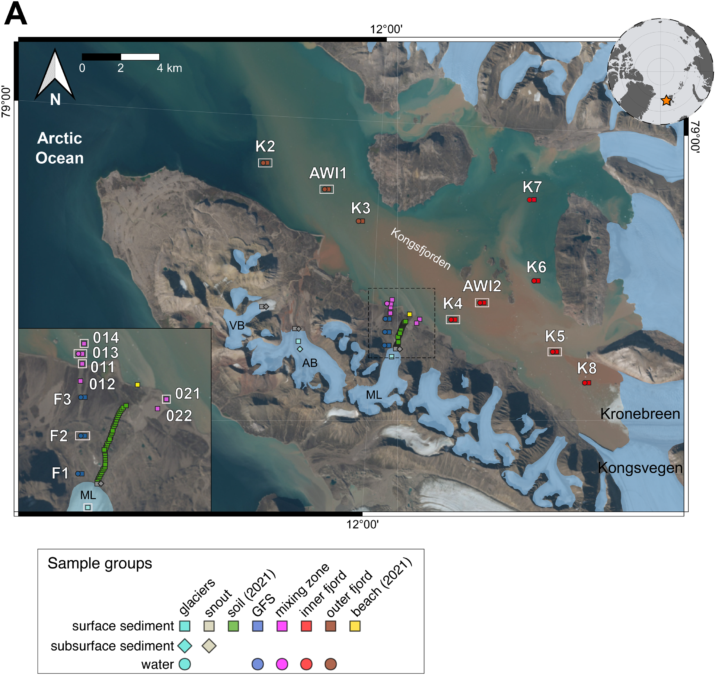 Samples were collected from around Kongsfjorden. However, fungal taxon data were assessed for just one site: AWI2. (Trejos-Espeleta et al., PLOS Biol., 2026)
"Sampling and developing experiments in the High Arctic is still a challenging task, just like understanding fragile, dynamic ecosystems such as a glaciated fjord," says the study's lead author, Juan Carlos Trejos-Espeleta, a geomicrobiologist at LMU Munich.
"This is why studies in these parts of the planet are rare but paradoxically have a high level of urgency… Only recently we are looking at marine fungi as important participants in the marine carbon cycle, having a potential role in carbon sequestration, just as it is known for terrestrial environments."
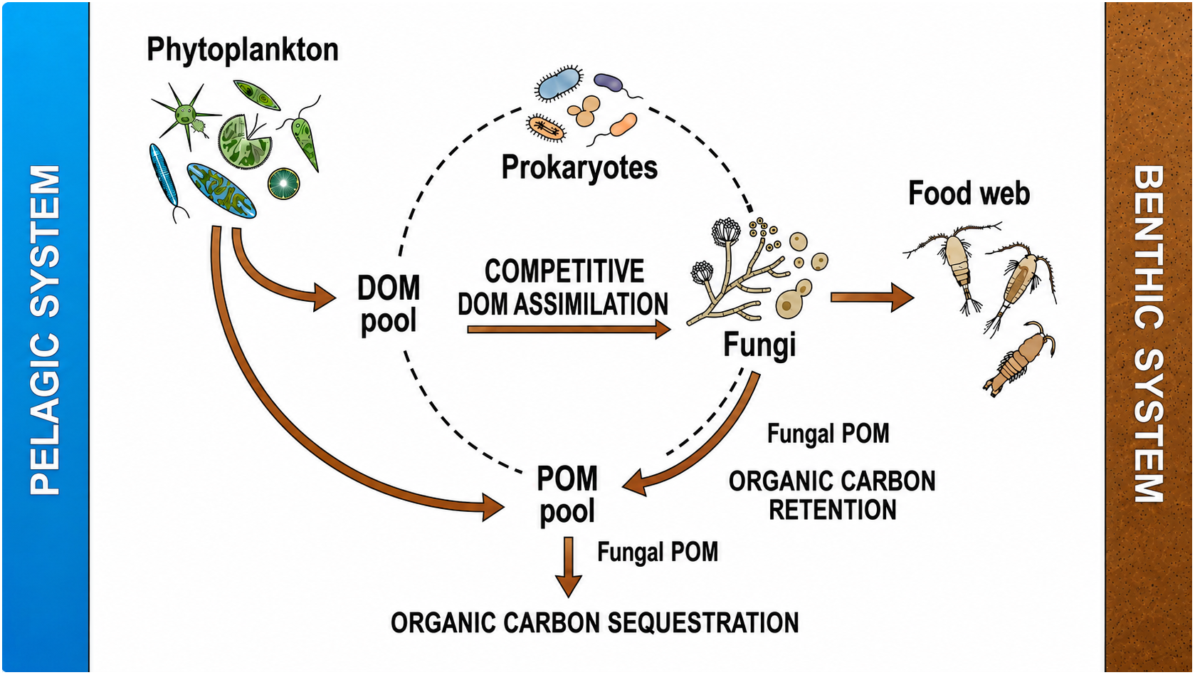 Conceptual model of fungal contributions to the marine carbon cycle in pelagic and benthic systems, integrating findings from the new study by Trejos-Espeleta and colleagues. (Reich, PLOS Biol., 2026)
As with soils from above the waterline, the underwater sediments were riddled with a mix of fungi and prokaryotes (bacteria and archaea).
That balance seems to be especially important to carbon equations.
"Easily degradable dissolved organic matter was considered primarily the niche of bacteria," writes molecular mycoecologist Marlis Reich of the University of Bremen.
"The new study by Trejos-Espeleta and colleagues shatters this paradigm."
Reich was not involved in this research, but she wrote an accompanying commentary that was published alongside it.
"Fungi in microbial communities are not just competitors but can outperform bacteria in dissolved organic matter assimilation, demonstrating that carbon cycling in marine ecosystems is far more complex than previously assumed and urgently needs to be studied with a holistic angle," she adds.
Where fungi were the bigger contributors in consuming organic matter, far less carbon dioxide was emitted than in samples where prokaryotes had a stronger hold in the ratio.

That pattern applied to both fjord sediment and tundra soils, although surprisingly, the fungi-to-prokaryote biomass ratio was much higher on the seafloor than on land.
More than 80 distinct varieties of fungi were participating in this natural carbon capture phenomenon, 34 of which fall into a group known as 'aquatic hyphomycetes', which belong to the genus Alatospora.
In comparison, only seven varieties of amino-acid-hungry fungi were found in nearby soils.
In incubation experiments, these seafloor fungi continued to chew up amino acids pretty efficiently even when oxygen was scarce. Alatospora in particular seemed unfazed by a lack of oxygen, though it's probably used to it – the Arctic fjord sediments are anoxic just a few millimeters below the seafloor's surface.
"Arctic fjords are major hotspots of carbon sequestration, but the role of fungi in these systems has been largely overlooked," says James Bradley of the Mediterranean Institute of Oceanography.
"Our results show that fungi in fjord sediments can efficiently retain labile organic matter as biomass, which means they may contribute directly to carbon storage at the seafloor."
Even at the bottom of a fjord, it appears fungi are hard at work converting organic matter into solid biomass – preventing it from being released into our atmosphere as carbon dioxide.
Related: Ecosystems of Rock-Eating Fungus And Tardigrades Found Thriving Deep Within a Gas Shale
But the team is concerned they've barely scratched the surface of these long-overlooked underwater ecosystems, at a time when they are rapidly changing.
"The Arctic is changing before our eyes at unprecedented rates and the efforts to understand its ecosystems' functioning remain insufficient," says Trejos Espeleta.
"Future research should not ignore fungi anymore as key agents of carbon cycling."
The research was published in PLOS Biology.
This article was fact-checked by Rachel Garner and edited by Peter Dockrill. While we pride ourselves on our process, we are only human. If you spot a mistake, please let us know.
 English (US)