
.jpg) 2 hours ago
4
2 hours ago
4
Article content
(Bloomberg) — The rapid deployment of solar power is one of the greatest stories of the 21st century.

THIS CONTENT IS RESERVED FOR SUBSCRIBERS ONLY
Subscribe now to read the latest news in your city and across Canada.
- Exclusive articles from Barbara Shecter, Joe O'Connor, Gabriel Friedman, and others.
- Daily content from Financial Times, the world's leading global business publication.
- Unlimited online access to read articles from Financial Post, National Post and 15 news sites across Canada with one account.
- National Post ePaper, an electronic replica of the print edition to view on any device, share and comment on.
- Daily puzzles, including the New York Times Crossword.
SUBSCRIBE TO UNLOCK MORE ARTICLES
Subscribe now to read the latest news in your city and across Canada.
- Exclusive articles from Barbara Shecter, Joe O'Connor, Gabriel Friedman and others.
- Daily content from Financial Times, the world's leading global business publication.
- Unlimited online access to read articles from Financial Post, National Post and 15 news sites across Canada with one account.
- National Post ePaper, an electronic replica of the print edition to view on any device, share and comment on.
- Daily puzzles, including the New York Times Crossword.
REGISTER / SIGN IN TO UNLOCK MORE ARTICLES
Create an account or sign in to continue with your reading experience.
- Access articles from across Canada with one account.
- Share your thoughts and join the conversation in the comments.
- Enjoy additional articles per month.
- Get email updates from your favourite authors.
THIS ARTICLE IS FREE TO READ REGISTER TO UNLOCK.
Create an account or sign in to continue with your reading experience.
- Access articles from across Canada with one account
- Share your thoughts and join the conversation in the comments
- Enjoy additional articles per month
- Get email updates from your favourite authors
Sign In or Create an Account
or
Article content
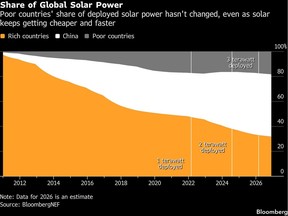
After crossing the 100-gigawatt mark in 2012, it took the world 10 years to deploy 1 terawatt of solar power. An additional 1 terawatt, enough to meet all of US power demand at its peak, took less than three years to build. Not even two years later in 2026 — the precise timing is subject to debate among analysts — the 3-terawatt threshold was reached.
Article content
Article content
Article content
No one really noticed.
Article content
By signing up you consent to receive the above newsletter from Postmedia Network Inc.
Article content
That makes sense. For most people, the increased deployment of solar isn’t perceived in figures, but in other ways. “Take a train anywhere, say in the UK, and you’re likely to spot solar panels,” said Lara Hayim, head of solar research at BloombergNEF.
Article content
The visual signal is only going to get stronger. Forecasters are so bullish about solar that, in just a few years, the 3-terawatt milestone will seem almost insignificant. BNEF expects the world to deploy more than 9 terawatts of solar by 2036.
Article content
But dig in a little deeper and you’ll find interesting stories. The first terawatt was mostly rich countries subsidizing the installation of solar, with China and poor countries still finding photovoltaics too expensive. That story changed going into the second and third terawatt, with China taking the baton from rich countries.
Article content
The result is that, even as the world has added solar power at an accelerated pace, the share of deployment going to poor countries has largely stalled since 2020. China has clearly been the main driver of the global story, said Hayim. But disaggregate the numbers, and “you can now see solar booms in other countries too.” In the past few years, countries like Pakistan, Nigeria and the Philippines have seen an extraordinary increase in the amount of solar power installed on rooftops. Some smaller markets, such as Cuba and Lebanon, have also seen rapid uptakes. It’s why the number of countries with at least 1 gigawatt of solar installed has grown to as many as 74 last year, up from 42 in 2020.
Article content
Article content
China’s solar deployment has been faster than the buildout of supporting infrastructure, such as transmission and batteries. That’s leading to more curtailment of solar production during peak hours, and thus a waste of resources. So analysts expect deployment in China to slow down. In its latest five-year plan, the country announced a series of measures to increase renewables consumption, rather than production, by more than 50%.
Article content
BloombergNEF expects that poor countries’ share of solar deployment will start growing again from this year onward. Most developing countries are starting with very low amounts of solar penetration in the grid and won’t hit the limits that China and other big adopters are facing now. By 2036, more than a quarter of all solar deployed will be in developing countries, with rich countries’ share falling to about 20%.
Article content
The boom in solar power has happened as countries have overcome local issues, from a lack of skilled workers to challenges of managing a grid with intermittent renewables. Still, Hayim says the main constraint for developing countries continues to be the lack of accessible financing.
 English (US)