
.jpg) 1 hour ago
3
1 hour ago
3


Article content
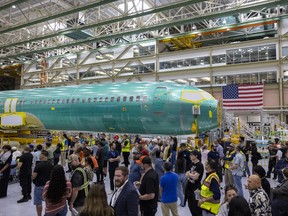
At Boeing’s airplane assembly plant in the city of Everett, just north of Seattle, a pair of giant doors open and a 44 metre-long fuselage covered in green primer is slowly wheeled into the facility.

THIS CONTENT IS RESERVED FOR SUBSCRIBERS ONLY
Subscribe now to read the latest news in your city and across Canada.
- Exclusive articles from Barbara Shecter, Joe O'Connor, Gabriel Friedman, and others.
- Daily content from Financial Times, the world's leading global business publication.
- Unlimited online access to read articles from Financial Post, National Post and 15 news sites across Canada with one account.
- National Post ePaper, an electronic replica of the print edition to view on any device, share and comment on.
- Daily puzzles, including the New York Times Crossword.
SUBSCRIBE TO UNLOCK MORE ARTICLES
Subscribe now to read the latest news in your city and across Canada.
- Exclusive articles from Barbara Shecter, Joe O'Connor, Gabriel Friedman and others.
- Daily content from Financial Times, the world's leading global business publication.
- Unlimited online access to read articles from Financial Post, National Post and 15 news sites across Canada with one account.
- National Post ePaper, an electronic replica of the print edition to view on any device, share and comment on.
- Daily puzzles, including the New York Times Crossword.
REGISTER / SIGN IN TO UNLOCK MORE ARTICLES
Create an account or sign in to continue with your reading experience.
- Access articles from across Canada with one account.
- Share your thoughts and join the conversation in the comments.
- Enjoy additional articles per month.
- Get email updates from your favourite authors.
THIS ARTICLE IS FREE TO READ REGISTER TO UNLOCK.
Create an account or sign in to continue with your reading experience.
- Access articles from across Canada with one account
- Share your thoughts and join the conversation in the comments
- Enjoy additional articles per month
- Get email updates from your favourite authors
Sign In or Create an Account
or
Article content
The Everett plant, the largest building on Earth by volume, once produced the four-engined 747 jumbo jet that redefined long-haul air travel from the 1970s onwards.
Article content
Article content
Article content
This month it began assembly of a much smaller but no less important aircraft in the context of Boeing’s long history.
Article content
By signing up you consent to receive the above newsletter from Postmedia Network Inc.
Article content
The Max 10, a new, larger version of the long-running 737 family, is “crucial for their financial performance, and their pathway to positive cash flow”, according to Kevin Michaels, managing director at AeroDynamic Advisory.
Article content
The aerospace and defence group is also counting on the Max 10 to restore its reputation after a catastrophic series of accidents triggered a regulatory clampdown, curtailing its ability to deliver planes to customers.
Article content
Boeing’s chief executive Kelly Ortberg, who has improved relations with regulators since he took over in August 2024, on Tuesday reported improved financial results and hailed the “fundamental improvements we made to factory health”.
Article content
Others have also noticed the change. “They are doing a terrific job in Boeing at the moment,” Ryanair boss Michael O’Leary, one of the company’s most important customers, told investors earlier this year. “They really are getting that thing turned around.” Boeing shares have recovered around a third of the value they shed between 2019 and 2022.
Article content
Article content
But much more will be required for the company to return to regular profits and once again mount a serious challenge to Airbus, the European group that has been the world’s largest planemaker by deliveries for the past seven years while Boeing has been mired in crisis.
Article content
Article content
According to aviation research firm Leeham Co, Boeing’s commercial airliner division alone has lost more than US$46 billion since 2019. It estimates that, left with little pricing power after years of delayed and cancelled aircraft deliveries, the company lost an average of US$2.8 million on each of the 314 planes it has delivered this year.
Article content
Fixing the 737 issues is critical, but it is not Ortberg’s only challenge. He must also resolve problems with Boeing’s delayed wide-body 777X program and decide when to launch a next generation short-haul model that will shape the company’s fortunes for decades to come.
Article content
The repercussions of his success or failure will be felt far beyond the giant plane factories in north-western America.
Article content
With global passenger kilometres flown forecast to double between now and 2050, according to the International Air Transport Association, the health of Boeing and Airbus — and any companies that might one day supplant them — will determine how expensive, how comfortable and how safe it will be to fly.
Advertisement 1
Advertisement 2
Article content
“Ortberg has a dozen balls in the air at the same time, and it would be very easy to drop a ball or two,” says Scott Hamilton, Leeham’s managing director.
Article content
“It’s still very much an uphill climb.”
Article content
Article content
Article content
Boeing’s existential crisis began in 2018, when a 737 Max 8 plunged into the Java Sea off Indonesia minutes after take-off.
Article content
A total of 346 people died in that crash and another involving a Max 8 in Ethiopia four months later. The revelation that crashes were caused by flawed sensors and control systems shattered Boeing’s reputation for engineering excellence and tarnished its standing among customers and passengers.
Article content
In the years that followed profits tumbled and debt soared, allowing Airbus to consolidate its lead in the all-important short-haul market despite having production issues of its own with the A320/321 series.
Article content
When a door plug blew out of an Alaska Airlines 737, this time a Max 9, during a routine flight in 2024, the Federal Aviation Administration introduced an intrusive inspection regime and restricted 737 production at Boeing’s Renton plant to 38 a month.
Article content
The FAA has since lifted the cap to 47 jets a month, and this month said it would allow Boeing to issue its own airworthiness certificates for all 737 Max and wide-body 787s for the first time since 2019.
Article content
Article content
But with Airbus’s A321neo model sold out until well into the 2030s, airlines are desperate to get their hands on the Max 10 — Boeing’s rival stretched short-haul jet — as they look to increase capacity and lower operating costs on key routes.
Article content
“We’ve been waiting a really long time for the Max 10 and hopefully that wait is coming to an end,” United Airlines’ chief commercial officer Andrew Nocella told investors earlier this month.
Article content
The model now accounts for 51 per cent of all 737 Max orders since 2020 — even though it has not yet been certified for delivery by the FAA. That makes it central to the wider Max program, which itself accounts for more than 70 per cent of Boeing’s order backlog of almost 7,000 jets.
Article content
But with production in Renton constrained by FAA caps and space limitations, Ortberg has been forced to spend US$1 billion replicating a 737 line 30 miles away in Everett in order to hit his next target of 52 narrow-body jets a month.
Article content
Standing on the floor of the Everett factory, Jennifer Boland-Masterson, senior director for Boeing’s North Line production, describes how 1,000 employees — half veterans of Renton, and half new hires — will eventually be deployed to the cavernous facility, a section of which was vacated after Boeing moved production of the 787 twin-aisle jet to South Carolina.
Article content
Article content
Michaels, at AeroDynamic, describes how Ortberg has changed employee incentives in order to force a shift from “get it out the door” to a “get it right” mentality, empowering workers to halt production if quality issues arise.
Article content
In a sign of Boeing’s caution, the Everett line will start by producing just one jet a month, with a view to producing five a month by the end of year, compared with 15 to 16 planes a month on a Renton line.
Article content
Ortberg acknowledged last year that operating a new line at such a low production rate would put “a little bit of pressure” on short-term profitability.
Article content
“That’s code for ‘lose money’,” says Hamilton of Leeham. He says Boeing is assembling Max 10s on the North Line ahead of FAA certification with a view to building up inventory for when the variant is cleared for delivery.
Article content
That depends, however, on everything going right in an industry where anything can go wrong.
Article content
Boeing confirmed that the Max 10 has completed all of the test flights required for certification, although it had only submitted 30 per cent of the tens of thousands of pages of paperwork to the FAA.
Article content
“The airplane’s been flying fantastic,” says Chris Payne, Boeing’s 737 Max program development lead. He adds that “we’re not making configuration changes” — meaning no engineering or technical issues have arisen that would require modification and delay the certification process.
Article content
Jon Ostrower, an aviation expert and editor-in-chief of industry publication The Air Current, notes that the size of the Max 10 means it has several unique design features distinguishing it from other 737s, including new, elongated landing gear that prevents the rear of the fuselage striking the ground during landings.
Article content
“The landing gear has done extremely well in testing,” says Ostrower. “But in the aerospace industry it’s never the thing that companies spend a lot of time worrying about that ends up tripping them up.”
Article content
Observers caution that the 737 Max’s fuselages are still being produced by Kansas-based Spirit AeroSystems, the troubled former supplier that produced the door plug that blew out of the Alaska Airlines jet in 2024.
Article content
Boeing acquired the company last year and Ihssane Mounir, senior vice-president of supply chain and fabrication, says that since then 737 fuselage defects requiring “rework” had been reduced by 30-40 per cent. But he acknowledged it was “absolutely not trouble-free” and that “there’s a lot of things that we need to work on together”.
Article content
Article content
Hamilton says that even if Boeing and Spirit fix the outstanding issues, they remain at the mercy of a dizzyingly complex supply chain already clogged by shortages of everything from skilled labour to rare earth metals, seats, windows and engines.
Article content
He adds that something as simple as a missing USB port on the back of a seat can prevent an aircraft from being delivered.
Article content
“You’re talking about a 10,000-piece jigsaw puzzle, and one missing piece can mess up the whole operation.”
Article content
Article content
Even if the rehabilitation of the 737 Max program proceeds without a hitch, analysts stress this will not restore Boeing’s fortunes without progress in its wide-body fortunes.
Article content
Sitting in another section of the Everett facility are 30 777-9 twin-aisle aircraft, some of which have been stored there since 2020.
Article content
The 777X program, of which the 777-9 is the biggest variant, is another big item on Ortberg’s long to-do list. The 777-9 had been due to enter service six years ago but has been plagued by production and regulatory challenges. Boeing last year took a US$4.9 billion charge against the program.
Article content
Article content
Speaking in London earlier this month, Ortberg said the company was on track to deliver its first 777-9 next year, but conceded that planes built years ago would need more work to bring them up to date.
Article content
Ortberg said Boeing had a “dedicated team” using a “side shop” that was separate from its production line for new jets. “We’ll be doing the modifications of the aeroplanes that are already built,” he said, adding that “will be over the next couple years. It’s not a short process to get that done.”
Article content
Tim Clark, the president of Dubai-based Emirates and one of the program’s launch customers, told reporters at the Farnborough Air Show last week that he was expecting delivery of the jets from the middle of next year, but would not accept delivery of the 10 older aircraft, arguing they had been overtaken by subsequent design changes.
Article content
“They will probably have to cut them up in my view because they should have taken a charge by now and written them out of their balance sheet,” Clark said. He added that Emirates remains committed to its overall order of 270 planes and that he was “quietly confident” that Ortberg and Stephanie Pope, the head of Boeing’s commercial aircraft division, were “getting this corporation back on to its feet”.
Article content
“In some respects the imposition of the regulator… slowing them down… has made them step back and have a good hard think about it,” Clark added. “So in the last two years there has been a huge review internally of processes, of safety and quality et cetera… We don’t want to knock that.”
Article content
Even though Boeing still dominates in wide-bodied airliners, its European rival is not standing still. Airbus is studying plans for a larger version of its own A350 aircraft that would mark a return to the market for the world’s biggest planes.
Article content
Article content
Article content
The struggles of the 737 Max and 777X programs illustrate the dilemmas that litter Boeing’s narrow path back to profitability. But Ortberg’s legacy will also be determined by another key decision.
Article content
Last week, he revealed that the company had started work on a new design for a successor to the 737 Max program. Boeing, he told reporters in London, was “spending time and money preparing ourselves to be ready when the market’s ready”.
Article content
Airbus has already said it plans to launch a new narrow-body program in 2030, with the aim of having a successor for its best-selling A321 family of jets in service in the second half of the next decade.
Article content
Article content
But Ortberg’s view is that the market is probably “less ready today than it was a year ago”, and that airlines were focused on ensuring that today’s planes were performing.
Article content
Carriers have become increasingly frustrated over the durability of aircraft and some of the newest engines, which have led to costly repairs and a shortage of spares, forcing some to ground planes.
Article content
“I’m not going to jump to something new until we’re sure that we’ve got a mature technology,” said Ortberg, adding that he was unconcerned about Airbus stealing a march.
Article content
“This is a long play… so whether they start one year or we start one year, I don’t think it’s as important as making sure that we’ve got the right aeroplane for the customer.”
Article content
A defining feature of these next-generation aircraft will be how they are powered. While Airbus is working with CFM International, a joint venture between GE Aerospace and Safran, to test a novel “open fan” engine without a traditional casing, Ortberg said Boeing’s current baseline is a more traditional, enclosed turbine.
Article content
But Ron Epstein, a veteran aerospace analyst at Bank of America, says it is imperative that Ortberg learns from one of Boeing’s “biggest mistakes”.
Article content
Article content
In 2011, fearful of losing a giant order from American Airlines, it chose to extend the life of the 737 through the Max program instead of developing a new generation of aircraft.
Article content
The result, Epstein adds, is that Boeing continues to rely on an airframe that was designed more than 60 years ago and which is “rigged up like an old bicycle” using cables to connect the pilot’s controls to the tail.
Article content
Airbus’s much newer A320/321 series, whose control surfaces are operated by “fly-by-wire” electronics, is a generation ahead of the 737 in design terms and has swept all before it. In 2022, the A320 became the bestselling aircraft ever despite launching two decades after the 737.
Article content
The European group reported a surge in profits for the second quarter after a sharp pick-up in deliveries of its jets, and signalled it has recovered from a period during which supply-chain bottlenecks prevented increased production of A320 jets.
Article content
“That’s why Kelly’s decisions when it comes to capital deployment are so important,” says Epstein. “Because a decision he makes now will have an impact on that company and the industry for the next 30 years.”
Article content
Additional reporting by Peter Campbell in London
Article content
© 2026 The Financial Times Ltd
Article content

We apologize, but this video has failed to load.
Article content
 English (US)