
.jpg) 2 hours ago
4
2 hours ago
4
When the FDA was deciding whether to approve the drug Tavneos several years ago to treat a set of rare autoimmune diseases, agency experts argued that would be a mistake, according to FDA records.
One problem cited: The manufacturer had provided only “limited safety data.”
As it often does, the FDA in 2021 approved the drug with a proviso: It required the manufacturer to conduct an additional years-long safety study once the drug was on the market.
Today, like many similar “postmarket” studies mandated by the FDA, that additional study is delayed, according to a federal database. As of last fall, only 21 of the planned 300 patients had been enrolled, the FDA said in an April letter and regulatory posting.
Meanwhile, the FDA has identified dozens of cases of liver damage “possibly” or “probably causally associated” with the drug. That was one of the potential side effects the postmarket study was meant to evaluate.
Tavneos illustrates the perils of the FDA’s approach to many drugs and medical devices — and the frequent lapses in follow-through.
A KFF Health News analysis of Food and Drug Administration data found hundreds of postmarket studies listed as delayed. In some cases, the work was delayed by more than a decade or the manufacturer was still developing a plan for the study.
As a result of delays, patients, doctors, and others could be left in a fog about the risks and benefits of the drugs or devices, even as they stake their money, their health, or their lives on the products.
Postmarket study requirements “have often proven toothless,” said cardiologist Sanket Dhruva, an associate professor of medicine at the University of California-San Francisco who has published related research.
The FDA’s reliance on postmarket studies reflects a balancing act.
Making new treatments available faster can save or improve lives, especially when patients with grim prognoses and no good options have little to lose. The full risks and benefits may be revealed only over the long term, and when therapies are used by far more people than even large clinical trials enroll.
But relying on post-approval studies to resolve questions risks exposing patients to products that do more harm than good. Whoever is paying the bills — patients, insurance companies, employers, or government health programs such as Medicare and Medicaid — can end up wasting money and rewarding manufacturers for useless or risky products.
“Doctors rely on this evidence, patients rely on this evidence, and if that evidence is not there, it’s going to lead to a lot of uncertainty,” Dhruva said.
Trump administration policy changes designed to hasten drugs through FDA review could leave more riding on postmarket studies, medical researchers say.
For example, in February, FDA leaders announced that “the default requirement” for agency approvals will be one clinical trial instead of two.
Reducing pre-approval testing “will inevitably put a lot of pressure on the post-approval system,” said Aaron Kesselheim, a professor at Harvard Medical School who has analyzed postmarket studies.
FDA officials said the new policy would “substantially reduce costs” for manufacturers and “speed drugs to market.” Writing in The New England Journal of Medicine, they denied the change would compromise safety or efficacy, saying that “erroneous conclusions may be reached even with two, three, or four studies.”
In response to questions for this article, a spokesperson for the Department of Health and Human Services, which includes the FDA, said postmarket studies can experience delays for legitimate reasons. “Assessing the significance of any delay requires a case-specific review,” said the spokesperson, Emily Hilliard.
The fact that a study is delayed “should not be treated as evidence that a product has an unresolved safety or effectiveness issue,” Hilliard said.
Amgen, the company that makes Tavneos, is still working on the postmarket research the FDA mandated, company spokesperson Alison Chartan said, adding, “We remain committed to completing this important study.”
 Amgen’s headquarters in Thousand Oaks, California, in May 2023. (Mario Tama/Getty Images)
Behind Schedule
An FDA database downloaded by KFF Health News in August tracks the progress of postmarket studies that makers of drugs or biologics — such as vaccines and gene therapies — were required to perform or promised to perform.
The database showed almost 600 were running behind schedule.
Of those, more than 250 originally had final reports due before July 31, 2026 — the date that, according to an FDA webpage, the database last had been updated.
About a third of ongoing studies were listed as delayed.
In some cases, the FDA has granted extensions. In others, it has denied them. And in rare instances, the products were discontinued before the studies ran their course.
Postmarket studies can involve clinical trials or other analyses of patient data. They can look at safety or efficacy. A product can be the subject of more than one postmarket study.
The nearly 600 delayed studies involved almost 350 products, KFF Health News found.
The FDA has defined delayed as behind the original schedule. That can mean off track or overdue.
As of August, other FDA databases tracking medical devices listed dozens of postmarket studies as behind schedule.
Products included:
The CustomFlex Artificial Iris, a prosthesis implanted in the eye in place of damaged, defective, or congenitally missing irises. The protocol for a study in children was accepted in 2019, the database said. The study was meant to follow patients for five years. According to an FDA page downloaded in August, zero patients were enrolled.
Barbara Fant of Clinical Research Consultants, to whom the FDA’s 2018 letter approving the product was addressed, said the rarity of an eye disease called aniridia poses challenges for post-approval studies. The German manufacturer, the U.S. distributor, and Clinical Research Consultants are working with the FDA to identify alternative ways to fulfill the postmarket requirements, Fant said.
“Confirming the long-term safety of the device remains a top priority for both the study team and FDA,” Fant said.
Paxlovid, a treatment for covid. A study to assess its safety in pregnant women was originally to be completed by the end of 2024, the FDA database said. “The trial completion and final report milestones were missed,” the database said.
Pfizer, the manufacturer, is working with the FDA and remains committed to “submitting results as soon as practicable,” Pfizer spokesperson Jerica Pitts said.
The Scandinavian Total Ankle Replacement system. The device and the original protocol for the clinical trial were approved in 2009. The study was meant to include a minimum of 500 subjects, the database said, but the actual number enrolled was 142. Almost half those patients had one or more adverse events, with dozens of “reoperations,” “revisions,” or “removals,” the database said.
Rachel Colloff and Cristina Pasquino — spokespeople for Enovis, which markets STAR Ankle — did not respond to multiple inquiries. Jenny Braga, a spokesperson for Stryker, which previously sold the product, did not answer questions about the postmarket study.
Oxaydo (originally named Oxecta), a form of the potentially addictive opioid painkiller oxycodone touted as designed to deter abuse. When the FDA approved it in 2011, it required the manufacturer, part of Pfizer, to conduct a postmarket study to assess whether it reduces “misuse and abuse, and their consequences: overdose, death and addiction.” The final report was originally scheduled to be submitted in 2016.
The FDA database listing the study as delayed said the agency “issued a failure to respond letter” in 2022.
Today the issue may be all but moot.
Control of the product passed from company to company over the years until 2023, when Acura Pharmaceuticals said in a Securities and Exchange Commission filing that patents on Oxaydo would begin expiring that year and it didn’t intend to continue marketing the drug.
According to another FDA database, Oxaydo has been discontinued.
The FDA has enforcement powers and uses them “where appropriate,” HHS’ Hilliard said. She did not provide requested details, and she did not answer questions about the studies listed above.
Delay Can Pay
For manufacturers, delay can pay, Harvard’s Kesselheim said. While postmarket studies are ongoing, companies can continue to sell the products.
“Medicare and Medicaid spent more than $18 billion from 2018 to 2021 for accelerated approval drugs with incomplete confirmatory trials past their original planned completion dates,” the HHS Office of Inspector General estimated in 2022.
The FDA can demand postmarket studies for a variety of reasons, including to address concerns that arise after a product has been approved. Some look at uses not covered by the original approval, and some are meant to shed light on serious risks that are already known.
In April, when it approved Foundayo, a weight loss drug made by Eli Lilly, the FDA required the company to conduct additional research to assess a variety of concerns, including “retained gastric contents,” “major adverse cardiovascular events,” and “drug-induced liver injury,” as well as effects of exposure during pregnancy, such as “major congenital malformations,” “spontaneous abortions,” and “stillbirths.”
The FDA said it approved the drug under the new Commissioner’s National Priority Voucher program, intended for products that “address critical national health priorities.” The program strives for an “ultra-fast” review, the FDA has said — one to two months, instead of six months or more with other expedited pathways.
“Postmarketing requirements and enhanced safety monitoring are a routine part of the FDA’s approach to evaluating newly approved medicines,” Eli Lilly spokesperson Kristiane Silva Bello said, “including ongoing monitoring in areas identified during clinical development.”
‘False Hope’
The FDA waded into a world of uncertainty in 2016 when it granted accelerated approval to a drug for Duchenne muscular dystrophy, a degenerative disease that primarily affects boys, disabling them at a young age and ultimately killing them.
Agency scientists had found that the drug, Exondys 51, was unproven and argued against greenlighting it.
Ellis Unger, then a senior drug evaluation official at the FDA, wrote in an internal memo that “thousands of patients and their families would be given false hope in exchange for hardship and risk.”
The manufacturer, Sarepta Therapeutics, conceded the uncertainty. “A clinical benefit of EXONDYS 51 has not been established,” it said when the drug, also known by the generic name eteplirsen, was approved.
The drug, the first FDA-approved treatment for Duchenne muscular dystrophy, targeted a subset of patients with the disease.
The FDA required Sarepta to conduct further studies and warned that it could withdraw approval if postmarket trials failed to verify a clinical benefit or were “not conducted with due diligence.”
Unger issued a warning of his own: “FDA has not succeeded in withdrawing the marketing of a single drug for lack of verification of clinical benefit following accelerated approval. The reality is that if eteplirsen is given accelerated approval, it is highly likely to remain on the market indefinitely, irrespective of whether or not efficacy is verified.”
Sarepta was originally required to submit a final report on a postmarket study by a May 2021 deadline, according to an FDA database and a 2016 FDA letter to the company.
Almost a decade after the drug was approved, and more than five years after that deadline, the study was listed in an FDA database as delayed.
“The final report milestone was missed, because the sponsor requested milestone extensions due to study delays,” the database said.
Meanwhile, in 2022 the website Pharmaceutical Technology ranked Exondys 51 as the second-most expensive drug in the U.S., at an annual cost of $750,000 to $1.5 million.
Last year, the drug generated $538 million in sales for Sarepta, according to a company presentation to investors.
Sarepta found it difficult to recruit patients for the postmarket clinical trial, company spokesperson Tracy Sorrentino said. The target population is small, patients were hesitant to enroll, and Sarepta was competing with other clinical trials for participants, Sorrentino said.
The study has been fully enrolled since 2023, Sorrentino said, and the company plans to provide an initial look at the data late this year.
‘Manipulated’
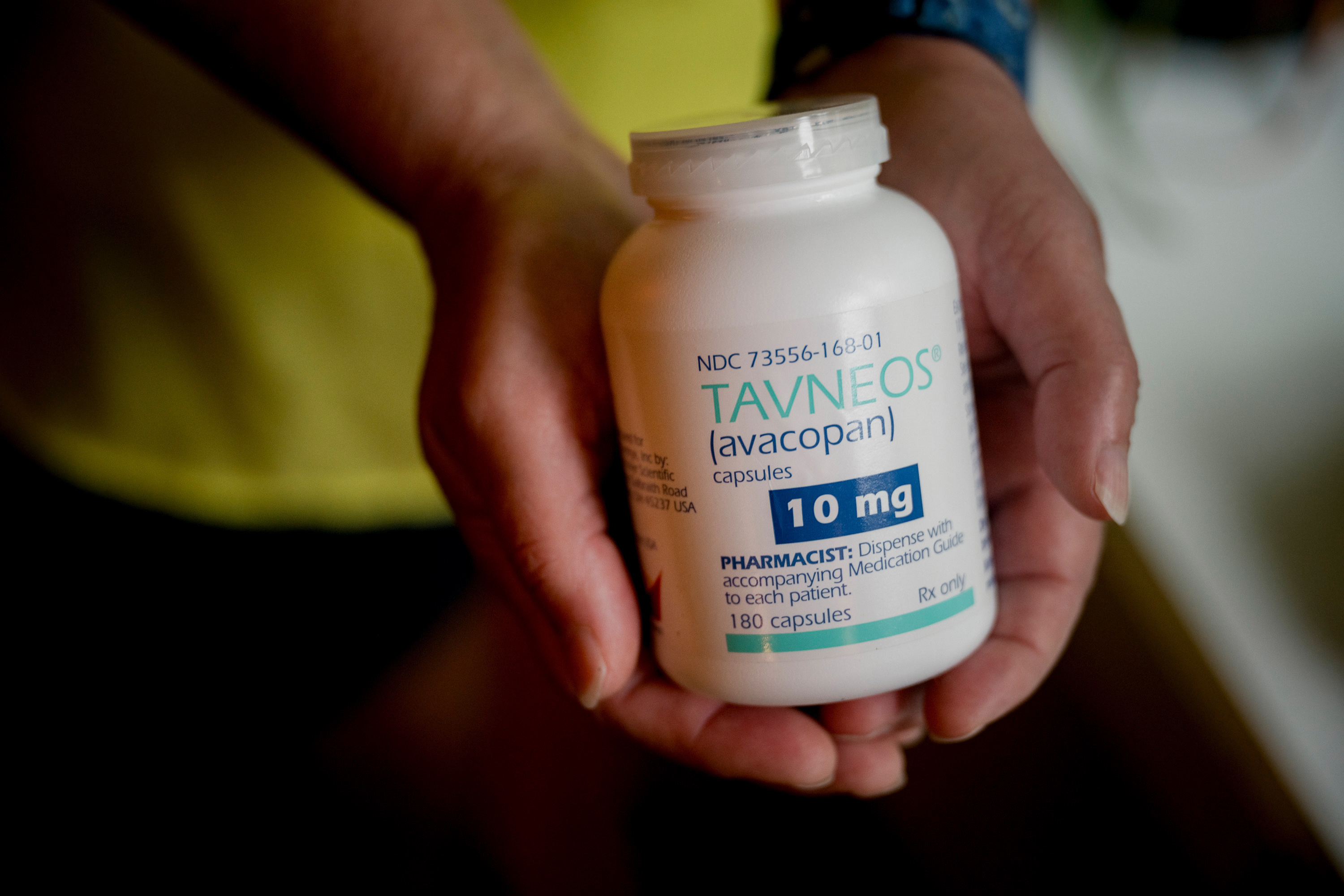 Amgen is the maker of the drug Tavneos. (Hannah Yoon/Bloomberg via Getty Images)
Amgen has cited similar challenges, even as Tavneos generated $459 million in global sales last year.
When an approved treatment is available, patients may be reluctant to enroll in a study in which they could be given a placebo, Amgen’s Chartan said.
The clinical trial was originally supposed to be done by the end of 2030. As of July 24, just 49 patients had been enrolled, Chartan said.
The FDA has said the study was to include 300 patients, and each patient enrolled must be followed for five years, said Hilliard, the HHS spokesperson.
Tavneos was approved to treat severe cases of a group of diseases — known by the shorthand ANCA-associated vasculitis — in which, as the Cleveland Clinic explains, the immune system inflicts potentially fatal damage on blood vessels and organs.
“As of January 2026, estimated real-world exposure” to Tavneos “exceeds 25,000 patient-years globally, consisting of over 6,500 in the United States and 19,000 abroad,” Amgen has said. (For context, one patient taking a drug for five years would amount to five “patient-years.”)
A clinical trial sponsored by ChemoCentryx to secure approval of Tavneos failed to prove it was effective, the FDA now alleges. Instead of disclosing that outcome to the FDA, company personnel “manipulated” the results, the FDA alleged in an April letter to Amgen.
Amgen, the parent company of ChemoCentryx, has denied the results were manipulated and has said the data “remain valid.”
Nonetheless, the European Union recently revoked its approval of Tavneos.
The FDA is trying to pull Tavneos from the market, and Amgen is fighting that effort.
The company has a lot riding on the outcome. Tavneos can cost more than $220,000 per year, according to the drug discount website GoodRx, and when Amgen acquired ChemoCentryx in 2022 for $3.7 billion, Tavneos was the only drug ChemoCentryx had brought to market.
In a June letter to the FDA, Amgen said the benefits of Tavneos outweigh the risks.
The FDA disagrees.
The FDA “can no longer conclude that there is, or has ever been, a valid demonstration of substantial evidence of effectiveness for TAVNEOS,” the agency wrote.
Citing 76 cases of DILI — drug-induced liver injury — the agency said it was “increasingly concerned about the safety profile of TAVNEOS.” Without proof of effectiveness, at least for its approved use, “the drug’s benefits cannot outweigh its known risks,” the FDA wrote.
Data reporter Maia Rosenfeld contributed to this report.
 English (US)