Image via HBO

Published Oct 24, 2026, 5:41 PM EDT
Liam Gaughan is a film and TV writer at Collider. He has been writing film reviews and news coverage for ten years. Between relentlessly adding new titles to his watchlist and attending as many screenings as he can, Liam is always watching new movies and television shows.
In addition to reviewing, writing, and commentating on both new and old releases, Liam has interviewed talent such as Mark Wahlberg, Jesse Plemons, Sam Mendes, Billy Eichner, Dylan O'Brien, Luke Wilson, and B.J. Novak. Liam aims to get his spec scripts produced and currently writes short films and stage plays. He lives in Allentown, PA.
Sign in to your Collider account
The anthology format is one perfectly suited for television that doesn’t have to stick within the confines of an expanding narrative. It’s a distinct medium when compared to that of a limited series, which has one story in mind that is completely resolved by the end of its run. Of course, there are always miniseries that end up being surprisingly expanded into drama shows, as was recently the case with The Beast in Me following its victory for Matthew Rhys at the Primetime Emmy Awards.
There are two distinct types of anthology shows. One is where a season consists of an anthology of stories, with each episode being completely unique, and the other is one where seasons of a show are self-contained narratives that exist within the broader confines of an overarching idea. Anthology shows are rarely consistent in quality, but there might be standout seasons. The very best anthology seasons prove how powerful that flexibility can be, delivering self-contained stories with such strong writing, performances, and direction.
10 'Amazing Stories' Season 2 (1987)
 Image via NBC
Amazing Stories was a groundbreaking anthology show created by none other than Steven Spielberg, who, at the height of his career in the ‘80s, created a program that allowed for his filmmaking friends to add exciting, high-concept stories with some sort of supernatural or science fiction hook.
The second season of Amazing Stories is a standout because of how many influential filmmakers were given a big break. Joe Dante’s episode “The Greibble" was a spiritual continuation of Gremlins that included Hayley Mills in her best role since The Parent Trap, Robert Zemeckis reunited with Christopher Lloyd for another high school comedy in “Go to the Head of the Class," and “Family Dog” offered a preview of the talents of Brad Bird with the show’s only animated episode, which announced the presence of a generational filmmaker who would go on to become one of the titans of Pixar. Its willingness to hand radically different stories to filmmakers with distinct voices is exactly what makes Season 2 such a strong example of anthology television at its most creatively adventurous.
9 'Feud' Season 1 (2017)
 Image via FX
Feud was released in an era where Ryan Murphy was actually making bold and thoughtful stories because it tackled one of the most infamous rivalries in the history of Hollywood between Bette Davis and Joan Crawford. Finding actresses that could take over the roles of these two legendary Hollywood stars was always going to be a challenge, but Murphy went for the best of the best when he got Susan Sarandon and Jessica Lange, two Academy Award-winning legends in their own right, to commit.
Feud takes a sensitive look at the way Hollywood gossip has evolved and how it was often used as a way to stigmatize women by turning famous actresses into objects of ridicule, and it’s also filled with so many fun homages to a great era within the Golden Age of filmmaking that any cinephile would do themselves a favor to check it out. Few anthology seasons feel this complete, with Davis and Crawford turning one famous Hollywood rivalry into a rich tragedy about aging and exploitation.
8 'Alfred Hitchcock Presents' Season 4 (1959–1959)
 Image via CBS
Alfred Hitchcock Presents was another groundbreaking anthology program from a brilliant filmmaker, with Hitchcock using the style of his thriller films as a genre in which other creatives could make high-concept projects within the confines of an hour-long television episode. The presence of Hitchcock on the small screen was a massive deal at the time, considering that this was the greatest decade of his career, and his involvement ensured that every episode reached the quality and composure of a feature film.
Season 4 of Alfred Hitchcock Presents started off with a bang with the episode “Poison,” a suspenseful medical thriller that was directed by Hitchcock himself. Although other strong episodes were helmed by regulars like Arthur Hiller, Season 4 was also notable for the inclusion of the episode “Design for Loving,” which was written by the brilliant author Ray Bradbury. Season 4 earns its place among anthology television's best by showing how much suspense could be packed into compact standalone stories.
7 'American Crime Story' Season 1 (2016)
 Image via FX
American Crime Story is the best show that Ryan Murphy has ever made because it aimed to go deeper than the headlines when examining some of the most highly covered and discussed true crime cases within the history of the United States. There isn’t a single media event in the 20th century that more significantly informed the news cycle as it exists today than the trial of O.J. Simpson, and the first season of American Crime Story is a thorough deconstruction of the case that explores it through the prism of celebrity, justice, power, gender dynamics, and media fixation.
American Crime Story set the bar high for what could be expected from the ensemble cast of an anthology show thanks to the Emmy Award-winning performances from Sarah Paulson and Courtney B. Vance, as well as an impressive comeback role for John Travolta. Rather than simply dramatizing a famous trial, The People v. O.J. Simpson uses the anthology format to build a season that feels impossible to separate from the larger history of prestige TV.
6 'True Detective' Season 1 (2014)
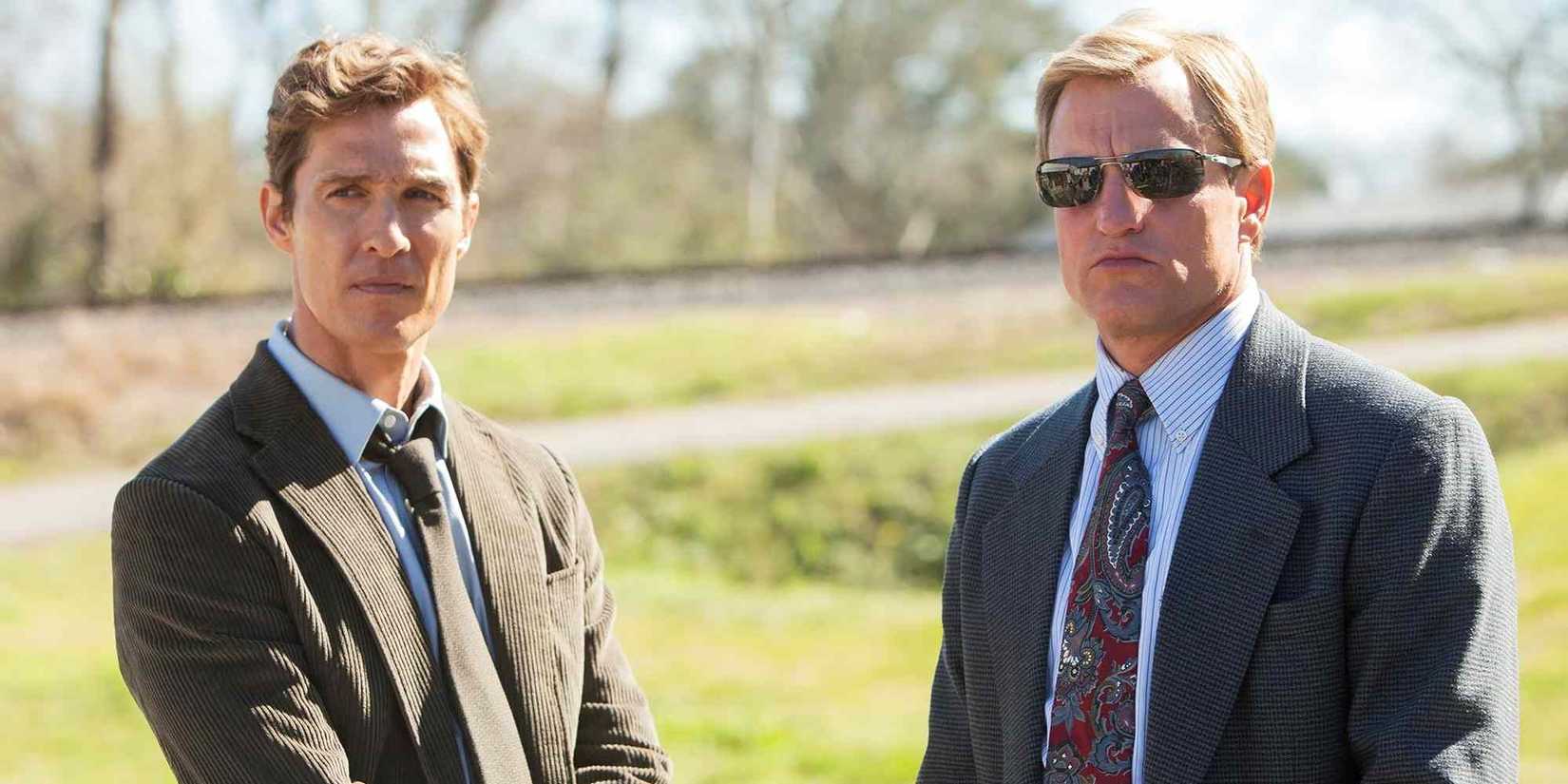 Image via HBO
True Detective Season 1 is a masterpiece that changed “prestige TV” forever because it showed that the same techniques used to make a feature film could be applied to the small screen, as creator Nic Pizzolato mapped out an intricate story that caused significant theorizing from an active fanbase. Just as important was the style of director Cary Joji Fukunaga, who made a splash with the episode “Who Goes There?” with a riveting tracking shot used to frame a raid sequence.
Matthew McConaughey and Woody Harrelson did the best work of their careers and developed a real-life friendship in their roles of two grizzled investigators who are drawn back to a case that haunted them throughout the rest of their careers. Although Season 2 of the show is worth watching and Season 3 is pretty great, its inaugural story is still the greatest of them all. As a single, closed narrative with cinematic direction and two towering lead performances, Season 1 remains one of the best examples of the peak of fantastic anthology series.
Collider Exclusive · Villain Personality Quiz Which Criminal Mastermind Would Be Your Nemesis? Lecter · Joker · Moriarty · Chigurh
Four of the finest criminal minds ever put on screen. One of them would look at you and see something worth their time. Eight questions decide which one comes for you, why they picked you, and what they would want when they arrived.
🍷Lecter
🃏Joker
♟️Moriarty
🪙Chigurh
MEET YOUR NEMESIS →
01
What would a criminal mastermind notice about you first? Great villains choose their opponents carefully. Something about you got their attention.
AMy manners, and everything I am careful not to say. BThat I still believe people are basically decent. CThat I am clever, and quietly enjoy proving it. DThat I handle things myself, and always have.
NEXT QUESTION →
02
How do they make first contact? The introduction tells you everything about what is coming next.
AA polite letter. Beautiful handwriting. Quietly wrong. BSomething on fire, with a message left beside it. CA puzzle, left where only I would look. DNo contact. Just the aftermath, and a coin.
NEXT QUESTION →
03
What do you actually believe about right and wrong? Every nemesis is really an argument about the thing you believe most.
AThere are lines. Mine are private and absolute. BRules are the only thing keeping us from being animals. CMorality is a system, and systems can be solved. DThings happen. Most of it was never up to me.
NEXT QUESTION →
04
What finally gets under your skin? Everybody has a pressure point. Finding yours is the whole plan.
ABeing seen clearly by somebody I cannot read. BWatching good people do something ugly. CLosing to someone who was simply better prepared. DHaving no move left that changes anything.
NEXT QUESTION →
05
They have made their move. How do you fight back? This is the part of the film where the audience finds out who you are.
ACarefully, and never where they expect to be touched. BLoudly. I would rather lose than play their game. CWith a better plan. I can out-think this. DDirectly, once, with whatever is closest to hand.
NEXT QUESTION →
06
What would they use against you? A good villain never brings a weapon you have not already handed them.
AMy privacy. I have kept far too much to myself. BMy conscience. I will not cross the line they want. CMy ego. I cannot resist a worthy opponent. DMy certainty that I can handle it alone.
NEXT QUESTION →
07
What do they actually want from you? The money is never the point. Something else always is.
ATo understand me better than anyone ever has. BTo prove I am no better than they are. CTo finally be beaten by someone worth the trouble. DNothing at all. I stepped into the wrong path.
NEXT QUESTION →
08
How does it end between the two of you? Eight questions in, this is the one that decides who comes for you.
AA conversation I will be replaying for years. BA choice forced on me that has no clean answer. COne final move, and the better mind wins. DA coin in the air, and nothing I can say.
REVEAL MY NEMESIS →
The Case File Is Complete Your Nemesis Is…
Four criminal masterminds. One of them was always going to be yours. Here is who comes for you, why they picked you out of everyone available, and what they want from the encounter.
Hannibal Lecter
Your nemesis does not want to beat you. He wants to know you completely, and he is patient enough to wait for it. The frightening part is how good the conversation is.
- Lecter is the most dangerous kind of opponent: the one who finds you interesting. He never raises his voice, because he has never needed to.
- You keep a great deal to yourself and you are careful about what you show. That reserve is exactly the door he would knock on.
- The films understood something other thrillers missed. The horror is not the violence. It is being perfectly understood by the wrong person.
- He would be unfailingly polite about all of it. That is the worst part.
The Joker
Your nemesis is not after money, territory or revenge. He is after a demonstration, and you are the person he has chosen to prove his point on.
- The Joker only picks opponents who believe in something. Your decency is not a defence against him. It is the entire reason he showed up.
- He has no plan you can predict and nothing you can take away, which removes every tool you would normally reach for.
- His whole argument is that you are one bad day away from being him, and you would spend the rest of your life proving him wrong.
- He would call it a magic trick. You would call it the worst night of your life.
Moriarty
Your nemesis respects you, which sounds flattering until you work out what it means. He chose you because nobody else was worth his time.
- Moriarty is the original criminal mastermind, the template every later one borrows from: a mind the equal of the hero's, pointed the wrong way.
- You enjoy being the cleverest person in the room. He is counting on exactly that, and he has already built the room.
- This is the rare nemesis who would be genuinely disappointed if you lost badly. He needs the game to be worth playing.
- It ends the way these things always end. Two people, one problem, and only one way down.
Anton Chigurh
Your nemesis has no personal interest in you whatsoever, and that is precisely what makes him unsurvivable. You are not a rival. You are a stop on the way.
- Chigurh does not negotiate, gloat or explain. He arrives, he asks one question, and the answer was decided long before you opened your mouth.
- You trust yourself to handle things. He is the one problem in the world that has no interest in how capable you are.
- No Country for Old Men rewrote the screen villain by removing the thing audiences quietly rely on: the sense that talking might work.
- Call it. He will wait.
↻ RETAKE THE QUIZ
5 'Small Axe' (2020)
 Image via Prime Video
Small Axe is a five-episode miniseries created and directed in its entirety by Steven McQueen, the Academy Award-winning filmmaker behind 12 Years a Slave. Although each episode is a standalone, they each either adapt a true story or bring to life a vibrant moment in history in an effort to examine the experience of Black British people throughout the second half of the 20th century.
What is most impressive about Small Axe is how distinct the episodes are in terms of form and intention. The debut episode “Mangrove” is a riveting courtroom drama that goes deeper into the societal injustices of British law than any traditional legal thriller had ever done, but the second episode “Lover’s Rock” is a more ethereal, expressive exploration of joy that saw McQueen paying homage to the style of the French New Wave. Each installment of Small Axe adopts a different tone and form while still contributing to one larger historical portrait
4 'Fargo' Season 2 (2015)
 Image via FX
Fargo was a show that sounded like a bad idea from the start because the 1996 film by the Coen brothers is considered to be an all-time cinematic classic, but Noah Hawley didn’t just make a retread. Fargo was instead an anthology show that spiritually and thematically connected to the themes of the original film, offering some parallels whilst telling a completely original story with each installment.
Season 2 is the highlight of Fargo because it tells the most complicated story about family and love, and earned praise for the dynamic chemistry between Kirsten Dunst and Jesse Plemons before they were married in real life. Although each season of Fargo is a standalone, Season 2 ties into the events of Season 1 in a very emotional way that makes both stories stronger as a result of the shared character lineage. By telling a completely new crime story while preserving the franchise's dark humor, Season 2 demonstrates how an anthology can reinvent itself without losing its identity.
3 'The White Lotus' Season 2 (2022)
 Image via Max
The White Lotus was a groundbreaking series that broke through during the perils of COVID-19 because it presented a frank, darkly amusing portrayal of class and privilege through the lens of a murder mystery. Although the first season of The White Lotus is a self-contained masterpiece, Season 2 surpasses it with a deeper exploration of heritage and a battle of wills between two distinct couples who both find the faults in one another.
The White Lotus gives shape to a wider narrative arc through the return of Jennifer Coolidge as Tonya, in what might be the greatest character that Mike White has ever created. Although the season featured a great dramatic turn from Aubrey Plaza, it also allowed Theo James to weaponize his own charisma by playing an unredeemable, toxic antagonist, and offered F. Murray Abraham a major comeback role. Moving the action to Sicily allows the series to refresh its characters and conflicts while preserving its core fascination with wealth.
2 'Black Mirror' Season 3 (2016)
 Image via Netflix
Black Mirror is the most inventive and original science fiction show of the 21st century because it offers a scathing, yet alarmingly real look at the ways that technology is changing everyone’s lives, and many of its greatest stories have ended up feeling wildly prescient.
There is no one right pick as to what the greatest Black Mirror episode of all time is because there are many that have stood out as being particularly creative, but Season 3 has a fairly unassailable run of classics. “Nosedive” is a powerful exploration of social media addiction that has become even more relevant in the TikTok era, “Shut Up and Dance” offers the most traumatizing twist of the entire series, and “San Junipero” offered a break from the relentless cynical outlook of the rest of the show with its sincere story of queer love. The sheer range of Season 3 shows how anthology television can deliver wildly different experiences without sacrificing cohesion.
1 'The Twilight Zone' Season 1 (1959-1960)
 Image via CBS
The Twilight Zone is among the most influential shows of all time because it became shorthand for inventive, high-concept stories of adventure, suspense, and terror that offered up worthy debates to be had among audiences. A great episode of The Twilight Zone is one that forces the viewer to consider what they would do in the same situation, and the conversations about comparative ethics and morality offer true insight into what audiences seek out of entertainment.
The Twilight Zone hasn’t “aged” at all because its themes are as relevant as ever, and it now serves as an informative portrayal of what societal functions were like in the era in which it was made. Although there have been several attempts to reboot and reimagine the series over the years, the first season of the original run remains the greatest based on the high quantity of all-time classic episodes. More than six decades later, Season 1 still feels like the blueprint for great anthology television.