
.jpg) 23 hours ago
4
23 hours ago
4
Article content
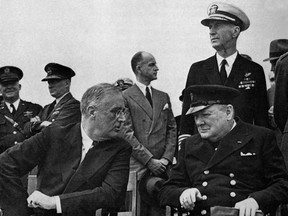
Exactly 85 years ago this coming weekend, on Aug. 9, 1941 — in the thick of World War Two — British prime minister Winston Churchill and U.S. president Franklin Roosevelt met secretly for three days on a U.S. navy cruiser in Placentia Bay, Nfld. The meeting ultimately changed the course of economic history by leading the world into decades of free trade and dynamic economic growth.

THIS CONTENT IS RESERVED FOR SUBSCRIBERS ONLY
Subscribe now to read the latest news in your city and across Canada.
- Exclusive articles from Barbara Shecter, Joe O'Connor, Gabriel Friedman, and others.
- Daily content from Financial Times, the world's leading global business publication.
- Unlimited online access to read articles from Financial Post, National Post and 15 news sites across Canada with one account.
- National Post ePaper, an electronic replica of the print edition to view on any device, share and comment on.
- Daily puzzles, including the New York Times Crossword.
SUBSCRIBE TO UNLOCK MORE ARTICLES
Subscribe now to read the latest news in your city and across Canada.
- Exclusive articles from Barbara Shecter, Joe O'Connor, Gabriel Friedman and others.
- Daily content from Financial Times, the world's leading global business publication.
- Unlimited online access to read articles from Financial Post, National Post and 15 news sites across Canada with one account.
- National Post ePaper, an electronic replica of the print edition to view on any device, share and comment on.
- Daily puzzles, including the New York Times Crossword.
REGISTER / SIGN IN TO UNLOCK MORE ARTICLES
Create an account or sign in to continue with your reading experience.
- Access articles from across Canada with one account.
- Share your thoughts and join the conversation in the comments.
- Enjoy additional articles per month.
- Get email updates from your favourite authors.
THIS ARTICLE IS FREE TO READ REGISTER TO UNLOCK.
Create an account or sign in to continue with your reading experience.
- Access articles from across Canada with one account
- Share your thoughts and join the conversation in the comments
- Enjoy additional articles per month
- Get email updates from your favourite authors
Sign In or Create an Account
or
Article content
Article content
Churchill had crossed the North Atlantic on a British battleship, dodging German U-boats, before arriving at Ship Harbour. The U.S. had not entered the war at that time, and so Roosevelt, pretending to be on a fishing trip in New England, sailed up to Placentia Bay on a U.S. navy cruiser.
Article content
Article content
By signing up you consent to receive the above newsletter from Postmedia Network Inc.
Article content
The story goes that Churchill ferried over to Roosevelt’s navy cruiser, where they met with military officials and others to draft what became known as the Atlantic Charter, a 600-word note endorsed by the two leaders that included a brief summary of six “common principles” that should guide the world at the end of the war.
Article content
The fourth principle would transform the international economy. Once peace is established, the nations of the world “will endeavour … to further the enjoyment by all states, great or small, victor or vanquished, of access, on equal terms, to the trade and to the raw materials of the world which are needed for their economic prosperity.”
Article content
It’s an agreement economic historians agree launched the momentum for the founding in 1947 of the General Agreement on Tariffs and Trade (GATT) and its successor World Trade Organization (WTO) — institutions that would replace a global system of trade wars and tariff battles with a free-trade regime that still survives today, but under a growing threat.
Article content
Article content
As the graph below illustrates, the opening of the global economy under the GATT/WTO rules unleashed a spectacular rise in trade. Tariffs fell from an average of 40 per cent to about 4.5 per cent, a rate that still prevails today globally but is now under threat from the Trump trade policies and the emerging willingness of other nations to turn away from the principles of free trade in favour of protective economic nationalism.
Article content
Article content
Constantly under attack is the most favoured nation (MFN) principle, a keystone of the WTO system. Under MFN rules, countries can’t play favourites (except when they make comprehensive free-trade agreements with chosen partners). Each nation should treat other nations equally without favouring one over another.
Article content

Article content
Under Donald Trump, MFN principles are ridiculed as policies that must be scrapped to set the stage for “the end of free trade,” a theme that seems to dominate academia and the media. Infamous Trump trade whisperer, former U.S. trade rep Robert Lighthizer, appeared last week in Foreign Affairs magazine to repeat his call for a new world trade order. Favoured nation should be scrapped, and the world should turn to balanced trade (an impossible and irrational objective) accompanied by increasing economic nationalism and constant trade manipulation by governments.
 English (US)