
.jpg) 1 hour ago
2
1 hour ago
2
For archaeologists there's something wonderfully strange about 'Cave 338', high up in the Pyrenees mountains in southwestern Europe.
As remote and inhospitable as it is, it seems that prehistoric people returned time and time again to the spot.
The cave is challenging to reach – 2,235 meters (7,333 feet) above sea level – and offers freezing cold temperatures when you get there.
But now new research is beginning to shed some light on what prompted multiple return trips around 5,500 years ago.
Archaeologists have unearthed a variety of objects that seem to hint at the story of this cave.
They include a finger bone, a child's tooth, bits of charcoal, primitive jewelry, and a multitude of green mineral fragments that had been crushed and burned millennia ago – and which perhaps are the key to this mystery.
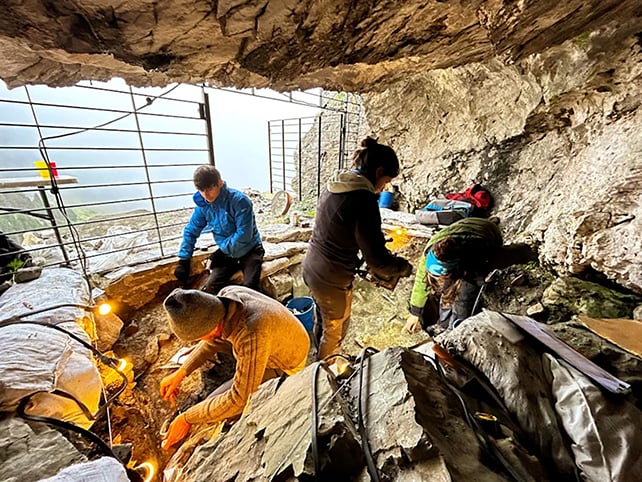 The Cave 338 site. (IPHES-CERCA)
The discoveries, reported by researchers from institutions across Spain, are the start of a bigger excavation project at the site. While we don't have all the answers yet about what went on here, the clues are piling up.
"For a long time, high-mountain environments were seen as marginal, places prehistoric communities passed through occasionally," says archaeologist Carlos Tornero from the Catalan Institute of Human Paleoecology and Social Evolution.
"But we found a really rich archaeological sequence, including multiple combustion structures and a very large number of green mineral fragments."
The green rock fragments are yet to be officially identified, but the research team thinks they could be pieces of malachite, which can be processed to form copper. We could be looking at an ancient, high-altitude mining camp.
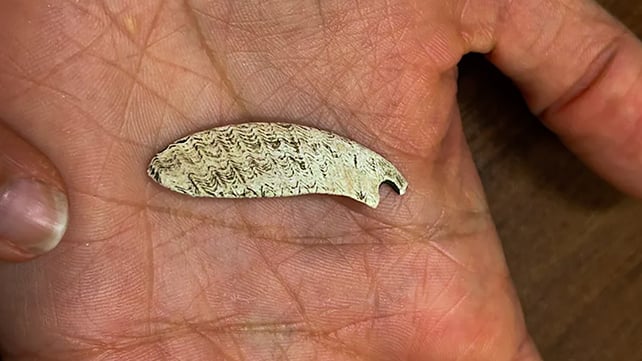 A shell pendant, one of the findings from the cave. (IPHES-CERCA)
A total of 23 hearths were found at the site, and the rock fragments were found across several layers of deposits, suggesting long-term mining. The material was most likely found nearby, and brought back to the cave to make into copper.
"Many of these fragments are thermally altered, while other materials in the cave are not, which clearly suggests that fire played an important role in their processing and that there was a deliberate intention behind it," says archaeometallurgist Julia Montes-Landa from the University of Granada.
"In other words, they weren't burned by accident."

The layers uncovered by the research team cover several thousand years in total, with the evidence for copper production thought to date from around 3500 BCE to 1000 BCE.
As for the human remains, the tooth belongs to a child of at least 11 years old, but it's not clear if it comes from the same person as the finger bone. These relics suggest the cave was also a burial site, but that's not certain yet.
The items of jewelry that were uncovered are intriguing as well, and will help with comparisons to other archaeological sites.
"The shell pendant is interesting because it has parallels in other sites in Catalonia, which suggests shared traditions or connections between different communities," says Tornero.
"The bear tooth pendant is much less common. That might point to something more specific or symbolic, possibly linked to the local environment."
Cave 338 is now "the highest-altitude prehistoric cave site with sustained occupation currently documented in the Pyrenees" according to the archaeologists.
While there are no definitive conclusions to be drawn yet, these findings already give us fresh insight into mountain life from the Late Neolithic to the Bronze Age. If this site was regularly returned to, then there might well be others.
Only 6 square meters (65 square feet) of the cave have been excavated so far, and there are plans to go much deeper into it to help establish the story of this remote spot.
Related: Neanderthals Mysteriously Collected Horned Skulls in a Cave, But Why?
"We can't say exactly how long people stayed each time, but the repeated use of the space and the density of remains suggest occupations that were short to medium in duration, but happening again and again over long periods of time," says Tornero.
The research has been published in Frontiers in Environmental Archaeology.
 English (US)