The Steelers wanted a more dependable receiver; instead, Metcalf has delivered disappointing production and familiar distractions.

Nov 23, 2026 at 6:00 am ET • 6 min read
There was a time the Steelers were really, really good at drafting and developing wide receivers. Hines Ward, Plaxico Burress, Santonio Holmes, Mike Wallace, Emmanuel Sanders, Antonio Brown, JuJu Smith-Schuster, Diontae Johnson, George Pickens. Of those nine names, two were first-round picks, six were Day 2 picks, and Brown was a sixth-rounder.
In fact, since drafting Pickens with the 52nd overall pick in 2022, Pittsburgh has selected exactly three receivers: Roman Wilson (third round, '24), Germie Bernard (second round, '26) and Kaden Wetjen (fourth round, '26). The philosophy, it seems, is less about developing receivers than trading for established players and paying a premium to do so. (By the way, as we've written previously, these struggles have not been limited to just pass catchers.)
Consider what the Steelers have done the last two offseasons. In March 2025, they traded a second-round pick as part of a package to acquire DK Metcalf, then gave him a five-year, $150 million contract. A year later, they traded for Michael Pittman Jr. and signed him to a three-year, $59 million deal.
That's $209 million in total contract commitments to two receivers, and through 11 weeks of the 2026 season, they have combined for 523 yards and two touchdowns. Pittman has played just three games because of injuries, while Metcalf has as many touchdown receptions this season as games he's been suspended since arriving in Pittsburgh. (Two. The answer for both is two.) And that doesn't include Sunday's ejection in Philadelphia, which could mean we'll have to update the "Days since DK was suspended" sign once again when the league is done with him.
It's also not a stretch to suggest that the Steelers are worse off at receiver than they were before all this started.
Did the Steelers pay for a version of Metcalf that no longer exists? (Yes. Yes, they did.)
Early in his career, Metcalf was one of the NFL's most dangerous targets. In 2020, his second season in Seattle, he caught 83 passes for 1,303 yards and 10 touchdowns. He was always a straight-line player – but he consistently won with his physicality, size and 4.3 speed.
That was six years ago. He had two more 1,000-plus-yard seasons in Seattle, but it turns out 2020 was his most productive year in the league. He's been an unrecognizable shell of that player in this season.
Season | Team | REC | YDS | TD | YDS/G |
2020 | SEA | 83 | 1,303 | 10 | 81.4 |
2021 | SEA | 75 | 967 | 12 | 56.9 |
2022 | SEA | 90 | 1,048 | 6 | 61.6 |
2023 | SEA | 66 | 1,114 | 8 | 69.6 |
2024 | SEA | 66 | 992 | 5 | 66.1 |
2025 | PIT | 59 | 850 | 6 | 56.7 |
2026* | PIT | 36 | 434 | 2 | 43.4 |
*2026 through Week 11.
So far this season, Metcalf is averaging 43.4 yards per game, and his 1.16 yards per route is easily the lowest of his career. For perspective, he averaged more than two yards per route in both 2020 and 2023.
Put another way: The Steelers paid $30 million annually for a receiver who has combined for 1,280 yards in 25 games. Here's where it gets worse: Among 16 veteran receivers we looked at who were acquired via trade or free agency between 2022 and 2025, Metcalf gave his team the least production for its money in his first season. Stefon Diggs, Jerry Jeudy and Darnell Mooney all provided considerably more bang for the buck, despite signing smaller contracts.
Let's dig a little further. For every $1 million in annual salary, Metcalf averaged just 1.89 receiving yards per game in 2025. Jeudy, who made $17.5 million annually, averaged 72.3 yards per game, or 4.13 yards for every $1 million. Mooney was even better: 62 yards per game on a $13 million annual deal, more than twice the production per dollar Pittsburgh got from Metcalf.
And it's gotten worse in 2026. Metcalf is now averaging just 1.45 receiving yards per game for every $1 million. In other words, the Steelers are paying the same price for 23% less production than they got a year ago.
Michael Pittman was supposed to help
If the Metcalf trade was supposed to solve Pittsburgh's WR1 problem, acquiring Pittman was supposed to address everything else. The Steelers needed someone who could consistently get open, move the chains and take some pressure off Metcalf.
Pittman had been a dependable receiver in Indianapolis, including a 109-catch, 1,152-yard season in 2023. But his production declined over the next two years, and injuries have limited him to seven catches for 89 yards since arriving in Pittsburgh.
Injuries happen, sure. And the Steelers gave up next to nothing to acquire him, essentially moving down 16 spots in the 2026 draft, from No. 214 to No. 230. The financial commitment, however, is another matter. The organization now has two expensive veteran receivers and little in the way of production to show for it.
Other teams found answers without overspending
So while Pittsburgh was overpaying for Metcalf in 2025, Washington acquired Deebo Samuel from San Francisco for a fifth-round pick. Samuel caught 72 passes for 727 yards and five touchdowns last season and added value as a runner.
New England took a different approach, signing Stefon Diggs to a three-year, $63.5 million contract. Diggs responded with 85 receptions for 1,013 yards, despite coming off a season-ending knee injury in 2024.
Neither receiver required anything approaching the combination of draft capital and long-term financial commitment that Metcalf received.
Receiver | Team/season | Contract | REC | YDS | TD |
Metcalf | PIT, 2025 | 5 years, $150M | 59 | 850 | 6 |
Diggs | NE, 2025 | 3 years, $63.5M | 85 | 1,013 | 4 |
Samuel | WAS, 2025 | Acquired for 5th-rounder | 72 | 727 | 5 |
Metcalf | PIT, 2026* | (Same 5 yr/$150M contract) | 36 | 434 | 2 |
Diggs | WAS, 2026* | 1-year deal | 36 | 386 | 6 |
Samuel | SF, 2026 | 1 year, up to $7M | 19 | 237 | 4 |
*2026 through Week 11.
Hindsight, you might say, is 20/20, and anybody can cherry-pick examples that worked out after the fact. Fair enough. But we don't know many folks who thought at the time that Metcalf was worth $30 million a year. Or that Michael Pittman, who is a possession receiver at best when he's healthy, had earned a new deal.
And we'll grant you this: None of this means Diggs or Samuel would've produced the same numbers in Pittsburgh, which now seems like where passing offenses go to die. But it's difficult to ignore the financial flexibility those teams maintained while getting meaningful contributions from those veteran additions.
The irony of George Pickens
And then there's Pickens, which might be the most hilariously frustrating part of this saga for Steelers fans.
The team had understandably grown tired of Pickens' mood swings, which often manifested themselves as inconsistent effort and dumb penalties. So two months after acquiring Metcalf, the Steelers traded Pickens to Dallas rather than deal with the nonsense for another season.
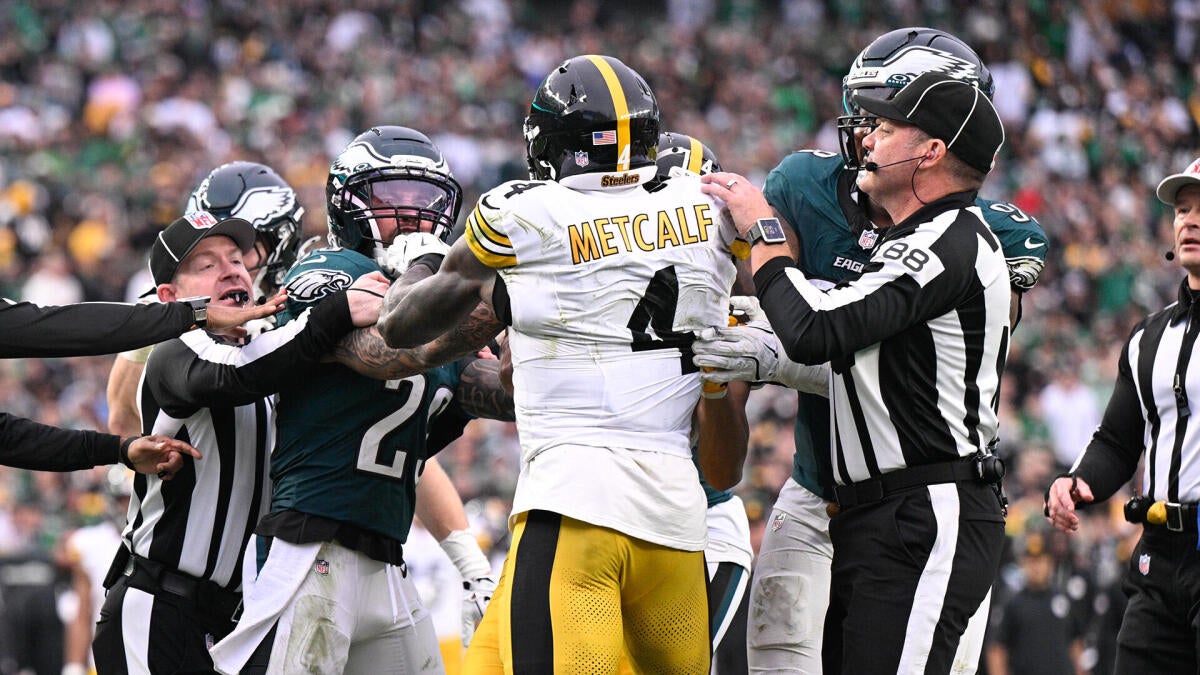
Pickens responded with 93 catches for 1,429 yards and nine touchdowns in 2025. He already has 780 yards and six touchdowns through 10 games in 2026. Metcalf, meanwhile, is one of the NFL's most ineffective receivers, and the cherry on top is that he's been a bigger headache in Pittsburgh than Pickens ever was. Last December, the NFL suspended him for two games after a physical confrontation with a fan in Detroit. And then, on Sunday, Metcalf was ejected after getting into it with Eagles defensive back Cooper DeJean.
So let's recap: Pittsburgh moved on from Pickens because he was a pain in the ass, then paid Metcalf $150 million to be invisible as a playmaker and front-and-center as a distraction. Make it make sense.
Now the Steelers have committed another $59 million to Pittman, who has spent most Sundays this fall on the sidelines in sweats. Aaron Rodgers is done after the season, which means that whoever is under center in 2027 could inherit one of the worst offenses in the league.
For all the money and draft picks the Steelers have wasted trying to fix their receiver room, perhaps the most damning indictment is this: A franchise that once set the standard for finding and developing young receivers now seems incapable of doing either.