
.jpg) 55 minutes ago
2
55 minutes ago
2
Article content
ENGINEERING UPDATE
Article content
Article content
Rogue PFS: Snowline’s PFS for the Valley gold deposit on the Rogue Project remains on track for delivery by Q1 2027, supported by an extensive 2026 field investigation program that is nearing completion. The PFS will represent a key milestone for the Company, with a refined mine plan reflecting integrated trade-off considerations around various design components. The associated rigour in site investigation and cost estimation are expected to allow the Company to establish initial Proven and Probable Reserves for the Valley gold deposit, based on an updated Mineral Resource Estimate for Valley and associated mine plan.
Article content
Key trade-offs being explored for the PFS include:
Article content
- Throughput: Increasing mill capacity from the 25 ktpd rate contemplated in the Preliminary Economic Assessment (“PEA”) may have positive effects on gold output and overall project economics, considered against associated increases in pre-production capital expenditures and other factors.
- Power: Liquified natural gas is being explored as a primary fuel versus diesel generators used in the PEA, based on a detailed power and load model for the project site. With power as the largest driver of operating costs1, gains in efficiency can have meaningful impact on project economics. Studies to assess potential contributions from solar, hydro and wind energy sources have also been advanced.
- Tailings and waste rock layout: The PEA envisioned a tailings storage facility (“TSF”) served by an 18 km tailings pipeline. For the PFS, trade-offs are considered for this site against additional locations, including sites closer to the mine site with potential for co-disposal of waste rock and tailings.
- Flowsheet optimization: Multiple mill-based processing methods are considered, complemented by optimization of grind size versus gold recovery and site layout providing efficiency and optionality moving forward.
- Water management: Water management, site water balance and the discharge and treatment strategy advancing to support permitting.
Article content
Article content
The PFS will establish the design basis and project description that are expected to carry directly into a feasibility study and project permitting, allowing the two to advance in parallel.
Article content
ENVIRONMENT & PERMITTING UPDATE
Article content
Environment: Snowline’s 2026 environmental baseline program is underway and on schedule, marking nearly one full year of significant expansion on work initiated in 2022. Field programs include hydrology, hydrogeology, water quality, meteorology, geochemistry, fish and aquatic habitat, terrestrial environment including wildlife and vegetation, heritage resources and air quality. The geographic extent of environmental surveys is shown in Figure 2.
Article content
Environmental baseline data will be integrated into PFS engineering design and trade-off studies to ensure the project design meets rigorous environmental standards and permitting requirements.
Article content
Article content

Article content
Article content
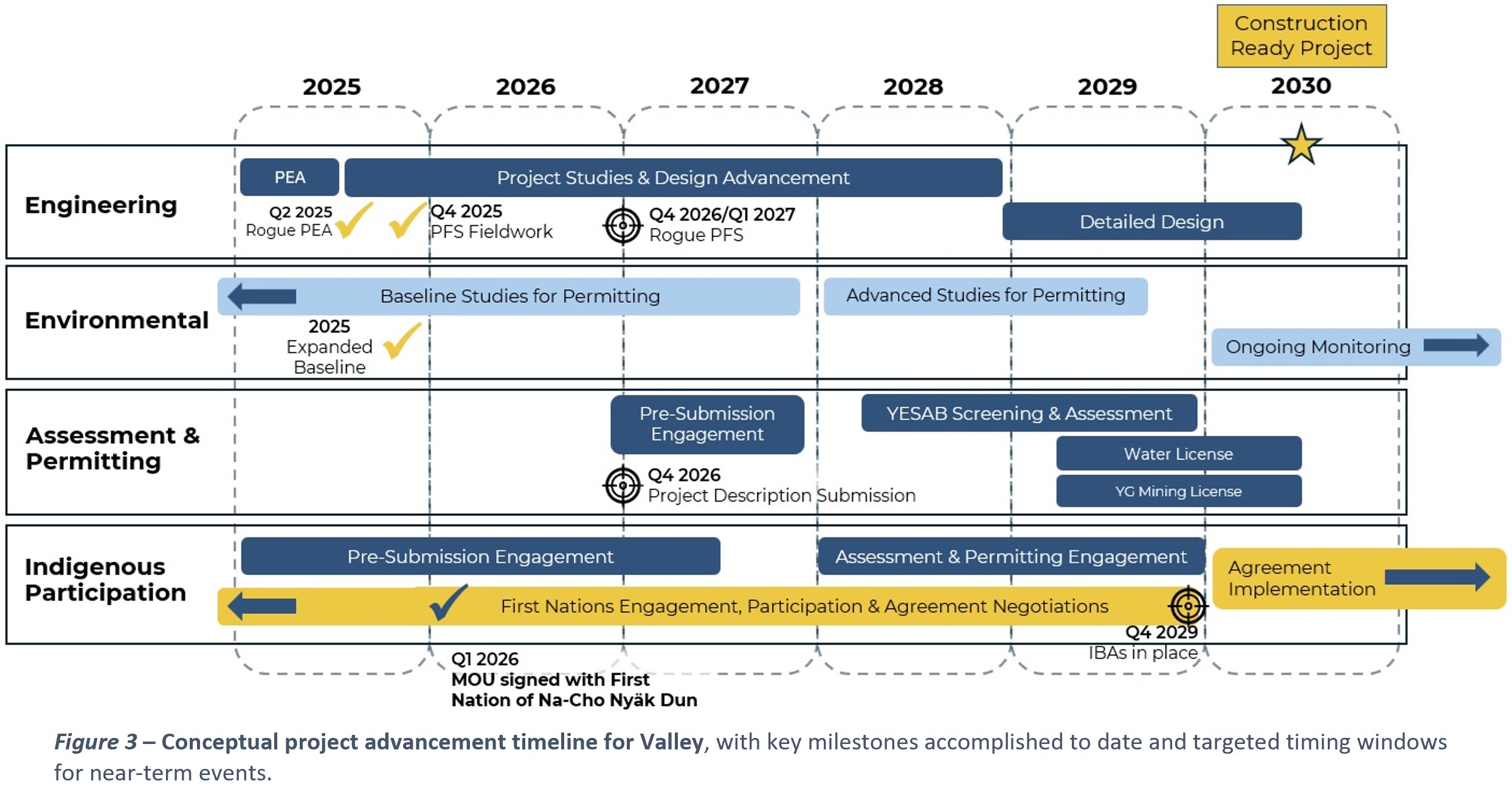
Permitting: The Company is targeting submission of a Project Description to the Yukon Environmental and Socio-economic Assessment Board (“YESAB”) in conjunction with its PFS, to initiate the Pre-Submission Engagement (“PSE”) for the Rogue Project. YESAB’s PSE process is a newly introduced (2022), early, structured engagement process for major Yukon projects that aims to identify issues, clarify information requirements, and align proponents, First Nations, regulators, and communities before a formal environmental and socio-economic assessment is submitted to YESAB, improving the quality, efficiency and predictability of the subsequent YESAB review. Following PSE, Snowline intends to submit the Project Proposal to YESAB that will initiate the Screening & Assessment process in early 2028. Figure 3 illustrates the permitting process in alignment with completion of the PFS, advancement of environmental studies and ongoing engagement with First Nations.
Article content
Article content
Article content
EXPLORATION UPDATE
Article content
Article content
Valley: Roughly 4,200 m of exploration drilling has been completed to date on Valley in 2026, in addition to approximately 2,300 m focused on geotechnical definition, infrastructure design, condemnation, and potential borrow source delineation. Recent exploration drilling at Valley focuses on untested areas within and around the Valley intrusion, including at depth and distal to the current Mineral Resource Estimate (“MRE”). Brief notes on reported drill holes follow, with locations shown on Figure 5 and results summarized in Table 1.
Article content
V-26-158 Drilled outside of the intrusion and outside of PEA pit, as a 300 m step-out from previous drilling along a northwest trending structural corridor.
V-26-159 Deepest hole to date at Valley, ending at 1,047 m downhole (~900 m vertical depth), drilled along western margin of the intrusion, west of and below the central high-grade zone of the deposit. The hole intersected 3.4 m averaging 5.86 g/t Au from 515.0 m downhole, more than 200 m below the PEA pit shell, associated with a zone of northeast trending quartz veins. This interval sits within a 625.5 m run of core almost entirely below the PEA pit shell averaging 0.36 g/t Au, including intermittent barren zones.
V-26-160 Long intersection of low grade outside of pit, with isolated >1g/t Au occurrences at depth. Did not intersect northeastern wall of the intrusion and ended in weakly mineralized granodiorite.
V-26-161 Drilled from northeast, entirely outside of PEA pit. Intersected a broad zone of low grade at depth, with isolated occurrences of >1 g/t Au, including 2.68 g/t Au over 4.0 m from 624 m downhole, roughly 300 m below the PEA pit shell.
V-26-162 A short (246 m) hole drilled in an untested area in the southeastern part of the Valley intrusion, intersecting low grades.
V-26-163 Deepest hole to date along the northeast margin of the intrusion; extends known low grade mineralization to depth. The strongest gold mineralization was encountered at the bottom of the hole, which ended in mineralization within the intrusion (6.3 m averaging 1.03 g/t Au).
V-26-164 Long run of low to moderate grades at depth, returned 450.5 m averaging 0.4 g/t Au outside of the pit shell boundary with localized high grades (Table 1).
 English (US)