
.jpg) 1 hour ago
4
1 hour ago
4
Article content
(Bloomberg) — The Philippine peso’s relief rally following the initial US-Iran ceasefire is likely to be short-lived as seasonal selling drives the currency to new record lows, strategists say.

THIS CONTENT IS RESERVED FOR SUBSCRIBERS ONLY
Subscribe now to read the latest news in your city and across Canada.
- Exclusive articles from Barbara Shecter, Joe O'Connor, Gabriel Friedman, and others.
- Daily content from Financial Times, the world's leading global business publication.
- Unlimited online access to read articles from Financial Post, National Post and 15 news sites across Canada with one account.
- National Post ePaper, an electronic replica of the print edition to view on any device, share and comment on.
- Daily puzzles, including the New York Times Crossword.
SUBSCRIBE TO UNLOCK MORE ARTICLES
Subscribe now to read the latest news in your city and across Canada.
- Exclusive articles from Barbara Shecter, Joe O'Connor, Gabriel Friedman and others.
- Daily content from Financial Times, the world's leading global business publication.
- Unlimited online access to read articles from Financial Post, National Post and 15 news sites across Canada with one account.
- National Post ePaper, an electronic replica of the print edition to view on any device, share and comment on.
- Daily puzzles, including the New York Times Crossword.
REGISTER / SIGN IN TO UNLOCK MORE ARTICLES
Create an account or sign in to continue with your reading experience.
- Access articles from across Canada with one account.
- Share your thoughts and join the conversation in the comments.
- Enjoy additional articles per month.
- Get email updates from your favourite authors.
THIS ARTICLE IS FREE TO READ REGISTER TO UNLOCK.
Create an account or sign in to continue with your reading experience.
- Access articles from across Canada with one account
- Share your thoughts and join the conversation in the comments
- Enjoy additional articles per month
- Get email updates from your favourite authors
Sign In or Create an Account
or
Article content
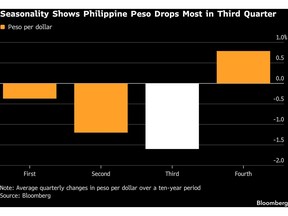
The peso has weakened an average 1.6% against the dollar in the third quarter over the past decade, the worst performance of any three-month period, data compiled by Bloomberg show. The losses are attributed to local companies buying more dollars to pay for imports ahead of the year-end busy season.
Article content
Article content
Article content
The currency already faces a raft of weakening pressures, including a widening balance of payments deficit, sluggish economic growth since the pandemic, and anemic household spending.
Article content
By signing up you consent to receive the above newsletter from Postmedia Network Inc.
Article content
There’s a “seasonal increase in demand for US dollars by importers” in the third quarter, as import activities pick up in preparation for demand at year-end, said Michael Ricafort, an economist at Rizal Commercial Banking Corp. in Manila.
Article content
The peso may decline to as weak as 62 per dollar this quarter, he said. The currency closed Friday at 61.51.
Article content
The peso surged by more than 1% on June 15 after the US and Iran agreed to a ceasefire, which drove down oil prices and reduced pressure on the finances of the energy-importing nation. The currency has since given up those gains but remains stronger than its record low of 61.750 per dollar set in April, and has outperformed most of its Southeast Asian peers over the period.
Article content
There are several negatives that threaten to send the peso lower.
Article content
The Philippines’ gross domestic product only grew by 2.8% in the first quarter from the previous year, the slowest pace outside the pandemic since the end of 2009, while household spending was the weakest since 2010. The central bank projects the balance of payments deficit will widen to $10.7 billion this year, versus an earlier estimate of $7.8 billion, as global growth is constrained by Middle East tensions.
Article content
Article content
“We expect the peso to underperform most Asian currencies” due to soft domestic growth, persistent external pressures and a large trade deficit that leaves the Philippines more vulnerable than many regional peers, said Kausani Basak, a foreign-exchange analyst at Australia & New Zealand Banking Group Ltd. “A hawkish Federal Reserve would likely add to depreciation pressures.”
Article content
The peso may weaken to 62.5 per dollar by the end of September, according to ANZ forecasts.
Article content
The next key data point for the currency will come in the form of remittance data due Wednesday. Money sent back to the Philippines increased by 2% in April from a year earlier, the slowest pace of growth since May 2022, central bank data showed last month.
Article content
“Domestic fundamentals still need to improve for peso gains to extend more convincingly,” said Christopher Wong, a strategist at Oversea-Chinese Banking Corp. in Singapore. “A key determinant for peso trajectory will be whether oil prices remain lower for longer, and whether hawkish bets for the Fed will abate moving forward,” he said.
Article content
This week’s main economic events:
Article content
- Monday, 13 July: India inflation, trade data
- Tuesday, 14 July: Japan industrial output, India wholesale prices, China trade data
- Wednesday, 15 July: China GDP, retail sales, industrial output, fixed assets; Philippines overseas cash remittances
- Thursday, 16 July: BOK rate decision
- Friday, 17 July: Singapore non-oil domestic exports; Malaysia GDP, inflation; India FX reserves; China FX net settlement
Article content
 English (US)