
.jpg) 1 hour ago
3
1 hour ago
3
Article content
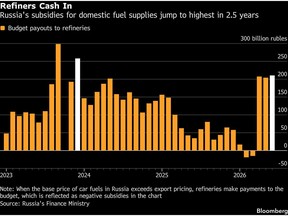
(Bloomberg) — Russia’s subsidy payouts to oil refiners that supply domestic markets jumped more than six-fold in June from a year earlier, as Moscow sought to avoid shortages by keeping more fuel at home.

THIS CONTENT IS RESERVED FOR SUBSCRIBERS ONLY
Subscribe now to read the latest news in your city and across Canada.
- Exclusive articles from Barbara Shecter, Joe O'Connor, Gabriel Friedman, and others.
- Daily content from Financial Times, the world's leading global business publication.
- Unlimited online access to read articles from Financial Post, National Post and 15 news sites across Canada with one account.
- National Post ePaper, an electronic replica of the print edition to view on any device, share and comment on.
- Daily puzzles, including the New York Times Crossword.
SUBSCRIBE TO UNLOCK MORE ARTICLES
Subscribe now to read the latest news in your city and across Canada.
- Exclusive articles from Barbara Shecter, Joe O'Connor, Gabriel Friedman and others.
- Daily content from Financial Times, the world's leading global business publication.
- Unlimited online access to read articles from Financial Post, National Post and 15 news sites across Canada with one account.
- National Post ePaper, an electronic replica of the print edition to view on any device, share and comment on.
- Daily puzzles, including the New York Times Crossword.
REGISTER / SIGN IN TO UNLOCK MORE ARTICLES
Create an account or sign in to continue with your reading experience.
- Access articles from across Canada with one account.
- Share your thoughts and join the conversation in the comments.
- Enjoy additional articles per month.
- Get email updates from your favourite authors.
THIS ARTICLE IS FREE TO READ REGISTER TO UNLOCK.
Create an account or sign in to continue with your reading experience.
- Access articles from across Canada with one account
- Share your thoughts and join the conversation in the comments
- Enjoy additional articles per month
- Get email updates from your favourite authors
Sign In or Create an Account
or
Article content
The government paid 210.6 billion rubles ($2.72 billion) to oil processors last month, partially compensating them for the difference between domestic and export prices, according to Finance Ministry data published Friday. That’s the largest monthly payout since December 2023, driven by high international fuel costs resulting from the disruption in the Strait of Hormuz.
Article content
Article content
Article content
Bolstering domestic fuel supplies is a key focus for the Russian government after Ukrainian attacks on refineries caused worsening shortages around the country. The subsidies give companies an incentive to keep more oil products at home and offer them to consumers at lower prices.
Article content
By signing up you consent to receive the above newsletter from Postmedia Network Inc.
Article content
Without the billion-dollar payouts, domestic prices for diesel and gasoline would have shown more significant growth, raising the cost of living for Russians and stoking inflation — both of which Moscow wants to avoid ahead of parliamentary elections in September.
Article content
The government continued to make the payments to refiners even after it banned most exports of gasoline through to the end of July.
Article content
The oil and gas industries make up about a fifth of the Russian state’s total revenue, a crucial contribution to a budget that is burdened by spending on the war with Ukraine.
Article content
The state’s total oil and gas revenues for June, net of all payouts to the industry, exceeded 683 billion rubles, up more than 38% from a year earlier, the data show. Oil taxes accounted for about 84% of that total.
Article content
The Finance Ministry calculated June oil and gas taxes based on the average Urals crude price of $86.52 a barrel. While that’s lower than the level for May, it’s still up 66% from a year earlier as uncertainties over the re-opening of the Strait of Hormuz persisted.
Article content
Global oil prices have fallen further in recent weeks as energy flows from the Persian Gulf recovered, meaning Moscow’s windfall oil revenue is set to decline from the highs seen earlier this year.
Article content
 English (US)