
.jpg) 1 hour ago
2
1 hour ago
2
Article content
(Bloomberg) — An unusually early heat wave is set to grip Los Angeles and much of the Southwest, putting California’s already fragile snowpack, and therefore its water supplies, at risk.

THIS CONTENT IS RESERVED FOR SUBSCRIBERS ONLY
Subscribe now to read the latest news in your city and across Canada.
- Exclusive articles from Barbara Shecter, Joe O'Connor, Gabriel Friedman, and others.
- Daily content from Financial Times, the world's leading global business publication.
- Unlimited online access to read articles from Financial Post, National Post and 15 news sites across Canada with one account.
- National Post ePaper, an electronic replica of the print edition to view on any device, share and comment on.
- Daily puzzles, including the New York Times Crossword.
SUBSCRIBE TO UNLOCK MORE ARTICLES
Subscribe now to read the latest news in your city and across Canada.
- Exclusive articles from Barbara Shecter, Joe O'Connor, Gabriel Friedman and others.
- Daily content from Financial Times, the world's leading global business publication.
- Unlimited online access to read articles from Financial Post, National Post and 15 news sites across Canada with one account.
- National Post ePaper, an electronic replica of the print edition to view on any device, share and comment on.
- Daily puzzles, including the New York Times Crossword.
REGISTER / SIGN IN TO UNLOCK MORE ARTICLES
Create an account or sign in to continue with your reading experience.
- Access articles from across Canada with one account.
- Share your thoughts and join the conversation in the comments.
- Enjoy additional articles per month.
- Get email updates from your favourite authors.
THIS ARTICLE IS FREE TO READ REGISTER TO UNLOCK.
Create an account or sign in to continue with your reading experience.
- Access articles from across Canada with one account
- Share your thoughts and join the conversation in the comments
- Enjoy additional articles per month
- Get email updates from your favourite authors
Sign In or Create an Account
or
Article content
Temperatures in downtown Los Angeles on Friday are forecast to reach 98F (37C), coming within a degree of highest reading for the month set on March 29, 1879, according to the National Weather Service. Across the region, temperatures are expected to rise 20F to 30F above normal, with several daily records likely to fall and some areas potentially breaking all-time March highs, the agency said.
Article content
Article content
Article content
“Brutal heatwaves are not just a summertime concern anymore,” said Jennifer Francis, a climate scientist with the Woodwell Climate Research Center. “Record-breaking March temperatures will stretch across the Southwest, South Central, and Southeast states this week.”
Article content
By signing up you consent to receive the above newsletter from Postmedia Network Inc.
Article content
Nine states across the Great Plains and West had their warmest winter going back 131 years, and five more, including California, had their second mildest, according to the US National Centers for Environmental Information. Overall, the US had its second warmest winter season measured from Dec. 1 to Feb. 28.
Article content
This meant many of the storms striking the West arrived as rain and not snow. Much of that water ran through rivers into the Pacific Ocean or seeped underground. As a result, California and the Colorado River basin are perilously low on the frozen water needed to replenish supplies late in the spring and summer. With the coming heat wave, what little snow is left in California’s Sierra Nevada range and elsewhere in the West may melt before it can be captured in reservoirs, presenting a water supply challenge for residents, farmers and livestock.California depends on mountain snowpack as a natural reservoir that stores water through winter and releases it gradually in the spring and summer, said Daniel Swain, a climate scientist with the University of California Agriculture and Natural Resources. Even when major storms delivered heavy snow, including a system linked to one of California’s deadliest avalanches that killed nine people, the accumulation quickly melted.
Article content
Article content
“This heat wave looks pretty extreme by March standards across large portions of the Southwest, and that is saying something given the winter we have just experienced,” Swain said. “It is a very big deal both in the shorter term and in the longer term.”
Article content
In Colorado, the high temperatures, lack of snow and strong winds across the state’s Front Range have caused utility Xcel Energy to use its enhanced power safety settings, the company said in a statement. The tool can shut electricity off on power lines if an object comes into contact with them.
Article content
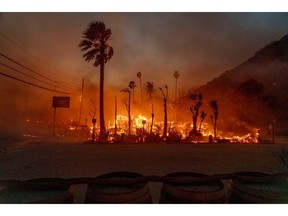
Right now, North America is on a heat seesaw. New York City’s Central Park reached a record 80F for the date, according to the National Weather Service. As the warmth in the East fades, the West will pick up the slack as temperatures rise. Through next Monday, 214 daily high-temperature records could be broken or tied across the US, and another 76 threatened, according to the US Weather Prediction Center.The heat may also set the stage for drier-than-normal soil conditions this summer, increasing the risk of an intense wildfire season, Swain added. Although the past few years have brought devastating fires — including the Palisades and Eaton fires that killed 31 people and destroyed over 16,000 structures — many burned through grasslands or brush rather than dense forests.
Article content
A large ridge of high pressure settling across the Southwest will magnify temperatures and topple records, according to Marc Chenard, a senior branch forecaster at the US Weather Prediction Center. “It is definitely not common to get this hot, this early,” he said.
Article content
 English (US)