
.jpg) 1 hour ago
3
1 hour ago
3
Article content

THIS CONTENT IS RESERVED FOR SUBSCRIBERS ONLY
Subscribe now to read the latest news in your city and across Canada.
- Exclusive articles from Barbara Shecter, Joe O'Connor, Gabriel Friedman, and others.
- Daily content from Financial Times, the world's leading global business publication.
- Unlimited online access to read articles from Financial Post, National Post and 15 news sites across Canada with one account.
- National Post ePaper, an electronic replica of the print edition to view on any device, share and comment on.
- Daily puzzles, including the New York Times Crossword.
SUBSCRIBE TO UNLOCK MORE ARTICLES
Subscribe now to read the latest news in your city and across Canada.
- Exclusive articles from Barbara Shecter, Joe O'Connor, Gabriel Friedman and others.
- Daily content from Financial Times, the world's leading global business publication.
- Unlimited online access to read articles from Financial Post, National Post and 15 news sites across Canada with one account.
- National Post ePaper, an electronic replica of the print edition to view on any device, share and comment on.
- Daily puzzles, including the New York Times Crossword.
REGISTER / SIGN IN TO UNLOCK MORE ARTICLES
Create an account or sign in to continue with your reading experience.
- Access articles from across Canada with one account.
- Share your thoughts and join the conversation in the comments.
- Enjoy additional articles per month.
- Get email updates from your favourite authors.
THIS ARTICLE IS FREE TO READ REGISTER TO UNLOCK.
Create an account or sign in to continue with your reading experience.
- Access articles from across Canada with one account
- Share your thoughts and join the conversation in the comments
- Enjoy additional articles per month
- Get email updates from your favourite authors
Sign In or Create an Account
or
Article content

Article content
Article content
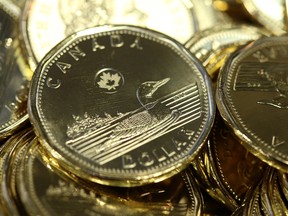
It looks like the Canadian dollar has turned away from falling below 70 cents U.S., even after the United States declined to re-sign the Canada-U.S.-Mexico Agreement (CUSMA), kick-starting annual reviews of the three-way pact.
Article content
The loonie came perilously close to breaching that threshold as June wound down, but it pulled back from the ledge and posted tentative gains on Thursday after falling to a year-to-date low of 70.26 cents U.S. on June 24.
Article content
Article content
“In theory, the decision (on CUSMA) adds to the headwinds facing the loonie from a weak economy, falling oil prices and a neutral Bank of Canada,” Karl Schamotta, chief market strategist at Corpay, a corporate payments company, said in a note on Thursday. “But the move was well telegraphed, and may already be priced in, suggesting the risk profile facing the currency may not be as negative as some have suggested.”
Article content
By signing up you consent to receive the above newsletter from Postmedia Network Inc.
Article content
It has been a tough year for the Canadian dollar, which is down just over three per cent from the start of year and off nearly five per cent from the closing high of 74 cents U.S. reached on Jan. 29.
Article content
The loonie has faced several headwinds including a global flight to the U.S. dollar, due partly to investors seeking safety after the break out of the Iran conflict.
Article content
Data from the International Monetary Fund indicated that official currency reserves of the U.S. dollar rose in the first quarter of 2026 and “by no little bit,” Warren Lovely, chief rates strategist at National Bank of Canada, said in a report on Thursday.
Article content
Lovely said the buying coincided with the war in Iran, but that the longer de-dollarization trend is probably still intact.
Article content
Article content
Canada’s currency also suffered as bets rose that the U.S. Federal Reserve would need to hike interest rates to combat oil-induced inflation from the war. That caused the yield on Canadian and U.S. bonds to widen further in favour of Treasuries leaving the greenback much more attractive to investors.
Article content
Article content
On Thursday, that dynamic eased slightly in favour of the loonie as the U.S. Bureau of Labor Statistics reported just over 57,000 positions were created in June, well off estimates for 113,000 additions to the jobs market. Meanwhile, numbers for April and May were also revised lower, adding up to a two-month loss of almost 75,000 jobs.
Article content
In the wake of the data release, bets for a rate hike at the July 29 Fed meeting weakened to an 18 per cent chance from a nearly 30 per cent chance, while markets cut the odds of an increase in September to around 60 per cent from 80 per cent, according to overnight interest rate swap data from Bloomberg. However, markets were still all in on a hike in October.
Article content
That could ramp up the pressure on the loonie as it would widen the interest rate differential between the Fed and the Bank of Canada, which has been on hold for the last five consecutive rate calls, with most economists expecting it to stay the course at the current level of 2.25 per cent well into 2027.
 English (US)