
.jpg) 1 hour ago
3
1 hour ago
3
Looking younger and actually making aging skin biologically younger may not be the same thing.
Fillers, lasers, microneedling, and other popular aesthetic treatments can visibly improve the skin.
But a new review suggests there is surprisingly little evidence that these changes amount to biological "rejuvenation" or "regeneration".
Researchers reviewed 136 publications on popular aesthetic treatments. They wanted to answer a simple question: Do these treatments just make skin look younger, or do they actually renew aging tissue?
The study, posted on Research Square, has not yet been peer-reviewed.
The publications covered common treatments including fillers, lasers, platelet-rich plasma (PRP), ultrasound, microneedling, and radiofrequency.
Rather than simply asking whether skin looked better after treatment, the researchers looked for evidence that its underlying structure and function had changed too.
They used a 22-point system designed to look beyond increases in collagen and assess whether studies investigated broader changes in the structure, function, and cells of aging skin.

The results revealed a substantial evidence gap.
Of 34 primary studies that could be scored, 26 – or 76.5 percent – fell into what the researchers classified as the "inadequate evidence" range.
Importantly, the scores do not measure how effective a treatment is. They reflect the number of different kinds of biological evidence for rejuvenation that were investigated.
No study scored higher than 5 out of 22. Under the researchers' system, the lowest category they describe as "rejuvenation" begins at 6 points.
The study that scored 5 was performed on cells in the laboratory rather than in people. Among clinical studies involving people, the highest score was 4.
According to the researchers, this does not show that aesthetic treatments have no effect. Instead, it suggests that the studies they reviewed had not brought together the range of biological evidence their framework requires to demonstrate rejuvenation.
Much of the existing research focused on one familiar substance: collagen.
Collagen provides skin with strength and structure, and certain aesthetic treatments can stimulate its production. But lead author and cell biologist William Richard Webb of Innovation Aesthetics says an increase in collagen alone does not demonstrate that skin has regenerated.
"Claiming one part is conclusive without assessing all components is like trying to make bread, and the only ingredient you have is yeast," Webb told ScienceAlert.
The researchers found that most studies concentrated on collagen, while other potential signs of biological rejuvenation were investigated far less often. These included how newly formed tissue was organized, whether the skin functioned differently, and whether cellular changes associated with aging had been reversed.
Scientists studying biological aging can look beyond appearance to changes inside cells. Previous research on human skin cells, for example, has examined changes in gene activity and chemical markers associated with biological age.
Other skin-aging research has looked at age-related changes to DNA and the ability of cells to multiply.
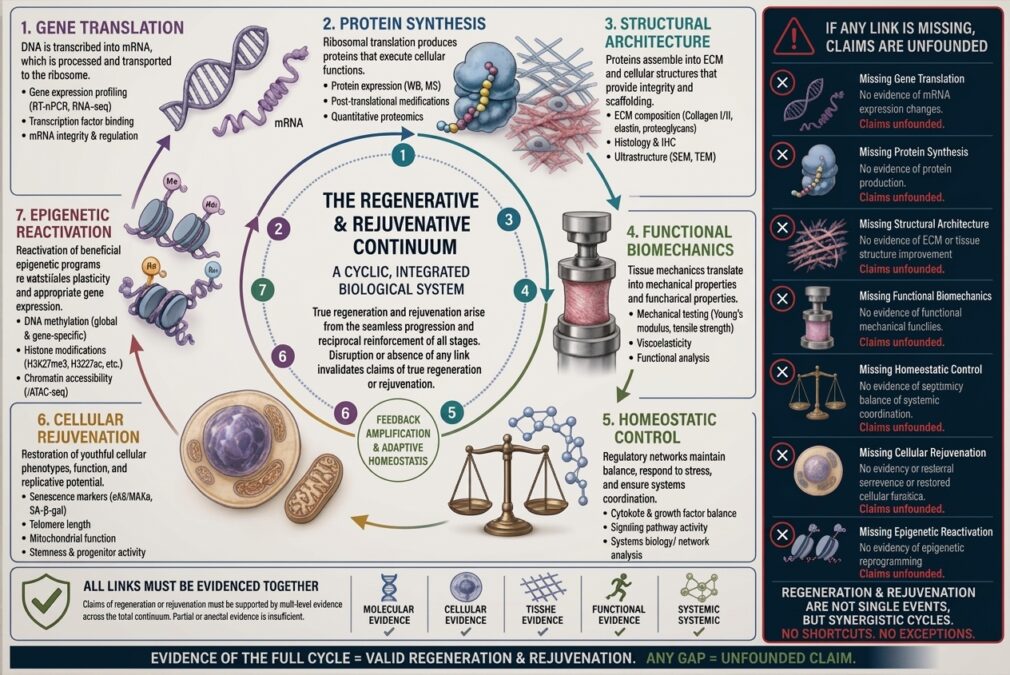 The seven biological domains used by the researchers to assess claims of true tissue regeneration and rejuvenation. (Webb et al., Research Square, 2026)
None of this means aesthetic treatments provide no benefit. Fillers can restore volume, some treatments can increase collagen, and some laser procedures can improve the appearance and texture of skin.
The question raised by the review is whether those effects are enough to call a treatment "regenerative" or biologically "rejuvenating."
This debate did not begin with the new study.
A 2026 review argued that regeneration in aesthetic medicine should be distinguished from temporary changes in appearance, while another recent review concluded that evidence varies between treatments and that better standardized research is needed.

Webb and team's review also identified problems with how some of the existing studies were conducted.
Many involved small groups of participants, some lacked comparison groups, and some relied on subjective assessments rather than objective measurements. These limitations can make the results less certain.
The distinction also matters when aesthetic treatments are marketed to consumers.
"Marketing claims must mirror scientific evidence," Webb told ScienceAlert.
He says that when terms such as "regeneration" or "rejuvenation" are used, people should be able to understand what a treatment has actually been shown to do – and what remains unproven.
Related: There Are 10 Signs of Faster Aging Hidden in Your Blood, Study Says
The new study has limitations of its own.
The 22-point system was developed by the research team and may not capture every aspect of skin rejuvenation.
The review also searched only three scientific databases, and some studies may have measured biological changes that were not reported.
For now, the findings highlight a simple distinction: showing that a treatment can make skin look younger is one thing.
Demonstrating that aging skin has actually become biologically younger requires a much higher bar of evidence.
This study is available as a preprint on Research Square.
This article was fact-checked by Rebecca Dyer and edited by Rebecca Dyer. While we pride ourselves on our process, we are only human. If you spot a mistake, please let us know.
 English (US)