
.jpg) 2 hours ago
3
2 hours ago
3
The one thing we all 'know' about black holes is that nothing escapes their ineluctable grasp.
That is mostly true – but since the 1970s, physicists have predicted that black holes could slowly lose energy in the form of thermal radiation.
This is Hawking radiation, and while it has been recreated in laboratory analogs, the mechanism whereby it siphons energy from a black hole, known as backreaction, has remained elusive.
Now, in a black hole analog made of – ironically – light, a team of physicists led by Lorenzo Procopio of Paderborn University in Germany has observed an analog of Hawking radiation backreaction.
Their findings have been published in the journal Nature.
"This simplifies the theoretical understanding and opens up new ways of calculating effects in such systems," Procopio says. "It might even shed light on how Hawking radiation arises in the context of gravity."
Black holes are the strangest, most extreme objects in the Universe.
They're so incredibly dense that, once you get close enough, there's no escaping their gravitational pull.
Think of a rocket leaving Earth. It needs to achieve a certain speed known as escape velocity to break free of the planet's gravity.
From a black hole, there's nothing in the Universe that can achieve escape velocity, not even light. The distance from a black hole's center that marks the point beyond which light can no longer escape is the event horizon.
Hawking radiation, first proposed by physicist Stephen Hawking in 1974, is black-body radiation predicted to arise from quantum effects near a black hole's event horizon.
However, while Hawking radiation is a robust and widely accepted prediction of quantum field theory in curved spacetime, exactly how the energy is transferred from the black hole to the radiation has remained an open question.
The big problem is the same one we always have with black holes: Direct observation of Hawking radiation is currently impossible. In fact, the signal is expected to be so faint that we may never disentangle it from the background radiation that permeates the Universe.
This is where physicists get creative.

Instead of studying black holes directly, they build laboratory systems that obey the same underlying physics.
Some are surprisingly simple, such as water swirling down a drain to mimic the flow of spacetime around a black hole. Others use ultra-cold Bose-Einstein condensates or chains of atoms to recreate the physics of an event horizon.
The analog used for this study was one developed over a decade ago by study co-author Ulf Leonhardt of the Weizmann Institute of Science in Israel.
It uses ultrafast laser pulses traveling through a specially patterned optical fiber. One pulse changes the optical properties of the fiber just enough to create the analog of an event horizon for the second pulse.
Previous experiments using this setup recreated Hawking radiation itself. This time, the researchers were looking for something subtler – the tiny backreaction that reveals how energy is transferred from the analog black hole into the radiation it emits.
To understand backreaction, it might help to think about Newton for a second.
Imagine you and a friend are both on roller skates. If you push your friend away, they'll roll forward – but you'll also roll backward. Every action has a reaction – Newton's third law of motion.
Backreaction is the black hole analog's version of that recoil. As Hawking radiation carries energy away, the system that created it must give up an equivalent amount of energy. Detecting that tiny energy loss is what the researchers were trying to do.
When they sent the laser pulses through the optical fiber, the researchers weren't looking at the friend rolling away. They were looking for the effect of the shove on the pusher – a tiny shift in the laser pulse that had generated the analog Hawking radiation.
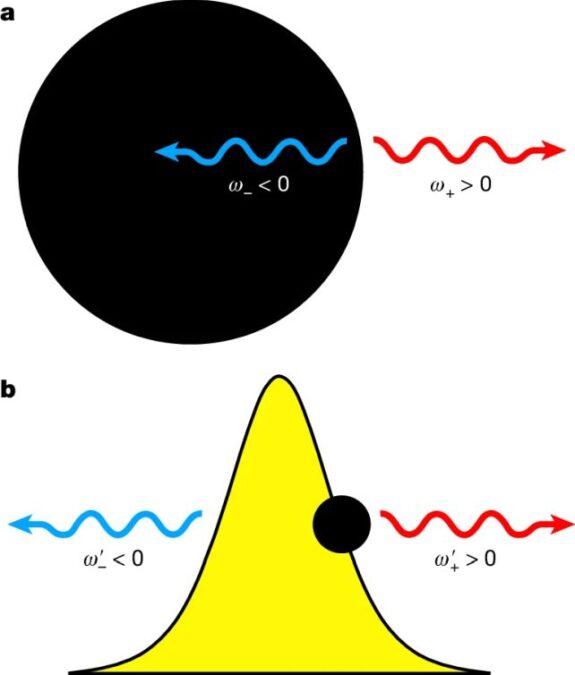 A diagram illustrating an analog event horizon emitting Hawking radiation. (Procopio et al., Nature, 2026)
They found it – and here's where the surprise emerged.
Previously, physicists thought the Hawking radiation seen in black hole analogs emerged through a complex cascade of optical interactions. Instead, the new results point to a single, direct process that naturally explains both the radiation and the backreaction.
"Our experiment and the underlying theory show that Hawking radiation is the result of a direct process, if the interaction between the radiation and the equivalent of the gravitational field is biquadratic," the researchers write in their paper.
"Maybe astrophysical black holes radiate by a process as simple and direct as ours. The resulting backreaction would describe in microscopic detail how black holes evaporate."

Observing the same process around a real black hole is likely to remain impossible for the foreseeable future.
Related: Scientists May Have Detected The First Signature of a Black Hole's Event Horizon
But if the mechanism turns up in other kinds of black hole analogs, it would strengthen the case that the researchers have identified something fundamental about Hawking radiation itself.
If so, it could help resolve some of the thorniest problems in theoretical black hole physics.
"All of this could shed light on the information paradox," the researchers write, "a problem Hawking struggled with until his very last, 2018 paper."
The new paper has been published in Nature.
This article was fact-checked by Jess Cockerill and edited by Michael Irving. While we pride ourselves on our process, we are only human. If you spot a mistake, please let us know.
 English (US)